
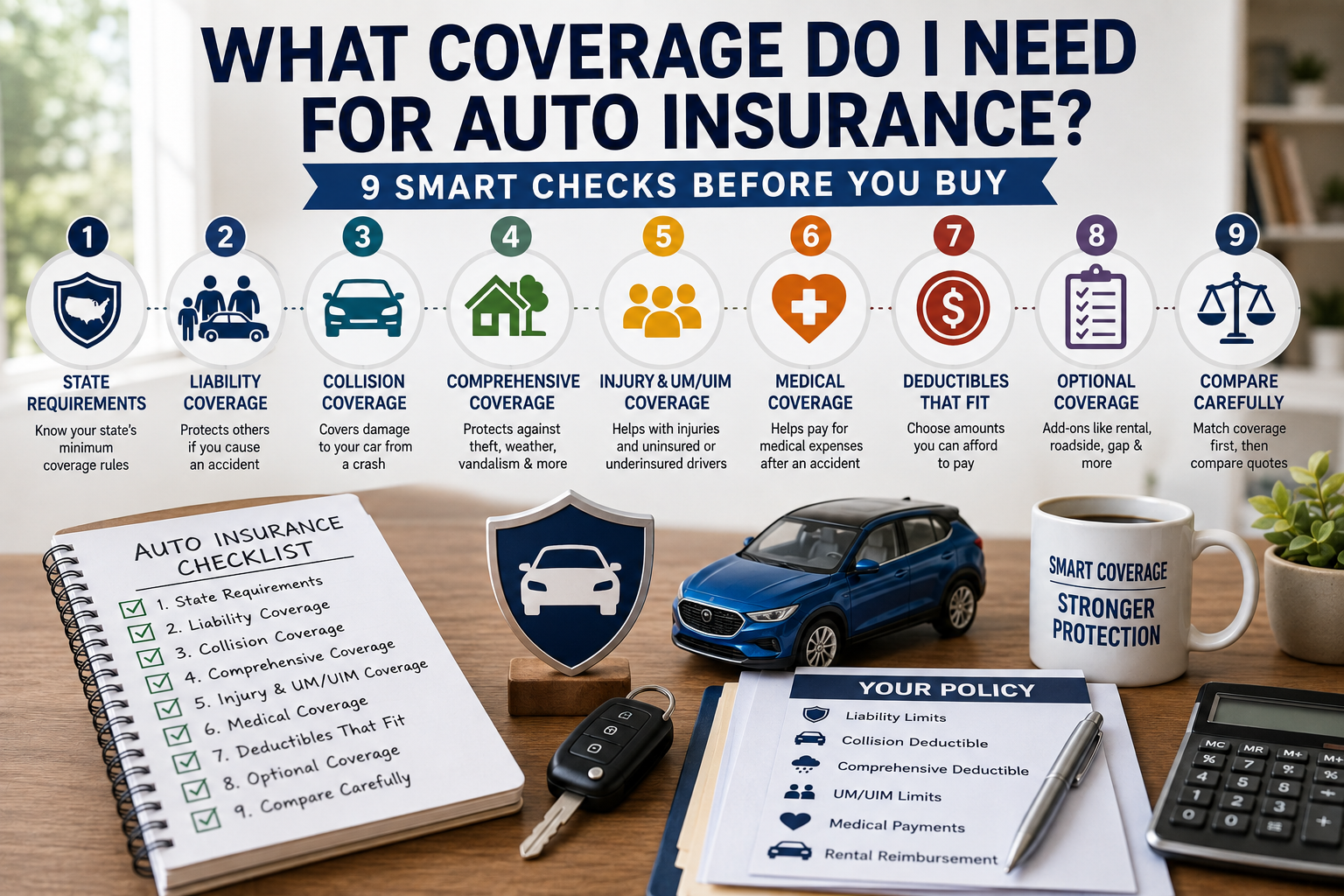
What coverage do I need for auto insurance? It is one of the most important questions a driver can ask before buying, renewing, or changing a policy.
The answer is not simply “buy the state minimum.”
It is also not automatically “buy full coverage.”
The right starting point is to understand which financial risks you face and which of those risks would be difficult to pay for yourself.
When asking what coverage do I need for auto insurance, think about:
- What your state legally requires
- How much liability protection you carry
- Whether your own vehicle needs collision protection
- Whether comprehensive coverage makes sense
- What happens if an uninsured driver hits you
- What happens if another driver’s insurance is not enough
- Whether you need injury-related coverage
- What deductible you could realistically afford
- Whether a lender or leasing company requires additional protection
- Whether optional coverage solves a real financial problem
Two drivers living on the same street may reasonably make different choices.
One may own an older vehicle outright and have enough savings to replace it.
Another may be financing a newer vehicle and could not afford a major repair or total loss without insurance.
That is why what coverage do I need for auto insurance cannot be answered properly by looking only at the monthly premium.
This guide breaks the decision into nine practical checks.
Educational note: PolicyQuotesUS.com provides general U.S. personal auto insurance education only. We are not an insurer, insurance agency, broker, quote marketplace, claims service, lender, leasing company, financial adviser, or coverage approval service. We do not sell, issue, bind, approve, underwrite, recommend, or adjust insurance policies or claims. Coverage requirements, premiums, deductibles, limits, exclusions, discounts, eligibility rules, underwriting practices, and available coverage vary by state, insurer, vehicle, driver, household, vehicle use, financing arrangement, and circumstances. Always review your declarations page, policy forms, endorsements, exclusions, and loan or lease agreement before relying on coverage.
Decision Snapshot: The Auto Insurance Coverage Priority Map
When several coverage choices compete for the same budget, use a priority sequence instead of treating every option as equally urgent. The Auto Insurance Coverage Priority Map starts with obligations and large-loss risk, then moves toward vehicle protection and convenience features.
- Legal requirements: satisfy the coverage rules that apply in the state where the vehicle is insured.
- Contract requirements: satisfy any lender or lessor requirements for a financed or leased vehicle.
- Catastrophic liability risk: decide how much protection you want against covered injuries or property damage for which you may be legally responsible.
- Own-vehicle loss: decide whether collision and comprehensive protection make sense given the vehicle, replacement ability, deductible and contract requirements.
- Injury and uninsured-driver risk: evaluate UM/UIM, PIP, MedPay or related protections available in your state and policy.
- Convenience and gap-filling options: consider rental reimbursement, roadside assistance, gap-related protection and other endorsements only after the higher-priority questions are clear.
Decision rule: do not let a small optional saving distract from a much larger uninsured or underinsured risk. The right coverage mix is a risk-allocation decision, not simply a checklist of products.
What Coverage Do I Need for Auto Insurance? Start With Four Layers
A useful way to answer what coverage do I need for auto insurance is to divide the policy into four layers.
Layer 1: Legally Required Coverage
Your state establishes the legal starting point.
Depending on where the vehicle is registered and principally garaged, required protection may include:
- Bodily injury liability
- Property damage liability
- Personal injury protection
- Medical payments coverage
- Uninsured motorist coverage
- Underinsured motorist coverage
- Other financial-responsibility requirements
State law does not create one universal policy for every U.S. driver.
Layer 2: Liability Protection
Liability coverage generally helps protect against covered financial responsibility when you cause injuries or property damage to others.
This is one of the most important areas to examine when asking what coverage do I need for auto insurance.
Layer 3: Protection for Your Own Vehicle and Occupants
This may include:
- Collision
- Comprehensive
- Personal injury protection
- Medical payments coverage
- Uninsured motorist protection
- Underinsured motorist protection
Layer 4: Optional Protection
Depending on the insurer and state, options may include:
- Rental reimbursement
- Roadside assistance
- Gap protection
- New-car replacement
- Custom equipment coverage
- Rideshare endorsements
- Other specialized protection
The goal is not to buy everything available.
The goal is to understand what each coverage does and decide whether the financial risk it addresses matters to you.
1. What Coverage Do I Need for Auto Insurance Under State Law?
The first step is determining what your state requires.
The PolicyQuotesUS.com auto insurance by state guide explains why location matters.
You can also review minimum car insurance requirements for the broader legal-baseline discussion.
When asking what coverage do I need for auto insurance, remember one important rule:
State minimum coverage is a legal floor, not automatically a complete financial protection plan.
Suppose your state allows a relatively low property damage liability limit.
You satisfy that requirement.
Then you cause an accident involving an expensive vehicle and substantial property damage.
If covered losses exceed your available limit, satisfying the minimum requirement does not automatically eliminate the remaining financial exposure.
Check the Official Rules
Insurance requirements can change.
Confirm current rules through your state’s insurance regulator rather than depending only on:
- Old articles
- Social media
- Friends
- Rules from another state
- A policy you carried several years ago
Before deciding what coverage do I need for auto insurance, establish the correct legal baseline.
Then build from there.
2. What Coverage Do I Need for Auto Insurance for Liability Protection?
Liability coverage is a major part of most personal auto insurance policies.
It generally addresses covered losses you cause to other people.
There are two major categories.
Bodily Injury Liability
Bodily injury liability may help with covered claims involving injuries to:
- Other drivers
- Passengers
- Pedestrians
- Cyclists
- Other people
Depending on the claim and policy, covered costs can involve:
- Medical treatment
- Lost income
- Legal defense
- Settlements
- Judgments
Property Damage Liability
Property damage liability may help pay for covered damage you cause to:
- Another person’s vehicle
- Fence
- Building
- Guardrail
- Sign
- Other property
The what does liability car insurance cover guide explains this area in greater depth.
Liability Limits Matter
When asking what coverage do I need for auto insurance, do not stop after confirming that liability coverage exists.
Check the limits.
A policy may show numbers representing:
- Bodily injury per person
- Bodily injury per accident
- Property damage
Some policies may use a combined single limit.
Limits determine how much protection is available for covered losses.
Why Minimum Liability Can Be Risky
A serious crash can involve:
- Several injured people
- Multiple vehicles
- Expensive vehicles
- Commercial property
- Legal costs
If the claim exceeds the available liability limit, the responsible driver can potentially face additional financial exposure.
That is why what coverage do I need for auto insurance is partly a question about how much liability risk you are willing and able to retain yourself.
3. What Coverage Do I Need for Auto Insurance to Protect My Own Car?
Liability insurance generally does not protect your own vehicle against every type of damage.
That is where collision and comprehensive coverage become important.
Collision Coverage
Collision coverage generally addresses covered physical damage to your insured vehicle caused by events such as:
- Hitting another vehicle
- Hitting a tree
- Hitting a pole
- Hitting a barrier
- Certain pothole-related damage
- Vehicle rollover
Suppose you cause a crash.
Your property damage liability may address covered damage to the other vehicle.
Your collision coverage may address covered damage to your vehicle, subject to the deductible and policy terms.
Comprehensive Coverage
Comprehensive coverage generally addresses certain covered non-collision events such as:
- Theft
- Fire
- Hail
- Flood
- Vandalism
- Falling objects
- Animal impacts
- Certain glass damage
The comprehensive vs collision insurance guide explains these differences in detail.
How Vehicle Value Changes the Decision
For drivers wondering what coverage do I need for auto insurance, vehicle value matters.
Consider:
- What your car is worth
- What repairs could cost
- What replacement would cost
- What collision costs each year
- What comprehensive costs each year
- What deductibles apply
- Whether you could replace the vehicle yourself
The more financially damaging losing the vehicle would be, the more carefully physical-damage protection deserves to be considered.
4. What Coverage Do I Need for Auto Insurance Against Uninsured Drivers?
Your own driving is only part of the risk.
Another driver can cause an accident.
And that driver may have no usable insurance.
This is where uninsured motorist coverage can become important.
Uninsured Motorist Coverage
Uninsured motorist coverage may address certain covered losses caused by an at-fault driver who has no applicable liability insurance.
Depending on state and policy rules, it can also be relevant in some hit-and-run situations.
The uninsured motorist coverage guide explains this protection in detail.
Underinsured Motorist Coverage
Underinsured motorist coverage addresses a different problem.
The at-fault driver has insurance.
But the available liability limits may not be enough.
A simple rule is:
UM = no usable insurance
UIM = not enough insurance
When deciding what coverage do I need for auto insurance, review both separately.
State Rules Differ
Depending on the state, UM or UIM coverage may be:
- Required
- Automatically offered
- Optional
- Rejectable in writing
- Subject to special limit rules
Check the actual policy and state requirements.
Check Who Qualifies for Protection
Ask:
- Who is an insured person?
- Are household members included?
- Are passengers covered?
- What limits apply?
- Are stacking rules relevant?
- How are hit-and-run claims treated?
- Are there owned-but-uninsured vehicle restrictions?
- Are there regular-use exclusions?
The coverage name alone does not tell the whole story.
5. What Coverage Do I Need for Auto Insurance for Medical Expenses?
An auto accident can create injury expenses even when vehicle damage is relatively minor.
Depending on the state, your available coverage may include:
- Personal injury protection
- Medical payments coverage
Personal Injury Protection
Personal injury protection, or PIP, may help cover certain accident-related expenses.
Depending on state rules and the policy, these can include:
- Medical costs
- Lost income
- Rehabilitation
- Funeral expenses
- Other eligible expenses
Medical Payments Coverage
Medical payments coverage, commonly called MedPay, may help pay certain eligible medical expenses after an accident.
Coverage limits and eligibility vary.
Health Insurance Does Not Automatically Answer the Question
Some drivers assume they do not need any auto medical coverage because they already have health insurance.
The policies can operate differently.
They may have different:
- Deductibles
- Copayments
- Networks
- Eligibility requirements
- Coordination rules
- Covered persons
When asking what coverage do I need for auto insurance, compare the actual protections rather than assuming one type of coverage makes another irrelevant.
6. What Coverage Do I Need for Auto Insurance on a Financed Vehicle?
Financing changes the decision.
State law determines the legal insurance requirement.
Your lender can impose additional contractual requirements.
A lender commonly requires:
- Collision
- Comprehensive
It may also impose deductible limits.
Why?
The lender has a financial interest in the vehicle.
If the vehicle is destroyed, the lender does not want its collateral left uninsured.
What Happens After a Total Loss?
Suppose:
- Loan balance: $32,000
- Covered vehicle settlement: $27,000
The physical-damage settlement does not automatically become $32,000 simply because that is what remains on the loan.
A $5,000 difference may remain.
The gap insurance guide explains how separate gap protection may address an eligible shortfall.
For a financed vehicle, what coverage do I need for auto insurance should therefore consider:
- State requirements
- Liability limits
- Collision
- Comprehensive
- Deductibles
- Lender requirements
- Possible gap exposure
Do not cancel required physical-damage coverage without checking the finance agreement.
7. What Coverage Do I Need for Auto Insurance on a Leased Vehicle?
A leased vehicle creates another set of contractual requirements.
The leasing company owns the vehicle.
A lease may require:
- Liability coverage
- Higher liability limits
- Collision coverage
- Comprehensive coverage
- Specific deductibles
- Lessor listing
- Gap-related protection
The leased car insurance guide explains these requirements further.
When asking what coverage do I need for auto insurance on a leased vehicle, do not rely only on state minimum requirements.
Check:
state law + lease contract + insurance policy
All three matter.
8. What Coverage Do I Need for Auto Insurance With the Right Deductible?
A deductible is not just a number used to change your quote.
It represents real money you may need after a claim.
Collision and comprehensive commonly have separate deductibles.
For example:
- Collision deductible: $1,000
- Comprehensive deductible: $500
Higher Deductible
A higher deductible can reduce premiums.
But you retain more financial risk.
Lower Deductible
A lower deductible can increase premiums.
But it reduces the amount you would generally need to absorb after an eligible claim.
The best deductible for auto insurance guide covers this decision in detail.
The Best Deductible Test
When deciding what coverage do I need for auto insurance, ask:
If I had a covered accident tomorrow, could I comfortably pay this deductible?
If the answer is no, the deductible may be too high for your financial situation.
Compare Deductible With Vehicle Value
Suppose:
- Vehicle value: $5,000
- Collision deductible: $2,000
That deductible represents a very large percentage of the vehicle’s value.
The coverage may still have value, but the numbers deserve careful review.
9. What Coverage Do I Need for Auto Insurance Beyond the Main Coverages?
After reviewing the major protections, consider optional coverage.
Optional does not mean useless.
It also does not mean everybody needs it.
The right question is:
What specific financial problem does this option solve for me?
Rental Reimbursement
May help with certain temporary transportation costs following an eligible covered loss.
Roadside Assistance
May provide services such as:
- Towing
- Battery jump-start
- Lockout assistance
- Flat-tire assistance
- Emergency fuel delivery
Gap Protection
May address an eligible shortfall between the covered vehicle settlement and remaining loan or lease balance after a qualifying total loss.
New-Car Replacement
Some insurers offer replacement-related protection for eligible newer vehicles.
Custom Equipment Coverage
Non-standard equipment may require additional protection.
Rideshare or Delivery Coverage
Personal auto policies may not automatically cover every form of business, rideshare, or delivery use.
For brand-specific business-use comparisons, review GEICO commercial auto insurance and GEICO commercial vehicle insurance alongside the policy’s actual eligibility rules.
If your vehicle use changes, notify the insurer.
When reviewing what coverage do I need for auto insurance, optional coverage should solve a real risk rather than simply make the policy look more complete.
What Coverage Do I Need for Auto Insurance on an Older Car?
There is no universal vehicle age at which collision or comprehensive should automatically disappear.
Instead, consider:
- Vehicle value
- Annual physical-damage premium
- Deductibles
- Replacement cost
- Repair cost
- Savings
- Dependence on the vehicle
Suppose your vehicle is worth approximately $4,500.
Your collision deductible is $1,000.
Collision coverage also costs a significant amount each year.
The realistic potential benefit may be limited.
That means the coverage deserves review.
It does not automatically mean you should cancel it.
Replacement Ability Matters
A lower-value vehicle can still be financially important.
If you could not afford to replace your $4,500 vehicle after a loss, the coverage may still have considerable practical value.
That is why what coverage do I need for auto insurance on an older car cannot be answered using vehicle age alone.
What Coverage Do I Need for Auto Insurance on a New Car?
Newer cars can create larger financial risks.
They may:
- Cost more to replace
- Cost more to repair
- Contain expensive cameras and sensors
- Use advanced driver-assistance technology
- Carry large loan balances
If financed or leased, collision and comprehensive are commonly required.
If owned outright, you still need to decide whether losing the vehicle without insurance would create unacceptable financial damage.
For many owners of newer vehicles, what coverage do I need for auto insurance will include a serious review of both collision and comprehensive protection.
What Coverage Do I Need for Auto Insurance for a New Driver?
New drivers can create a different risk profile.
When adding a new driver, review:
- Liability limits
- Collision
- Comprehensive
- Deductibles
- UM/UIM
- Medical coverage
- Vehicle choice
- Household-driver listing
- Available discounts
- Driver training programs
Do not decide solely on the cheapest possible premium.
The amount of financial risk retained by the household matters too.
When asking what coverage do I need for auto insurance for a new driver, also make sure the insurer has accurate information about:
- Driver age
- Licence status
- Vehicle
- Mileage
- Garaging
- Household members
- Vehicle use
What Coverage Do I Need for Auto Insurance for a Household With Several Drivers?
A household can include:
- Spouse
- Partner
- Teen driver
- Adult child
- Relative
- Occasional vehicle user
Insurer rules differ regarding how household members and regular drivers must be listed.
Be accurate.
Failing to disclose a regular driver can create underwriting or claim complications.
When reviewing what coverage do I need for auto insurance, household composition matters because the policy needs to reflect who actually uses the vehicles.
What Coverage Do I Need for Auto Insurance if I Drive for Work?
Vehicle use can materially affect coverage.
Examples include:
- Commuting
- Business errands
- Client transportation
- Food delivery
- Package delivery
- Rideshare driving
A standard personal-use assumption may not match every situation.
Tell the insurer how the vehicle is actually used.
Do not wait until after a claim to discover that a particular use creates a coverage issue.
What Coverage Do I Need for Auto Insurance if I Work From Home?
Working from home can reduce annual mileage.
That can affect some insurers’ pricing.
But it does not eliminate the major risks.
Your vehicle can still be:
- Stolen
- Damaged by hail
- Hit while parked
- Damaged by fire
- Involved in an accident
When asking what coverage do I need for auto insurance as a low-mileage driver, provide accurate annual mileage and vehicle use.
Then review coverage normally.
What Coverage Do I Need for Auto Insurance if I Have Significant Savings?
More savings may allow you to retain some smaller risks yourself.
For example, you may be more comfortable with:
- Higher deductibles
- Self-funding minor losses
- Dropping collision on a very low-value owned vehicle
But having substantial savings can also increase the importance of examining liability exposure.
A serious accident can create claims far larger than a deductible.
So more savings does not automatically mean:
buy less insurance.
It can mean:
retain manageable risks yourself while protecting carefully against catastrophic risks.
Liability Coverage vs Protection for Your Own Vehicle
When answering what coverage do I need for auto insurance, keep liability and physical-damage protection separate.
Liability
Primarily addresses certain losses involving other people.
Collision
Primarily addresses certain crash-related damage to your own insured vehicle.
Comprehensive
Primarily addresses certain non-collision damage to your own insured vehicle.
The liability vs full coverage auto insurance guide explains this comparison in greater detail.
A driver can carry strong liability limits while choosing limited physical-damage coverage on a low-value owned vehicle.
Another driver with a financed vehicle may need both strong liability and comprehensive physical-damage protection.
There is no single correct package for every household.
What “Full Coverage” Actually Means
The phrase “full coverage” is widely used.
It is not a standardized insurance policy.
People commonly use it to mean:
Liability + Collision + Comprehensive
But a policy described as full coverage may still exclude or omit:
- UM/UIM
- PIP
- MedPay
- Gap insurance
- Rental reimbursement
- Roadside assistance
- New-car replacement
- Specialized endorsements
So if someone asks what coverage do I need for auto insurance, saying “get full coverage” is not precise enough.
The better question is:
Which exact coverages, limits, deductibles, and endorsements are on the policy?
How Much Liability Coverage Do I Need?
There is no universal liability limit suitable for every driver.
Consider:
- State minimums
- Income
- Savings
- Assets
- Potential severity of an accident
- Price difference between higher and lower limits
A policy that meets minimum state requirements can still leave significant exposure after a severe accident.
If you have substantial assets or unusual liability concerns, consider getting individualized guidance from an appropriately licensed professional.
How Much Collision Coverage Do I Need?
Collision coverage is generally tied to the insured vehicle and the policy’s settlement method rather than selecting a liability-style dollar limit.
The major decisions usually include:
- Whether to carry collision
- Deductible
- Policy valuation provisions
- Available endorsements
When deciding what coverage do I need for auto insurance, compare the value of the vehicle with the cost of protecting it.
How Much Comprehensive Coverage Do I Need?
The same general principle applies.
Consider:
- Vehicle value
- Theft risk
- Hail risk
- Flood risk
- Fire exposure
- Animal impact risk
- Comprehensive premium
- Deductible
Comprehensive can remain useful on some older cars even when collision becomes harder to justify.
The risks are different.
What Coverage Do I Need for Auto Insurance if My Car Is Paid Off?
Paying off the loan removes the lender’s financial interest.
That can give you more flexibility.
You may no longer be contractually required to carry collision and comprehensive.
But paying off the vehicle does not automatically mean dropping them is smart.
Ask:
- What is the car worth?
- What do the coverages cost?
- What are the deductibles?
- Could I replace the vehicle without insurance?
The end of the loan creates an opportunity to review the policy—not an automatic instruction to reduce it.
What Coverage Do I Need for Auto Insurance if I Lease?
A lease usually deserves closer attention.
Check:
- Required liability limits
- Collision requirements
- Comprehensive requirements
- Deductible limits
- Lessor information
- Gap provisions
Do not assume state minimum coverage satisfies the lease.
The lease agreement may require substantially more.
What Coverage Do I Need for Auto Insurance Before Comparing Quotes?
Determine the coverage structure first.
Otherwise, the quote comparison can become misleading.
Match these items across insurers:
- Drivers
- Vehicles
- Garaging address
- Mileage
- Vehicle use
- Liability limits
- UM/UIM limits
- Collision deductible
- Comprehensive deductible
- PIP or MedPay
- Rental reimbursement
- Roadside assistance
- Gap-related protection
- Other endorsements
- Policy term
Then compare premiums.
Why Matching Matters
Imagine:
Quote A: $950
Quote B: $1,100
Quote A appears cheaper.
But suppose Quote A has:
- Lower liability limits
- $1,500 collision deductible
- No rental reimbursement
while Quote B has:
- Higher liability limits
- $500 collision deductible
- Rental reimbursement
Those are not equivalent policies.
When asking what coverage do I need for auto insurance, coverage should be chosen before price is compared.
What to Check on the Declarations Page
Your declarations page is one of the most useful documents in the policy.
Review:
- Named insured
- Covered vehicles
- Listed drivers
- Policy dates
- Bodily injury limits
- Property damage limits
- UM/UIM limits
- PIP
- MedPay
- Collision deductible
- Comprehensive deductible
- Endorsements
- Lender or lessor
- Premium
But remember that the declarations page is a summary.
The full policy contains:
- Definitions
- Coverage provisions
- Exclusions
- Conditions
- Endorsements
Both matter.
What Coverage Do I Need for Auto Insurance After Life Changes?
Insurance needs can change.
Review your coverage after:
- Buying a vehicle
- Selling a vehicle
- Paying off a loan
- Starting a lease
- Moving
- Adding a driver
- Removing a driver
- A teenager obtaining a licence
- Starting rideshare work
- Starting delivery work
- Major mileage changes
- Significant changes in vehicle value
- Major changes in household finances
The answer to what coverage do I need for auto insurance today may not be identical to the answer three years from now.
Common Auto Insurance Coverage Mistakes
Mistake 1: Assuming the State Minimum Is Automatically Enough
It establishes legal compliance, not necessarily adequate financial protection.
Mistake 2: Buying Only by Price
A cheaper policy may simply provide less protection.
Mistake 3: Assuming Full Coverage Covers Everything
It does not.
Mistake 4: Carrying Liability Limits You Do Not Understand
Know what each number means.
Mistake 5: Choosing a Deductible You Cannot Pay
A low premium does not help if a claim creates an unaffordable deductible.
Mistake 6: Dropping Collision on a Financed Vehicle
Check the loan agreement first.
Mistake 7: Dropping Required Coverage on a Lease
Check the lease agreement first.
Mistake 8: Ignoring UM/UIM
Other drivers may have inadequate insurance.
Mistake 9: Assuming Health Insurance Solves Every Injury-Coverage Question
Auto medical protection can operate differently.
Mistake 10: Forgetting Household Drivers
Accurate driver information matters.
Mistake 11: Failing to Disclose Business, Rideshare or Delivery Use
Vehicle use can affect eligibility and claims.
Mistake 12: Comparing Different Liability Limits
That is not a fair quote comparison.
Mistake 13: Comparing Different Deductibles
Higher deductibles can make a quote appear artificially cheap.
Mistake 14: Forgetting Gap Exposure
A total-loss settlement can be lower than the amount owed.
Mistake 15: Keeping Coverage Forever Without Reviewing It
Vehicle value and household circumstances change.
Mistake 16: Canceling the Old Policy Too Early
Make sure replacement coverage is effective before ending existing protection.
What Coverage Do I Need for Auto Insurance? The 9-Check System
Use this simple process.
Check 1: State Requirements
Confirm the legal minimum.
Check 2: Liability Limits
Decide how much liability risk you can reasonably retain.
Check 3: Collision Coverage
Decide whether you need crash protection for your own vehicle.
Check 4: Comprehensive Coverage
Review theft, weather, fire, animal and other non-collision risks.
Check 5: UM/UIM
Understand what happens if the responsible driver has no insurance or not enough insurance.
Check 6: Medical Protection
Review PIP, MedPay and applicable state rules.
Check 7: Deductibles
Choose amounts you could actually afford after a claim.
Check 8: Financing and Optional Protection
Check lender, lease, gap, rental, roadside and special-use requirements.
Check 9: Match Quotes Before Comparing Price
Keep the coverage identical.
Then compare cost.
That nine-step process gives a much stronger answer to what coverage do I need for auto insurance than simply asking for the cheapest quote.
Auto Insurance Coverage Checklist
Before buying or renewing a policy, review:
| Coverage Question | Checked? |
|---|---|
| State requirements confirmed | Yes / No |
| Bodily injury liability reviewed | Yes / No |
| Property damage liability reviewed | Yes / No |
| Liability limits understood | Yes / No |
| Collision reviewed | Yes / No |
| Comprehensive reviewed | Yes / No |
| Collision deductible reviewed | Yes / No |
| Comprehensive deductible reviewed | Yes / No |
| UM coverage reviewed | Yes / No |
| UIM coverage reviewed | Yes / No |
| PIP reviewed if applicable | Yes / No |
| MedPay reviewed if applicable | Yes / No |
| Vehicle value estimated | Yes / No |
| Lender requirements checked | Yes / No |
| Lease requirements checked | Yes / No |
| Gap exposure checked | Yes / No |
| Rental reimbursement reviewed | Yes / No |
| Roadside assistance reviewed | Yes / No |
| Household drivers disclosed | Yes / No |
| Vehicle use disclosed accurately | Yes / No |
| Quotes matched before price comparison | Yes / No |
Questions to Ask Before Buying Auto Insurance
If you are still wondering what coverage do I need for auto insurance, ask these questions:
- What coverage does my state require?
- What are my current liability limits?
- What happens if a serious claim exceeds those limits?
- Does liability protect my own vehicle?
- Do I need collision coverage?
- Do I need comprehensive coverage?
- What are my deductibles?
- Could I afford those deductibles tomorrow?
- What is my vehicle approximately worth?
- Could I replace the vehicle without insurance?
- Is uninsured motorist coverage required or available?
- Is underinsured motorist coverage required or available?
- Is PIP required or available?
- Is MedPay available?
- Who qualifies as an insured?
- Are all household drivers listed correctly?
- Is my vehicle use described accurately?
- Does my lender require collision and comprehensive?
- Does my lease require specific limits?
- Could I have a loan-value gap after a total loss?
- Is rental reimbursement included?
- Is roadside assistance included?
- Which exclusions deserve special attention?
- Are all quotes being compared using identical coverage?
Answering those questions gives you a much clearer picture of the policy.
Final Takeaway
So, what coverage do I need for auto insurance?
Start with your state’s legal requirements.
Then look at the financial risks the minimum coverage does not solve.
Review:
state requirements → liability limits → collision → comprehensive → uninsured motorist → underinsured motorist → medical protection → deductibles → financing requirements → optional coverage
Then compare policies on identical terms.
The goal is not automatically to buy:
the cheapest policy
or
the policy with the most coverage
The goal is to understand exactly which risks you are transferring to the insurer and which risks you are keeping yourself.
A strong auto insurance decision considers:
- Legal requirements
- Liability exposure
- Vehicle value
- Vehicle financing
- Household drivers
- Vehicle use
- Available savings
- Deductible affordability
- Other insurance
- Risks that would be difficult to fund yourself
For a paid-off older vehicle, what coverage do I need for auto insurance may lead to a different answer than it would for a newly financed vehicle.
For a household with substantial assets, liability limits may deserve more attention.
For a driver with limited emergency savings, deductible affordability may be particularly important.
There is no single policy package that is automatically correct for everyone.
But there is a reliable process:
understand the risk → understand the coverage → choose the limit or deductible → compare equivalent policies → review the documents
That is the practical answer to what coverage do I need for auto insurance.
Questions and Answers About What Coverage Do I Need for Auto Insurance
What Coverage Do I Need for Auto Insurance at Minimum?
You need the coverage required by the state where your vehicle is registered and principally garaged. Because requirements vary, verify them with the applicable state insurance regulator.
Is State-Minimum Auto Insurance Enough?
It may satisfy legal requirements, but it may not provide sufficient protection against a serious liability claim or protect your own vehicle against physical damage.
What Coverage Do I Need for Auto Insurance on a Financed Car?
Start with state requirements, then check the finance agreement. Lenders commonly require collision and comprehensive coverage while they have a financial interest in the vehicle.
What Coverage Do I Need for Auto Insurance on a Leased Car?
Review state requirements and the lease. A leasing company may require collision, comprehensive, specified liability limits, deductibles, and other protection.
What Coverage Do I Need for Auto Insurance on an Older Car?
Review the vehicle’s current value, collision and comprehensive premiums, deductibles, replacement cost, available savings, and how difficult losing the vehicle would be financially.
What Coverage Do I Need for Auto Insurance for a New Driver?
Review liability limits, physical-damage protection, deductibles, UM/UIM, medical coverage, household-driver information, vehicle choice, and available discounts.
Do I Need Collision Coverage?
Consider your vehicle’s value, whether it is financed, the deductible, premium, and whether you could afford to repair or replace the vehicle yourself.
Do I Need Comprehensive Coverage?
Consider exposure to theft, fire, hail, flood, vandalism, falling objects, animal impacts, and other covered non-collision events.
Do I Need Uninsured Motorist Coverage?
Requirements vary by state. UM coverage can provide protection against certain losses involving an at-fault driver with no usable insurance.
Do I Need Underinsured Motorist Coverage?
UIM can address certain covered losses when the responsible driver has insurance but insufficient liability limits.
Do I Need PIP?
Some states require or offer PIP. Review the applicable state rules and policy terms.
Do I Need Medical Payments Coverage?
MedPay can address certain accident-related medical expenses. Its usefulness depends on state rules, limits, household circumstances, and other insurance.
Do I Need Full Coverage?
“Full coverage” is not a standardized policy. Review the specific liability, collision, comprehensive, UM/UIM, medical, and optional protections you actually need.
Should I Choose the Highest Deductible?
Not automatically. A higher deductible can reduce the premium but increases your financial responsibility after a claim.
Does Full Coverage Pay Off My Car Loan?
Not automatically. Collision or comprehensive settlements are based on policy terms and vehicle value. Separate gap protection may address an eligible loan or lease shortfall.
How Often Should I Review What Coverage I Need for Auto Insurance?
Review your policy at renewal and after major changes involving vehicles, drivers, loans, leases, location, vehicle use, mileage, finances, or vehicle value.
Helpful Official Resources
- National Association of Insurance Commissioners — Auto Insurance
- National Association of Insurance Commissioners — State Insurance Departments
- National Highway Traffic Safety Administration — Vehicle Safety Resources
Author Bio
Related Coverage and State Guides
PolicyQuotesUS.com Editorial Team
The PolicyQuotesUS.com Editorial Team creates clear, neutral educational content for U.S. consumers researching what coverage do I need for auto insurance, liability limits, collision coverage, comprehensive coverage, uninsured and underinsured motorist protection, PIP, medical payments coverage, deductibles, financed vehicles, leased vehicles, and related auto insurance decisions.
Copyright Notice
© 2026 – PolicyQuotesUS.com. All rights reserved.
This article about what coverage do I need for auto insurance is protected by copyright and may not be copied, scraped, spun, republished, reproduced, distributed, or used commercially without prior written permission from PolicyQuotesUS.com. Brief quotations may be used with clear attribution and a link to the original article.
PolicyQuotesUS.com publishes original educational information about U.S. personal auto insurance, liability coverage, collision coverage, comprehensive coverage, uninsured motorist coverage, underinsured motorist coverage, personal injury protection, medical payments coverage, deductibles, policy limits, gap insurance, premiums, claims, and related consumer insurance topics.
Unauthorized reuse, including AI rewriting, automated extraction, content spinning, bulk scraping, database collection, or republication on another website, is prohibited.
Disclaimer
This article about what coverage do I need for auto insurance provides general educational information intended for people living in the United States.
It is not personalized insurance, financial, legal, tax, lending, leasing, medical, claims, underwriting, vehicle-valuation, or accounting advice.
Coverage requirements, premiums, limits, deductibles, exclusions, endorsements, eligibility rules, state requirements, lender requirements, lease requirements, provider practices, and claim outcomes vary by state, insurer, policy, vehicle, driver, household, vehicle use, financing arrangement, and circumstances.
PolicyQuotesUS.com does not sell insurance, issue policies, bind coverage, provide personalized insurance recommendations, determine eligibility, guarantee premiums, guarantee savings, approve claims, determine liability, calculate total-loss settlements, or guarantee policy availability.
Review the declarations page, policy forms, endorsements, exclusions, limits, deductibles, finance or lease agreement, applicable state requirements, and actual claim circumstances before relying on coverage.
When necessary, confirm policy-specific questions with the insurer, licensed insurance professional, lender, lessor, attorney, financial professional, or appropriate state insurance regulator.