
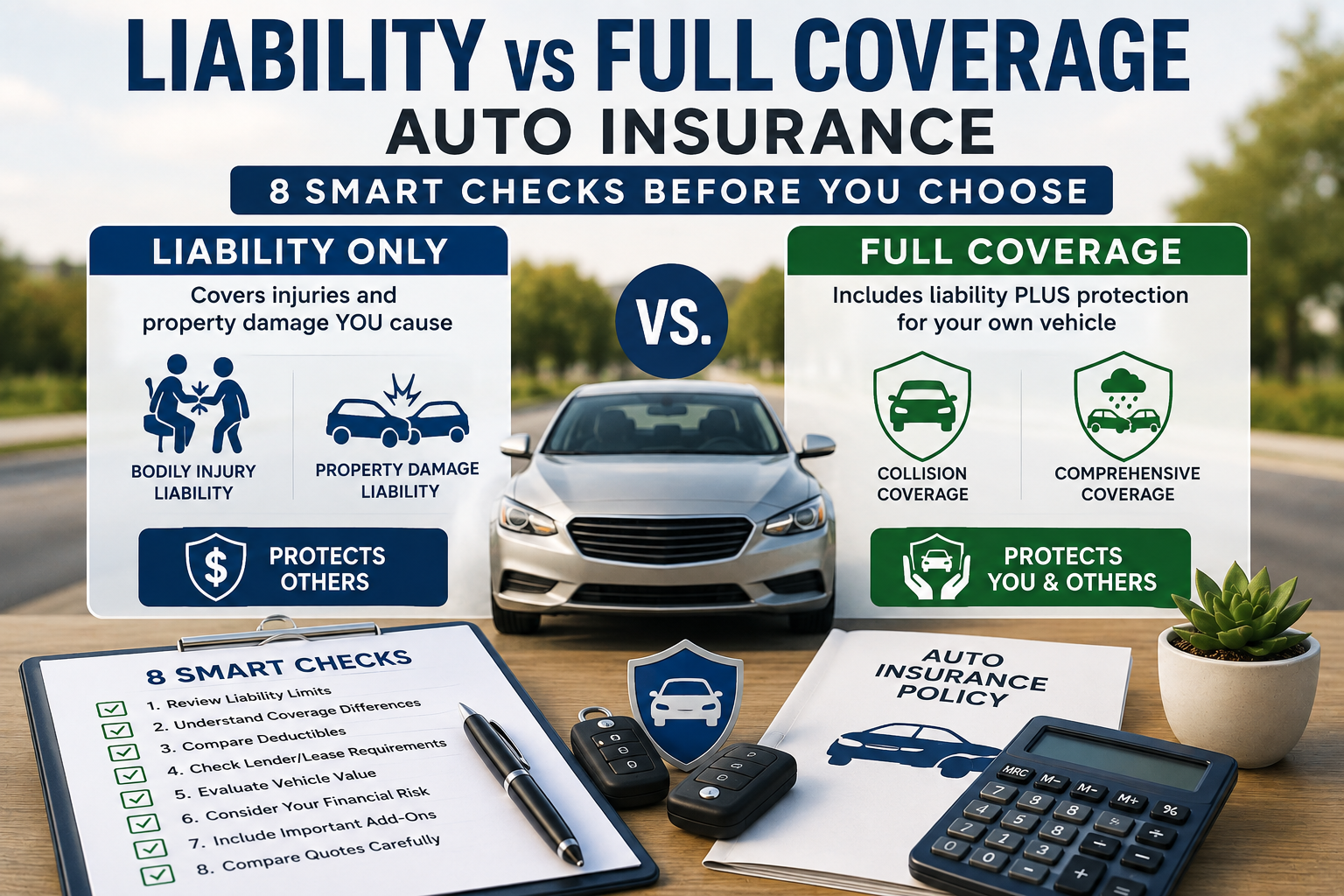
Liability vs full coverage auto insurance is really a comparison between how much financial risk you keep yourself and how much protection you add for your own vehicle.
The simplest difference is:
Liability insurance → primarily helps with covered injuries or property damage you cause to other people.
Full coverage → an informal term commonly used for a policy that includes liability plus collision and comprehensive coverage.
That means a liability-only policy may satisfy certain legal requirements but usually provides little or no protection for damage to your own vehicle after an at-fault crash.
A policy described as “full coverage” may provide much broader protection, but the phrase can be misleading.
There is no single standardized insurance policy officially called “full coverage.”
Two drivers may both say they have full coverage while carrying very different:
- Liability limits
- Collision deductibles
- Comprehensive deductibles
- Uninsured motorist protection
- Medical coverage
- Rental reimbursement
- Roadside assistance
- Gap protection
- Exclusions
That is why liability vs full coverage auto insurance should be compared using the actual policy—not the label.
This guide covers eight smart checks before choosing between them.
Educational note: PolicyQuotesUS.com provides general U.S. personal auto insurance education only. We are not an insurer, insurance agency, broker, quote marketplace, claims service, lender, leasing company, financial adviser, or coverage approval service. We do not sell, issue, bind, approve, underwrite, recommend, or adjust insurance policies or claims. Coverage requirements, premiums, deductibles, limits, exclusions, eligibility rules, discounts, underwriting practices, and policy terms vary by state, insurer, vehicle, driver, household, financing arrangement, and circumstances. Always review your declarations page, policy forms, endorsements, exclusions, and loan or lease agreement before relying on coverage.
Decision Snapshot: The Risk-Transfer Test
The practical difference between liability-only insurance and a policy that also includes collision and comprehensive coverage is how much financial risk remains with you after different kinds of loss. Use the Risk-Transfer Test before comparing premiums.
| Loss question | Liability-only approach | Liability plus collision/comprehensive |
|---|---|---|
| You damage another person’s vehicle in a covered at-fault crash | Liability may respond up to applicable limits and terms. | Liability may respond in the same way; physical-damage coverage is mainly about your own vehicle. |
| Your own vehicle is damaged in a covered collision | You generally keep that repair or replacement risk yourself. | Collision may respond, subject to deductible, limits and policy terms. |
| Your vehicle is stolen or damaged by a covered non-collision event | You generally keep that loss yourself. | Comprehensive may respond, subject to deductible, limits and policy terms. |
| Your vehicle is financed or leased | May conflict with lender or lessor requirements. | Often better aligned with contractual physical-damage requirements, but the contract must be checked. |
| The vehicle is totaled but the loan balance is higher than the settlement | Liability does not solve the loan-balance gap. | Collision or comprehensive can address the covered vehicle loss, but gap-related protection is a separate issue. |
Decision rule: compare the premium difference with the financial risk you would retain if your own vehicle were damaged, stolen or totaled. “Cheaper” and “better fit” are not always the same answer.
Liability vs Full Coverage Auto Insurance at a Glance
The basic comparison looks like this:
| Feature | Liability-Only Policy | “Full Coverage” Policy |
|---|---|---|
| Bodily injury liability | Usually included | Usually included |
| Property damage liability | Usually included | Usually included |
| Collision coverage | Usually not included | Commonly included |
| Comprehensive coverage | Usually not included | Commonly included |
| Protects your own car after an at-fault crash | Usually no | Potentially, through collision |
| Protects your car against theft or hail | Usually no | Potentially, through comprehensive |
| Deductibles | Usually no physical-damage deductible | Collision/comprehensive deductibles normally apply |
| State minimum compliance | May satisfy minimum requirements | Can exceed minimum requirements |
| Lender/lease acceptance | Often not enough | Often required |
| Premium | Usually lower | Usually higher |
This is a general comparison.
The actual policy controls.
1. Understand What Liability Insurance Covers
The first part of liability vs full coverage auto insurance is liability coverage.
Liability insurance generally addresses certain covered losses you cause to other people.
It commonly includes:
Bodily Injury Liability
This can help pay covered costs involving injuries to:
- Other drivers
- Passengers
- Pedestrians
- Cyclists
Depending on the claim, covered costs may include certain:
- Medical expenses
- Lost income
- Legal costs
- Settlements
- Judgments
Property Damage Liability
This can help pay for covered damage you cause to:
- Another vehicle
- Fence
- Building
- Guardrail
- Sign
- Other property
The what does liability car insurance cover guide explains these protections in more detail.
Liability Usually Does Not Repair Your Own Car
This is one of the most important distinctions in liability vs full coverage auto insurance.
Suppose you cause an accident.
Your liability coverage may help pay for the other driver’s damaged vehicle.
But your own damaged vehicle generally will not be repaired under liability coverage.
That is where collision coverage becomes relevant.
2. Understand What “Full Coverage” Usually Adds
“Full coverage” is not a standardized policy.
In everyday insurance discussions, however, it commonly means:
Liability + Collision + Comprehensive
These three coverage categories address different risks.
Liability
Protects mainly against covered injuries and property damage you cause to others.
Collision
Can help pay for covered physical damage to your own insured vehicle after events such as:
- Hitting another vehicle
- Hitting an object
- Rollover
Comprehensive
Can help pay for certain covered non-collision events such as:
- Theft
- Fire
- Hail
- Flood
- Vandalism
- Falling objects
- Animal impacts
The comprehensive vs collision insurance guide explains the physical-damage side in detail.
Why “Full Coverage” Can Be Misleading
A driver may hear “full coverage” and assume:
everything is insured.
That is not correct.
Even a broad policy can still contain:
- Deductibles
- Liability limits
- Exclusions
- Coverage conditions
- Driver restrictions
- Vehicle-use restrictions
The words “full coverage” should never replace reading the actual declarations page.
3. Compare What Happens After an At-Fault Accident
A simple accident makes liability vs full coverage auto insurance easier to understand.
Imagine you lose control and hit another vehicle.
Both vehicles are damaged.
Liability-Only Policy
Your property damage liability may help pay for covered damage to the other vehicle, subject to your policy limit.
Damage to your own vehicle may remain your financial responsibility.
Policy With Liability and Collision
Your property damage liability may address the other vehicle.
Your collision coverage may address covered damage to your own car, subject to the deductible and policy terms.
That is the central practical difference.
Liability-only transfers fewer risks to the insurer.
Adding collision and comprehensive transfers more physical-damage risk.
4. Check Your Liability Limits
Liability vs full coverage auto insurance is not only about whether collision and comprehensive are present.
Liability limits matter enormously.
Suppose your property damage liability limit is $25,000.
You cause a covered accident resulting in $55,000 of damage to another vehicle.
Your insurer does not automatically promise to pay the entire $55,000.
Payment remains subject to the applicable policy limit and claim terms.
That can leave the responsible driver exposed to costs above the limit.
Minimum Coverage Is a Starting Point
Meeting minimum car insurance requirements may establish legal compliance.
It does not necessarily mean the limits are enough for every serious loss.
When comparing liability vs full coverage auto insurance, review:
- Bodily injury per-person limit
- Bodily injury per-accident limit
- Property damage limit
- Any combined single limit
- Required state coverages
A cheap policy with very low liability limits may create a much larger financial exposure.
5. Check the Deductibles on Physical-Damage Coverage
Liability coverage usually does not involve the same type of physical-damage deductible that applies to collision and comprehensive.
Full coverage commonly does.
For example:
- Collision deductible: $500
- Comprehensive deductible: $250
After a covered physical-damage claim, the deductible affects the insurer’s payment.
Higher Deductible
Can reduce the premium.
But increases your out-of-pocket responsibility after a claim.
Lower Deductible
Can increase the premium.
But reduces your out-of-pocket contribution after an eligible loss.
The best deductible for auto insurance guide explains that decision in more detail.
The best deductible is not simply the amount that produces the lowest premium.
It is an amount you could realistically afford after an unexpected loss.
6. Check Whether Your Vehicle Is Financed or Leased
Liability vs full coverage auto insurance can become much simpler when a lender or leasing company is involved.
If you own the vehicle outright, you may have more freedom to decide whether to carry collision and comprehensive coverage.
If the vehicle is financed or leased, the contract may require both.
Financed Vehicle
The lender has a financial interest in the vehicle.
It may require:
- Collision
- Comprehensive
- Certain deductible limits
- Lender listing on the policy
Leased Vehicle
The leasing company owns the vehicle.
Lease agreements commonly impose broader insurance requirements than state minimum liability rules.
The leased car insurance guide explains those requirements separately.
Do Not Drop Required Coverage
Dropping collision or comprehensive on a financed or leased vehicle can violate the contract.
The lender may then take action allowed under the agreement.
Always check the finance or lease documents before changing coverage.
7. Compare the Vehicle’s Value With the Cost of Coverage
Vehicle value plays a major role in liability vs full coverage auto insurance.
Imagine two drivers.
Driver A
- Vehicle value: $35,000
- Vehicle financed
- Limited savings
Losing the car without physical-damage insurance could create a major financial problem.
Driver B
- Vehicle value: $3,500
- Vehicle owned outright
- Strong emergency savings
The cost-versus-benefit calculation may look very different.
That does not mean Driver B should automatically drop collision and comprehensive.
It means the decision deserves review.
Useful Questions
Ask:
- What is the vehicle approximately worth?
- What does collision cost annually?
- What does comprehensive cost annually?
- What are the deductibles?
- Could I replace the vehicle myself?
- How important is the vehicle to my household?
- Is theft common where I live?
- Is hail a significant risk?
- Is flooding a concern?
The age of the vehicle alone is not enough.
8. Compare Quotes on Identical Terms
One of the easiest ways to make a poor liability vs full coverage auto insurance comparison is to compare mismatched quotes.
For example:
Quote A
- $25,000 property damage liability
- $1,000 collision deductible
- $1,000 comprehensive deductible
Quote B
- $100,000 property damage liability
- $500 collision deductible
- $250 comprehensive deductible
If Quote A is cheaper, that does not automatically mean the insurer offers better value.
You are comparing different protection.
Match These First
Keep the same:
- Liability limits
- Collision deductible
- Comprehensive deductible
- Vehicle
- Drivers
- Garaging address
- Mileage
- Vehicle use
- Policy term
- UM/UIM coverage
- Medical coverage
- Rental coverage
- Roadside options
Then compare:
- Premium
- Payment fees
- Discounts
- Exclusions
- Claim provisions
The strongest comparison is always:
same coverage → same limits → same deductibles → compare price
What Full Coverage Still May Not Include
Liability vs full coverage auto insurance can leave important risks uninsured.
Depending on the policy, you may still need to review:
- Uninsured motorist coverage
- Underinsured motorist coverage
- Personal injury protection
- Medical payments coverage
- Rental reimbursement
- Roadside assistance
- Gap insurance
- New-car replacement
- Custom equipment
- Rideshare endorsements
The broader what coverage do I need for auto insurance guide explains how these pieces fit together.
Gap Insurance Is Separate
A full coverage policy does not automatically pay off your remaining auto loan after a total loss.
Suppose:
- Loan balance: $29,000
- Covered total-loss settlement: $25,000
Collision or comprehensive generally addresses the covered value of the vehicle under the policy.
The remaining $4,000 loan difference is a separate issue.
The gap insurance guide explains that risk.
Liability vs Full Coverage Auto Insurance for an Older Car
Older vehicles require a more careful calculation.
Do not automatically drop physical-damage coverage because a vehicle reaches a certain age.
Instead, compare:
Vehicle value
against
Annual collision/comprehensive premium + deductible + ability to replace the vehicle
Example
Vehicle value:
$5,000
Collision deductible:
$1,000
The maximum practical collision benefit after a total loss may therefore be much smaller than the full $5,000 value.
If collision also costs a substantial amount every year, the owner may decide to review whether continuing it remains worthwhile.
But another driver with the same $5,000 vehicle may have no ability to replace it.
For that person, keeping physical-damage protection may still be important.
The correct decision depends on the household.
Liability vs Full Coverage Auto Insurance for a New Car
A newer vehicle can create a larger potential physical-damage loss.
New vehicles can also:
- Cost more to repair
- Use expensive sensors
- Use cameras and driver-assistance equipment
- Require specialized parts
- Carry larger loan balances
If financed or leased, collision and comprehensive may already be required.
Even when the vehicle is owned outright, losing a high-value car without physical-damage protection could create significant financial exposure.
Liability vs Full Coverage Auto Insurance and Total Losses
Total-loss situations reveal another important difference.
Liability-Only
If your own vehicle is totaled in an at-fault accident, liability-only coverage generally does not pay for your vehicle.
Collision
May address your own vehicle after an eligible crash-related total loss.
Comprehensive
May address an eligible total loss caused by events such as:
- Theft
- Fire
- Flood
- Other covered non-collision loss
Settlement remains subject to:
- Policy valuation terms
- Deductible
- Exclusions
- Vehicle condition
- Claim facts
A total-loss settlement does not automatically equal:
- Original purchase price
- Replacement vehicle price
- Remaining loan balance
Those are different numbers.
Liability vs Full Coverage Auto Insurance and Uninsured Drivers
Another common misconception is that full coverage automatically solves every uninsured-driver problem.
It may not.
Uninsured motorist coverage is often a separate coverage.
The uninsured motorist coverage guide explains how it may protect against certain losses involving an at-fault driver with no usable insurance.
Underinsured motorist coverage addresses a different problem:
the at-fault driver has insurance, but their limits may not be enough.
Those protections should be reviewed separately from collision and comprehensive.
Common Liability vs Full Coverage Auto Insurance Mistakes
Mistake 1: Assuming Liability Protects Your Own Car
It generally does not after an at-fault crash.
Mistake 2: Thinking Full Coverage Means Everything Is Covered
It does not.
Mistake 3: Comparing Premiums With Different Liability Limits
That is not a fair comparison.
Mistake 4: Comparing Different Deductibles
Higher deductibles can make a quote look cheaper.
Mistake 5: Dropping Collision on a Financed Vehicle
Check the loan agreement first.
Mistake 6: Dropping Comprehensive on a Lease
Check the lease first.
Mistake 7: Keeping Very Low Liability Limits Just to Save Money
A serious loss can exceed them.
Mistake 8: Assuming Gap Insurance Is Included
Usually it is a separate product or endorsement.
Mistake 9: Ignoring UM/UIM Coverage
Those protections address a different risk.
Mistake 10: Dropping Physical-Damage Coverage Solely Because the Car Is Old
Review vehicle value and replacement affordability.
Mistake 11: Assuming Rental Reimbursement Is Included
It may be separate.
Mistake 12: Choosing Coverage Only by Monthly Price
Compare the actual protection.
Liability vs Full Coverage Auto Insurance Checklist
Before choosing a policy, review:
| Question | Checked? |
|---|---|
| Liability limits reviewed | Yes / No |
| State requirements checked | Yes / No |
| Collision coverage reviewed | Yes / No |
| Comprehensive coverage reviewed | Yes / No |
| Collision deductible reviewed | Yes / No |
| Comprehensive deductible reviewed | Yes / No |
| Vehicle value estimated | Yes / No |
| Replacement affordability considered | Yes / No |
| Loan requirements checked | Yes / No |
| Lease requirements checked | Yes / No |
| UM/UIM coverage reviewed | Yes / No |
| Medical coverage reviewed | Yes / No |
| Gap protection reviewed | Yes / No |
| Rental reimbursement reviewed | Yes / No |
| Quotes compared on equal terms | Yes / No |
Questions to Ask Before Choosing
Ask:
- What liability limits do I have?
- What liability limits do I actually want?
- Does my policy include collision?
- Does it include comprehensive?
- What are the deductibles?
- What is my vehicle worth?
- Could I replace it without insurance?
- Does my lender require collision and comprehensive?
- Does my lease require them?
- Is uninsured motorist coverage included?
- Is underinsured motorist coverage included?
- Is medical coverage included?
- Is rental reimbursement included?
- Is roadside assistance included?
- Is gap protection included?
- What exclusions apply?
- Are all quotes being compared with the same limits and deductibles?
Those questions are much more useful than simply asking:
“How much is full coverage?”
Final Takeaway
Liability vs full coverage auto insurance is not simply a choice between a cheap policy and an expensive policy.
It is a choice between different levels of financial risk.
Liability coverage generally protects against certain covered injuries and property damage you cause to other people.
A policy described as full coverage commonly adds:
- Collision
- Comprehensive
Those additional coverages can protect your own insured vehicle against certain covered crash and non-collision losses.
But full coverage still does not mean:
- Every loss is covered
- Every driver is covered
- Every vehicle use is covered
- Every deductible disappears
- Every loan balance is paid
- Every optional benefit is included
The strongest decision process is:
check liability limits → check vehicle value → check financing requirements → review deductibles → compare physical-damage costs → compare quotes on identical terms
For a financed or leased vehicle, collision and comprehensive may be contractually required.
For an owned vehicle, the decision can be more flexible.
And for an older vehicle, the question should not simply be:
“Is the car old enough to drop full coverage?”
It should be:
“What could I lose, what does this protection cost, and could I afford to absorb that loss myself?”
That is the practical way to compare liability vs full coverage auto insurance.
Questions and Answers About Liability vs Full Coverage Auto Insurance
What Is the Main Difference Between Liability and Full Coverage?
Liability generally protects against covered injuries or property damage you cause to others. Full coverage commonly adds collision and comprehensive protection for your own vehicle.
Is Full Coverage a Real Insurance Policy?
Not technically. “Full coverage” is an informal phrase rather than a standardized policy name.
Does Liability Insurance Cover My Own Car?
Generally not after an at-fault accident. Collision coverage is usually the relevant protection for covered crash damage to your own insured vehicle.
Does Full Coverage Include Collision and Comprehensive?
That is how the phrase is commonly used, but always verify the declarations page.
Is Full Coverage Required by Law?
Collision and comprehensive are generally not standard state liability requirements. A lender or leasing company may require them contractually.
Is Liability-Only Insurance Cheaper?
It often costs less than a comparable policy that adds collision and comprehensive because less physical-damage risk is transferred to the insurer.
Does Full Coverage Pay Off My Car Loan?
Not automatically. The covered vehicle settlement may be lower than the remaining loan balance. Gap insurance may address certain eligible shortfalls separately.
Should I Keep Full Coverage on an Older Vehicle?
It depends on the vehicle’s value, premium, deductibles, replacement affordability, and your financial situation.
Can I Drop Full Coverage After Paying Off My Car?
Paying off the loan can remove the lender’s requirement, but it does not automatically mean dropping collision and comprehensive is a good financial decision.
Does Full Coverage Include Uninsured Motorist Coverage?
Not necessarily. UM/UIM protection may be required or optional depending on state and policy.
Does Full Coverage Include Rental Reimbursement?
Not automatically. Rental reimbursement is often a separate optional coverage.
Which Is Better: Liability or Full Coverage?
Neither answer is universally correct. Liability-only costs less but leaves more vehicle risk with the driver. Adding collision and comprehensive transfers more of that risk to the insurer.
Helpful Official Resources
- National Association of Insurance Commissioners — Auto Insurance
- National Association of Insurance Commissioners — State Insurance Departments
- Insurance Information Institute — What Is Auto Insurance?
Author Bio
PolicyQuotesUS.com Editorial Team
The PolicyQuotesUS.com Editorial Team creates clear, neutral educational content for U.S. consumers researching liability vs full coverage auto insurance, liability limits, collision coverage, comprehensive coverage, deductibles, financed vehicles, leased vehicles, uninsured motorist protection, gap insurance, and related auto insurance decisions.
Copyright Notice
© 2026 – PolicyQuotesUS.com. All rights reserved.
This article about liability vs full coverage auto insurance is protected by copyright and may not be copied, scraped, spun, republished, reproduced, distributed, or used commercially without prior written permission from PolicyQuotesUS.com. Brief quotations may be used with clear attribution and a link to the original article.
PolicyQuotesUS.com publishes original educational information about U.S. personal auto insurance, liability coverage, collision coverage, comprehensive coverage, uninsured motorist coverage, underinsured motorist coverage, personal injury protection, medical payments coverage, deductibles, policy limits, gap insurance, premiums, claims, and related consumer insurance topics.
Unauthorized reuse, including AI rewriting, automated extraction, content spinning, bulk scraping, database collection, or republication on another website, is prohibited.
Disclaimer
This liability vs full coverage auto insurance article provides general educational information intended for people living in the United States.
It is not personalized insurance, financial, legal, tax, lending, leasing, claims, underwriting, repair, vehicle-valuation, or accounting advice.
Coverage requirements, premiums, limits, deductibles, exclusions, endorsements, eligibility rules, lender requirements, lease requirements, and claim outcomes vary by state, insurer, policy, vehicle, driver, household, financing arrangement, and circumstances.
PolicyQuotesUS.com does not sell insurance, issue policies, bind coverage, determine eligibility, guarantee premiums, guarantee savings, approve claims, determine liability, calculate total-loss settlements, or guarantee payment of any loan or lease balance.
Review the declarations page, policy forms, endorsements, exclusions, limits, deductibles, finance or lease agreement, and actual claim circumstances before relying on coverage.
When necessary, confirm policy-specific questions with the insurer, licensed insurance professional, lender, lessor, attorney, or appropriate state insurance regulator.