
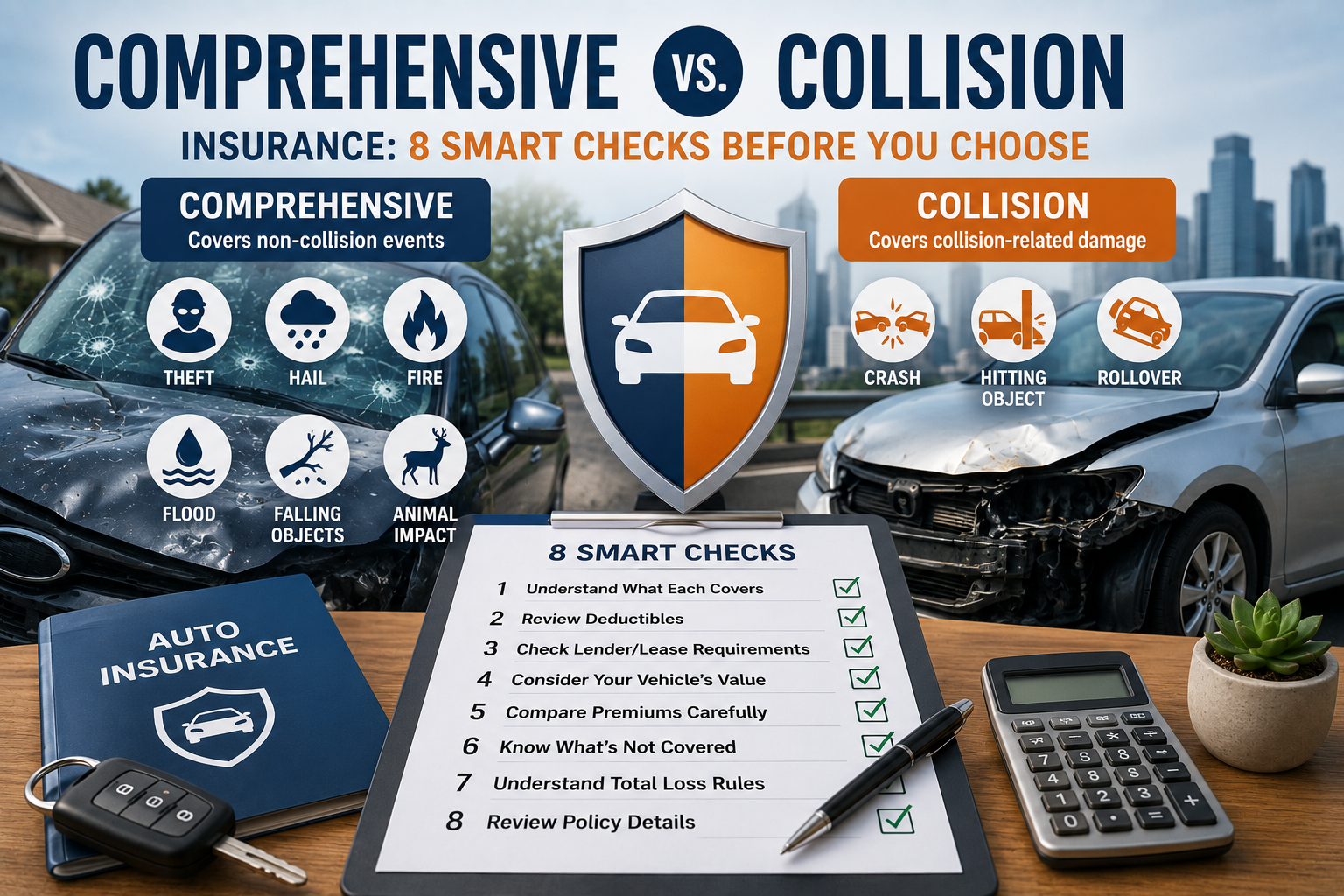
Comprehensive vs Collision Insurance is one of the most important comparisons to understand when deciding how to protect your own vehicle.
Both coverages can help pay for physical damage to an insured car, but they respond to different types of loss.
The simplest distinction is:
Collision insurance → covered crash-related damage to your vehicle
Comprehensive insurance → covered non-collision damage to your vehicle
For example:
- Hitting another vehicle → usually collision
- Backing into a pole → usually collision
- Vehicle rollover → usually collision
- Theft → usually comprehensive
- Hail damage → usually comprehensive
- Fire → usually comprehensive
- Flood → usually comprehensive
- Animal impact → usually comprehensive
Comprehensive vs Collision Insurance should not be confused with liability coverage.
Liability generally protects against covered injuries or property damage you cause to other people.
Comprehensive and collision primarily protect your own insured vehicle.
This guide explains eight smart checks drivers can use when comparing Comprehensive vs Collision Insurance, including deductibles, financed and leased vehicles, total losses, older cars, premiums, exclusions, and when keeping one or both coverages may make sense.
Educational note: PolicyQuotesUS.com provides general U.S. personal auto insurance education only. We are not an insurer, insurance agency, broker, quote marketplace, claims service, lender, leasing company, vehicle appraiser, financial adviser, or coverage approval service. We do not sell, issue, bind, approve, underwrite, recommend, or adjust insurance policies or claims. Coverage, deductibles, exclusions, premiums, valuation methods, lender requirements, claim decisions, and policy terms vary by state, insurer, vehicle, driver, household, financing arrangement, and circumstances. Always review the declarations page, policy forms, endorsements, exclusions, and loan or lease agreement before relying on coverage.
Decision Snapshot: The Loss-Cause Matrix
The fastest way to separate comprehensive from collision is to ask what caused the vehicle damage. The matrix below gives a practical starting point. For the broader protection mix around these coverages, see what coverage you may need for auto insurance.
| Loss type | Coverage that commonly matters | Key decision point |
|---|---|---|
| Crash with another vehicle or object | Collision | Usually subject to a collision deductible and policy terms. |
| Vehicle theft, hail, fire, falling object or many other covered non-collision events | Comprehensive | Usually subject to a comprehensive deductible and the policy’s covered causes of loss. |
| Damage or injury you cause to someone else | Liability, not comprehensive or collision | State minimum car insurance requirements and your selected liability limits are separate questions. |
| Loan balance exceeds a covered total-loss settlement | Gap-related protection, not a substitute for comprehensive or collision | Physical-damage coverage and loan-balance protection solve different problems. |
| Personal belongings stolen from the vehicle | Usually not solved by comprehensive or collision alone | Check the applicable policy and any other insurance that may cover personal property. |
Quote-comparison rule: when evaluating car insurance quotes online, keep both the coverage choice and deductible consistent. Otherwise, a cheaper premium may simply reflect a different amount of protection or a larger claim-day cost.
Comprehensive vs Collision Insurance at a Glance
The easiest way to understand Comprehensive vs Collision Insurance is to focus on what caused the damage.
| Coverage | Generally Associated With | Common Examples |
|---|---|---|
| Collision | Covered crashes involving another vehicle or object | Rear-end crash, pole, barrier, rollover |
| Comprehensive | Covered events other than collision | Theft, hail, fire, flood, vandalism, animal impact |
This table is only a quick guide.
The actual insurance contract controls.
Definitions, exclusions, deductibles, claim conditions, glass provisions, vehicle valuation, and state rules can affect the result.
1. Understand What Collision Insurance Covers
The first part of Comprehensive vs Collision Insurance is collision coverage.
Collision insurance generally helps pay for covered physical damage to your insured vehicle when it collides with another vehicle or object.
It may also apply when the vehicle overturns.
Common examples can include:
- Hitting another car
- Being involved in a multi-vehicle crash
- Backing into a pole
- Sliding into a guardrail
- Striking a tree
- Hitting a fence
- Rolling the vehicle
- Certain pothole-related damage
Coverage remains subject to the policy and deductible.
Collision Can Apply Even When You Caused the Crash
Suppose you accidentally rear-end another vehicle.
Your liability insurance may address covered damage to the other person’s vehicle.
Your collision insurance may address covered damage to your vehicle, subject to your deductible.
That distinction is fundamental to Comprehensive vs Collision Insurance.
Collision Does Not Mean Liability
Collision insurance is not designed primarily to pay for:
- The other driver’s injuries
- Damage to the other driver’s car
- Damage to somebody else’s fence or building
Those losses may involve liability coverage.
The what does liability car insurance cover guide explains that protection separately.
2. Understand What Comprehensive Insurance Covers
The second part of Comprehensive vs Collision Insurance is comprehensive coverage.
Comprehensive insurance is often described as other than collision coverage.
It generally protects against certain covered losses that do not result from crashing into another vehicle or object.
Common examples include:
- Vehicle theft
- Vandalism
- Fire
- Hail
- Windstorm
- Flood
- Falling tree branches
- Other falling objects
- Animal impacts
- Certain glass damage
Example: Hailstorm
Your car is parked outside during a severe hailstorm.
The body panels and windshield are damaged.
That is the type of loss commonly associated with comprehensive coverage.
Example: Deer Impact
A deer runs into the road and your vehicle strikes it.
Animal impacts are commonly handled under comprehensive coverage rather than collision.
Example: Stolen Vehicle
Your car is stolen and not recovered.
If theft is covered and the vehicle becomes a total loss, comprehensive coverage may be the relevant physical-damage protection.
Again, the policy controls the final result.
3. Know What Comprehensive and Collision Do Not Replace
A good Comprehensive vs Collision Insurance comparison also needs to explain the gaps.
Neither coverage automatically replaces every other part of an auto policy.
Comprehensive and collision generally do not replace:
- Bodily injury liability
- Property damage liability
- Personal injury protection
- Medical payments coverage
- Uninsured motorist coverage
- Underinsured motorist coverage
- Gap insurance
- Rental reimbursement
- Roadside assistance
They also generally do not cover ordinary:
- Maintenance
- Wear and tear
- Mechanical breakdown
- Aging parts
- Corrosion
- Neglect
Personal Belongings Are Another Issue
Suppose someone breaks into your vehicle and steals a laptop.
Comprehensive coverage may potentially address covered damage to the vehicle itself.
The laptop may need to be considered under another insurance policy, such as homeowners or renters insurance, depending on the circumstances.
Do not assume everything located inside a damaged vehicle is automatically covered by auto comprehensive insurance.
4. Compare the Deductibles
Deductibles are one of the most important practical differences when evaluating Comprehensive vs Collision Insurance.
A deductible is the amount the policyholder generally absorbs under a covered physical-damage claim before the insurer’s payment is calculated.
For example:
- Collision deductible: $500
- Comprehensive deductible: $250
The two deductibles do not necessarily need to be identical.
Higher Deductible
A higher deductible can reduce the premium.
But it increases the amount you may need to pay after an eligible loss.
Lower Deductible
A lower deductible may cost more in premium.
But it reduces your immediate out-of-pocket responsibility after a covered claim.
The best deductible for auto insurance guide explains this tradeoff in more detail.
The Real Deductible Test
Do not ask only:
Which deductible gives me the cheapest quote?
Ask:
Could I comfortably pay this deductible tomorrow if my vehicle were damaged?
That is a much stronger decision rule.
5. Check Whether a Lender or Leasing Company Requires Both
Comprehensive vs Collision Insurance may be optional from the driver’s perspective once a vehicle is owned outright.
A financed or leased vehicle is different.
A lender or lessor has a financial interest in the car.
For that reason, the finance or lease agreement commonly requires both:
- Collision
- Comprehensive
The agreement may also restrict deductible amounts.
Financed Vehicle
If you borrowed money to buy the vehicle, the lender may require physical-damage coverage until the loan is repaid.
Leased Vehicle
A leasing company owns the vehicle.
Its contract can require comprehensive and collision coverage throughout the lease.
The leased car insurance guide explains those requirements in more detail.
State Law and Lender Requirements Are Different
State auto insurance laws generally focus more heavily on liability and financial responsibility.
The lender or lessor can impose additional contractual requirements.
So ask:
What does my state require?
What does my lender or lessor require?
Those are separate questions.
6. Understand Total-Loss Settlements
Another important Comprehensive vs Collision Insurance issue is what happens when the vehicle cannot economically be repaired.
A vehicle may be declared a total loss after:
- Serious collision
- Theft
- Fire
- Flood
- Other qualifying covered event
The insurer then determines the settlement according to the policy’s valuation and claim provisions.
The Settlement Is Not Automatically the Loan Balance
Suppose:
- Remaining loan balance: $30,000
- Covered vehicle settlement: $26,000
Collision or comprehensive coverage does not automatically pay the extra $4,000 simply because that amount remains on the loan.
That is a different financial problem.
The gap insurance guide explains how gap protection may address an eligible loan or lease shortfall after a qualifying total loss.
Comprehensive vs Collision Insurance and Gap Are Different
Remember:
Collision/comprehensive → physical-damage settlement
Gap insurance → eligible financial difference after a total loss
One does not replace the other.
7. Decide Whether Both Still Make Sense on an Older Car
There is no universal age at which Comprehensive vs Collision Insurance should automatically be removed.
A 10-year-old vehicle may still be financially important to one household.
Another vehicle of the same age may be worth so little that carrying expensive physical-damage coverage provides limited value.
A better decision looks at:
- Current vehicle value
- Collision premium
- Comprehensive premium
- Collision deductible
- Comprehensive deductible
- Maximum realistic settlement
- Replacement cost
- Available savings
- Local theft risk
- Hail exposure
- Flood exposure
- Animal-collision exposure
- How essential the vehicle is
Simple Example
Suppose a vehicle is worth approximately $4,500.
The collision deductible is $1,000.
The annual collision premium has become relatively expensive.
The maximum practical benefit after a total loss may therefore be limited.
That does not automatically mean collision should be dropped.
But it does mean the coverage deserves a serious cost-versus-risk review.
Comprehensive May Still Be Attractive
Some drivers may decide to remove collision but retain comprehensive.
That can be reasonable to investigate because comprehensive may still protect against:
- Theft
- Fire
- Hail
- Flood
- Animal impact
Availability depends on the insurer and policy.
Do not assume every insurer allows every combination.
8. Compare Quotes on Exactly the Same Terms
Comprehensive vs Collision Insurance quotes become misleading if the deductibles or coverage choices differ.
When comparing insurers, keep the same:
- Vehicle
- Drivers
- Garaging address
- Vehicle use
- Mileage
- Collision deductible
- Comprehensive deductible
- Liability limits
- UM/UIM choices
- Rental reimbursement
- Roadside assistance
- Policy term
Then compare the premium.
Example
Quote A
- Collision deductible: $1,000
- Comprehensive deductible: $1,000
- Lower premium
Quote B
- Collision deductible: $500
- Comprehensive deductible: $250
- Higher premium
Quote A is not automatically the cheaper insurer.
Some of the difference comes from the driver accepting more claim-day financial responsibility.
The correct order is:
match coverage → match deductibles → compare price
Comprehensive vs Collision Insurance and “Full Coverage”
The phrase “full coverage” causes a lot of confusion.
It is not one standardized insurance policy.
People often use it informally to describe a policy containing:
- Liability
- Collision
- Comprehensive
But the policy may also contain or omit:
- UM/UIM
- PIP
- MedPay
- Rental reimbursement
- Roadside assistance
- Gap coverage
- Other endorsements
The liability vs full coverage auto insurance guide explains this distinction.
Do not ask only:
Do I have full coverage?
Ask:
Exactly which coverages, limits, deductibles, and exclusions appear on my policy?
Can You Have Comprehensive Without Collision?
Sometimes.
An insurer may allow a driver who owns the vehicle outright to keep comprehensive coverage while removing collision.
That can appeal to someone who is willing to pay for crash damage personally but still wants protection against certain risks such as:
- Theft
- Hail
- Fire
- Vandalism
- Animal impact
Whether this is available depends on:
- Insurer
- Policy
- State
- Vehicle
- Underwriting rules
Financed and leased vehicles may not have this freedom because the contract can require both coverages.
Can You Have Collision Without Comprehensive?
Possibly, depending on the insurer and circumstances.
But again, do not assume every combination is available.
If you are considering removing one part of Comprehensive vs Collision Insurance, ask the insurer:
- Is this combination allowed?
- When does the change become effective?
- Does removing one coverage affect other endorsements?
- Will updated declarations be issued?
Make changes deliberately rather than simply unchecking a box.
Seven Real-World Comprehensive vs Collision Insurance Examples
Hail Damages a Parked Car
Likely coverage to examine: Comprehensive.
Driver Hits a Concrete Barrier
Likely coverage to examine: Collision.
Deer Runs Into the Road
Likely coverage to examine: Comprehensive.
Car Is Stolen
Likely coverage to examine: Comprehensive.
Driver Rear-Ends Another Vehicle
Damage to your own car:
Likely coverage to examine: Collision.
Damage to the other car:
Likely coverage to examine: Property damage liability.
Tree Branch Falls on a Parked Vehicle
Likely coverage to examine: Comprehensive.
Vehicle Rolls Over After Losing Control
Likely coverage to examine: Collision.
These examples show why Comprehensive vs Collision Insurance is primarily about the cause of physical damage.
What About Pothole Damage?
Pothole damage is commonly associated with collision coverage because the vehicle struck a road hazard.
However, claim treatment can depend on:
- Actual damage
- Policy language
- Deductible
- Facts of the incident
A minor tire or wheel repair may also cost less than the deductible.
Before filing a claim, compare the repair estimate with the deductible and consider asking the insurer how the loss would be handled.
What About Windshield Damage?
Glass claims can be handled differently depending on:
- State
- Insurer
- Comprehensive deductible
- Glass endorsement
- Type of damage
Some policies may offer:
- Separate glass deductible
- Reduced glass deductible
- Special windshield provisions
Do not assume every comprehensive policy handles glass identically.
Comprehensive vs Collision Insurance and Vehicle Value
Vehicle value is one of the strongest factors in deciding whether physical-damage coverage remains worthwhile.
Consider three numbers:
1. Approximate vehicle value
2. Annual coverage premium
3. Deductible
Then consider how difficult the vehicle would be to replace without insurance.
The Cheapest Car Is Not Always the Easiest to Replace
A vehicle worth only several thousand dollars may still be essential for:
- Work
- Family responsibilities
- Medical appointments
- Daily transportation
If replacing it out of pocket would be difficult, physical-damage protection may still have significant practical value.
That is why dropping Comprehensive vs Collision Insurance solely because a car is “old” can be too simplistic.
Comprehensive vs Collision Insurance and Claim Decisions
Having coverage listed does not guarantee every claim will be paid.
The insurer may still review:
- Cause of loss
- Policy status
- Driver eligibility
- Vehicle use
- Exclusions
- Deductible
- Damage
- Repairability
- Vehicle value
- Fraud or misrepresentation concerns
- Other claim conditions
The declarations page shows what coverage was selected.
The full policy explains how it applies.
Keep both.
Common Comprehensive vs Collision Insurance Mistakes
Mistake 1: Thinking They Are the Same Coverage
They respond to different causes of vehicle damage.
Mistake 2: Assuming “Full Coverage” Covers Everything
It does not.
Mistake 3: Choosing a Deductible You Cannot Afford
A cheaper premium can create a difficult claim-day expense.
Mistake 4: Dropping Required Coverage on a Financed Vehicle
Check the loan agreement first.
Mistake 5: Removing Coverage From a Leased Vehicle
Check the lease first.
Mistake 6: Assuming the Settlement Will Pay Off Your Loan
It may not.
Mistake 7: Confusing Gap Insurance With Physical-Damage Coverage
They solve different problems.
Mistake 8: Dropping Both Coverages Just Because the Car Is Old
Review the vehicle’s actual value and your ability to replace it.
Mistake 9: Comparing Quotes With Different Deductibles
Match them first.
Mistake 10: Assuming Rental Reimbursement Is Included
It is usually a separate coverage decision.
Mistake 11: Assuming Personal Belongings Are Covered
They may fall under another policy.
Mistake 12: Ignoring Glass Provisions
Glass treatment can differ.
Comprehensive vs Collision Insurance Comparison Checklist
Before choosing or changing coverage, check:
| Question | Checked? |
|---|---|
| Collision coverage understood | Yes / No |
| Comprehensive coverage understood | Yes / No |
| Collision deductible reviewed | Yes / No |
| Comprehensive deductible reviewed | Yes / No |
| Vehicle value estimated | Yes / No |
| Annual collision premium reviewed | Yes / No |
| Annual comprehensive premium reviewed | Yes / No |
| Replacement affordability considered | Yes / No |
| Lender requirement checked | Yes / No |
| Lease requirement checked | Yes / No |
| Total-loss settlement understood | Yes / No |
| Gap protection checked | Yes / No |
| Glass provisions reviewed | Yes / No |
| Exclusions reviewed | Yes / No |
| Quotes compared on equal terms | Yes / No |
Questions to Ask Before Choosing Coverage
Ask:
- What losses does collision cover?
- What losses does comprehensive cover?
- What is my collision deductible?
- What is my comprehensive deductible?
- Is there separate glass coverage?
- Does my lender require both?
- Does my lease require both?
- What is my vehicle approximately worth?
- Could I replace the car without insurance?
- Can I carry comprehensive without collision?
- Can I carry collision without comprehensive?
- How would a total-loss settlement be calculated?
- Does the policy include gap insurance?
- Is rental reimbursement separate?
- Which exclusions deserve attention?
- Are all quote comparisons using the same deductibles?
Those questions make Comprehensive vs Collision Insurance much easier to evaluate.
Final Takeaway
Comprehensive vs Collision Insurance becomes simple once you separate the cause of the vehicle damage.
Collision insurance generally addresses covered damage to your insured vehicle resulting from a crash with another vehicle or object, or certain rollover events.
Comprehensive insurance generally addresses covered non-collision events such as:
- Theft
- Fire
- Hail
- Flood
- Vandalism
- Falling objects
- Animal impacts
Neither coverage replaces liability insurance.
Neither automatically replaces gap protection.
And neither means every possible vehicle loss is covered.
The strongest decision process is:
identify the risk → check the vehicle’s value → review deductibles → check lender or lease requirements → compare premiums → review exclusions
For a financed or leased vehicle, you may have little choice about keeping both.
For a vehicle owned outright, the decision becomes more flexible.
And for an older vehicle, the question should not simply be:
“How old is the car?”
It should be:
“What is the car worth, what does the coverage cost, what deductible would I pay, and could I afford to replace the vehicle myself?”
That is the practical way to make a strong Comprehensive vs Collision Insurance decision.
Questions and Answers About Comprehensive vs Collision Insurance
What Is the Main Difference Between Comprehensive and Collision Insurance?
Collision generally covers certain crash-related damage to your insured vehicle. Comprehensive generally covers certain non-collision events such as theft, fire, hail, flood, vandalism, falling objects, and animal impacts.
Does Collision Cover an Accident I Caused?
Collision may help pay for covered damage to your insured vehicle regardless of fault, subject to the deductible and policy terms.
Does Comprehensive Insurance Cover Theft?
Vehicle theft is commonly associated with comprehensive coverage, subject to policy terms and exclusions.
Is Hitting a Deer Comprehensive or Collision?
Animal impacts are commonly handled under comprehensive coverage.
Is Hitting a Pothole Comprehensive or Collision?
Pothole damage is generally associated with collision coverage, subject to the policy and circumstances.
Does Comprehensive Cover a Cracked Windshield?
It may. Glass coverage, deductibles, and special windshield provisions vary by state, insurer, and policy.
Are Comprehensive and Collision Required by Law?
They are generally not standard state liability requirements, but lenders and leasing companies commonly require them on financed or leased vehicles.
Can I Drop Collision After Paying Off My Car?
Paying off the vehicle can remove the lender’s contractual requirement, but whether dropping collision makes financial sense depends on the vehicle’s value, deductible, premium, and your ability to replace it.
Can I Keep Comprehensive and Drop Collision?
Some insurers may allow this on an owned vehicle. Availability varies.
Does Comprehensive or Collision Pay Off My Auto Loan?
Not automatically. A total-loss settlement may be lower than the remaining loan balance. Gap insurance may address certain eligible shortfalls under a separate contract.
Is Gap Insurance the Same as Comprehensive Insurance?
No. Comprehensive addresses certain non-collision physical damage. Gap insurance addresses an eligible financial difference between a total-loss settlement and a remaining loan or lease balance.
Which Is Better: Comprehensive or Collision?
Neither is universally better. They protect against different categories of loss. Many drivers carry both, especially when a lender or leasing company requires them.
Helpful Official Resources
- National Association of Insurance Commissioners — What Does Auto Insurance Cover?
- National Association of Insurance Commissioners — Auto Insurance
- National Association of Insurance Commissioners — State Insurance Department Directory
Author Bio
PolicyQuotesUS.com Editorial Team
The PolicyQuotesUS.com Editorial Team creates clear, neutral educational content for U.S. consumers researching comprehensive vs collision insurance, liability coverage, deductibles, vehicle protection, auto insurance quotes, financed vehicles, leased vehicles, and related insurance decisions.
Copyright Notice
© 2026 – PolicyQuotesUS.com. All rights reserved.
This article about Comprehensive vs Collision Insurance is protected by copyright and may not be copied, scraped, spun, republished, reproduced, distributed, or used commercially without prior written permission from PolicyQuotesUS.com. Brief quotations may be used with clear attribution and a link to the original article.
PolicyQuotesUS.com publishes original educational information about U.S. personal auto insurance, Comprehensive vs Collision Insurance, liability coverage, uninsured motorist coverage, underinsured motorist coverage, personal injury protection, medical payments coverage, gap insurance, deductibles, policy limits, premiums, claims, and related consumer insurance topics.
Unauthorized reuse, including AI rewriting, automated extraction, content spinning, bulk scraping, database collection, or republication on another website, is prohibited.
Disclaimer
This Comprehensive vs Collision Insurance article provides general educational information intended for people living in the United States.
It is not personalized insurance, financial, legal, tax, lending, leasing, repair, vehicle-valuation, claims, underwriting, or accounting advice.
Coverage, definitions, deductibles, exclusions, endorsements, valuation methods, premiums, lender requirements, lease requirements, eligibility rules, vehicle-repair decisions, and claim outcomes vary by state, insurer, policy, vehicle, driver, household, financing agreement, and circumstances.
PolicyQuotesUS.com does not sell insurance, issue policies, bind coverage, determine eligibility, guarantee premiums, approve claims, determine total-loss valuations, or guarantee payment of a loan or lease balance.
Review the declarations page, policy forms, endorsements, exclusions, deductibles, loan or lease agreement, and actual claim circumstances before relying on coverage.
When necessary, confirm policy-specific questions with the insurer, licensed insurance professional, lender, lessor, repair professional, or appropriate state insurance regulator.