
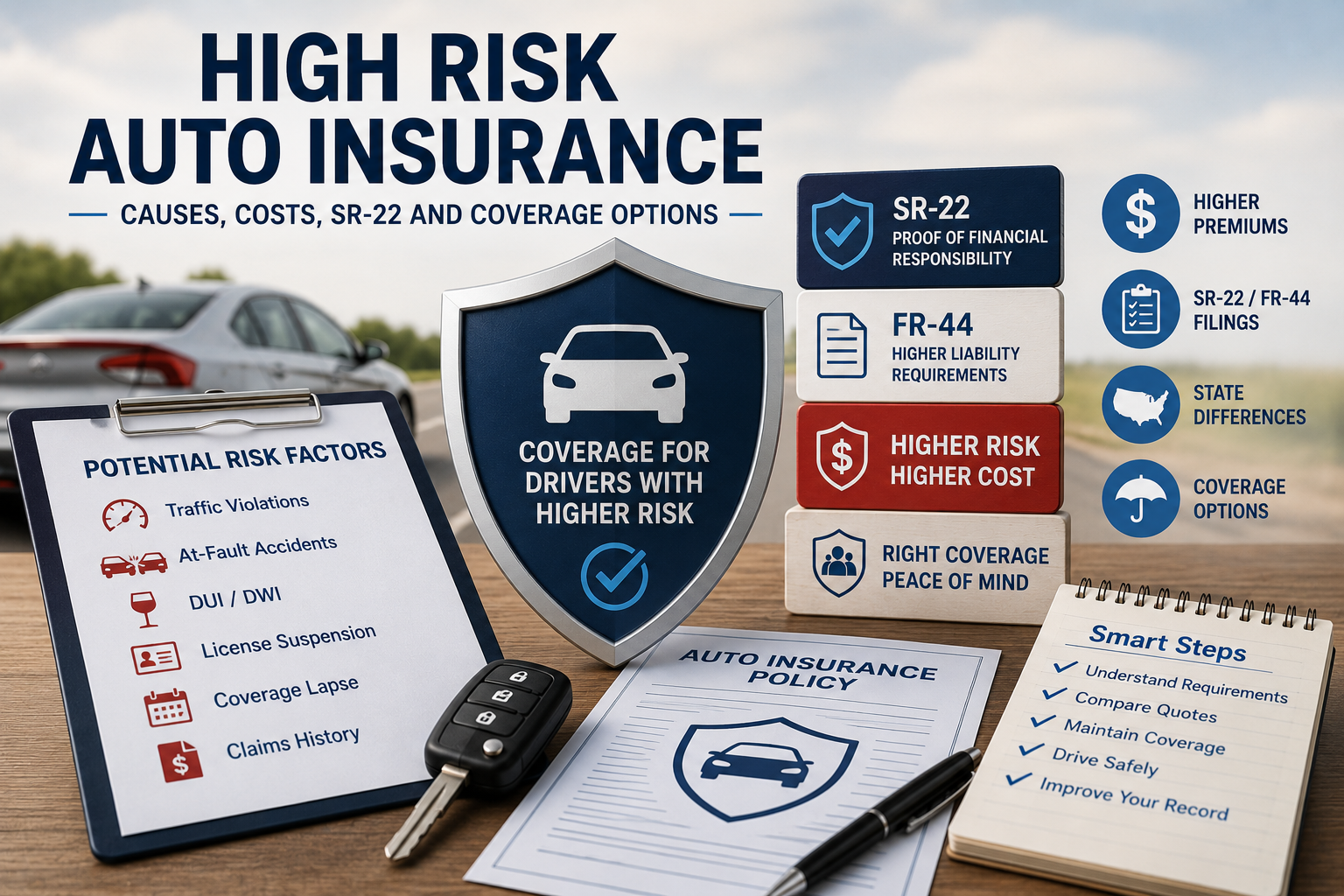
High Risk Auto Insurance generally describes personal auto coverage for a driver an insurer considers more likely than average to experience a covered loss, claim, policy problem, or costly accident. Drivers comparing options can also review car insurance quotes online to understand how to prepare consistent information and compare policies more accurately.
One insurer may consider a driver high risk while another may accept the same person into a standard rating tier. Driving history, accidents, coverage lapses, license problems, household drivers, vehicle use, state rules, and other underwriting information can all influence that decision.
Some drivers may also need an SR-22 or FR-44 financial-responsibility filing. Others may simply be paying substantially more because of recent driving history or difficulty finding an insurer willing to offer coverage.
This guide explains the major causes of High Risk Auto Insurance, how insurers evaluate risk, SR-22 and FR-44 filings, insurer options, state differences, coverage choices, quote comparisons, and practical steps that may improve future insurance options.
Educational note: PolicyQuotesUS.com provides general U.S. personal auto insurance education only. We are not an insurer, insurance agency, broker, quote marketplace, claims service, legal service, motor vehicle agency, or coverage approval service. Premiums, underwriting rules, filing requirements, limits, deductibles, exclusions, eligibility, discounts, state rules, and policy availability vary. Confirm official licensing or filing requirements with the appropriate state authority and review the issued policy before purchasing, changing, or canceling insurance.
WordPress → + Add Block → “Table of Contents by Rank Math”
Decision Snapshot: The High-Risk Recovery Roadmap
High-risk insurance is not one permanent category. The useful question is which part of the driver’s profile is creating the difficulty and which factors can realistically improve with time or better information. Use this High-Risk Recovery Roadmap before assuming every future policy will look the same.
| Risk factor | Immediate action | Longer-term improvement path |
|---|---|---|
| Coverage lapse | Restore compliant coverage and avoid another gap. | Build continuous insurance history where possible. |
| SR-22 or FR-44 filing | Confirm the exact filing requirement, state rules and duration. | Maintain the required policy and avoid events that restart or extend obligations. |
| Serious or repeated violations | Shop across insurers and non-standard markets where appropriate. | Allow time for the driving record and insurer lookback periods to improve, while maintaining safer driving. |
| Vehicle or use profile | Quote the actual vehicle and actual use accurately. | Reconsider vehicle choice or business/use patterns when a future change is practical. |
| Household-driver risk | Disclose household and regular drivers correctly. | Review the policy again when household circumstances genuinely change. |
Decision rule: focus first on obtaining valid, accurate coverage. Then separate temporary risk factors from structural ones so future shopping is based on what has actually changed—not on the assumption that “high risk” lasts forever.
What High Risk Auto Insurance Means
High Risk Auto Insurance is best understood as a market classification rather than a special nationwide policy.
Insurance companies estimate the likelihood and potential cost of future claims. A driver whose history or circumstances appear to create greater expected risk may receive a higher premium, qualify for fewer products, be placed in a non-standard market, or be declined by a particular insurer.
That does not mean every company will reach the same decision.
Insurers can weigh factors differently within applicable state law. One company may view an older accident as relatively minor while another places more weight on it. One may accept a recent coverage lapse while another may not.
Possible outcomes include:
- Standard-market coverage at a higher premium
- A different rating tier within a standard insurer
- Non-standard auto insurance
- Coverage through an independent agent
- Coverage through a direct insurer
- A state assigned-risk or residual-market mechanism when eligible
The key point is that one decline does not prove that High Risk Auto Insurance is unavailable everywhere.
What Can Make a Driver High Risk?
There is no universal checklist that automatically places every driver into the same category.
Several factors can matter.
Serious Driving Violations
A serious violation can substantially affect insurance eligibility and price.
Examples may include:
- DUI or DWI
- Reckless driving
- Racing
- Hit-and-run violations
- Serious speeding offenses
- Driving while suspended or revoked
The legal consequences depend on state law. Insurance consequences can also vary by insurer.
Multiple Moving Violations
Several tickets within a relatively short period may create greater underwriting concern than one isolated incident.
The type, severity, timing, and frequency all matter.
There is no universal ticket count at which High Risk Auto Insurance automatically becomes necessary.
At-Fault Accidents
A serious at-fault accident or several accidents can affect premiums and eligibility.
Insurers may consider:
- Fault
- Claim amount
- Bodily injuries
- Property damage
- Frequency
- Time since the accident
- Other driving incidents
Coverage Lapses
A break in continuous insurance can affect future quotes.
The consequences can depend on how long the lapse lasted, why it happened, whether the vehicle remained registered or driven, and the insurer’s underwriting rules.
Avoid creating a new lapse simply because you are shopping for another policy.
Driving Without Required Insurance
Driving without legally required insurance can create licensing, registration, financial-responsibility, or administrative consequences depending on the state.
It can also make future insurance more difficult or expensive.
License Suspension or Revocation
A suspension or revocation may require several steps before normal driving privileges return.
Depending on the reason and state, these may include:
- Reinstatement procedures
- Fees
- Proof of financial responsibility
- SR-22 or FR-44 filing
- Court requirements
- Other state-specific conditions
Claims History
Insurers may consider the frequency and severity of prior claims.
Not every claim is necessarily treated identically. Theft, weather damage, glass losses, collision claims, and bodily injury claims may be evaluated differently.
Limited Driving Experience
A newly licensed driver can have a limited record from which an insurer can estimate future losses.
Age, driving experience, vehicle, location, household members, mileage, and other factors may then play a larger role.
Household Drivers
Insurance applications generally require accurate information about household members and regular vehicle users.
Do not hide a higher-risk household driver in an attempt to obtain a cheaper quote.
Vehicle and Vehicle Use
The vehicle itself can affect underwriting.
Factors may include:
- Performance
- Repair cost
- Theft exposure
- Modifications
- Mileage
- Garaging location
- Delivery use
- Rideshare use
- Commercial activity
Vehicle use should always be described accurately.
How Insurers Evaluate High-Risk Drivers
An insurer may review a combination of information rather than one single factor.
That information can include:
- Driving record
- Accident history
- Claims history
- Prior insurance
- Coverage lapses
- License status
- SR-22 or FR-44 requirements
- Household drivers
- Vehicle
- Mileage
- Vehicle use
- Garaging location
- Requested limits
- Deductibles
- Prior cancellation or nonrenewal information where permitted
- Credit-based insurance information where legally allowed
No national underwriting formula applies to every company.
That is one reason comparison matters so much with High Risk Auto Insurance.
A driver rejected by Company A may still receive a reasonable offer from Company B.
How Much Does High Risk Auto Insurance Cost?
There is no trustworthy single price.
High Risk Auto Insurance premiums depend on the complete driver and policy profile.
Important factors can include:
- Type of driving incident
- Number of incidents
- Time since an incident
- Accident history
- Claims
- Coverage lapse
- SR-22 or FR-44 requirement
- Driver age and experience
- Vehicle
- Location
- Household drivers
- Mileage
- Vehicle use
- Liability limits
- Collision and comprehensive coverage
- Deductibles
- Optional coverage
- Payment structure
This is why fixed national price claims become misleading very quickly.
A useful comparison asks:
What does this policy cost for the same driver, same vehicle and same coverage?
not simply:
Which advertisement shows the lowest price?
The cheap car insurance quotes guide explains how to compare lower-cost options without stripping away important protection.
Standard vs Non-Standard Insurance
Drivers needing High Risk Auto Insurance may find coverage through several types of insurers.
Standard Insurers
Some standard insurers accept drivers with accidents, violations, lapses, or other underwriting concerns.
A driver should not automatically assume that an incident forces them permanently into the non-standard market.
Non-Standard Insurers
Non-standard insurers may specialize in drivers who:
- Have serious violations
- Have multiple incidents
- Need financial-responsibility filings
- Have prior insurance lapses
- Have difficulty receiving standard offers
- Have unusual underwriting circumstances
“Non-standard” does not mean the policy should be purchased without checking it carefully.
Review:
- Insurer licensing
- Coverage limits
- Exclusions
- Fees
- Deductibles
- Claims procedures
- Cancellation terms
- Payment requirements
Independent Agents
An independent agent may have access to several insurers.
That can be useful when a driver’s history makes shopping more complicated, although the available choices are still limited to insurers represented by that agent.
Direct and Captive Insurers
A direct insurer may sell through its website, call center, or employees.
A captive agent generally represents one insurer or group.
Either can be worth checking.
What Is an SR-22?
An SR-22 is generally proof that qualifying motor vehicle liability insurance or financial responsibility is in force.
An SR-22 is not a separate type of auto insurance coverage.
The underlying policy contains the actual liability limits and other insurance protection. The filing provides evidence to the relevant authority.
Depending on the state and circumstances, an SR-22 may be required after events such as:
- Driving without insurance
- Certain license suspensions
- Certain serious violations
- Financial-responsibility problems
- Reinstatement requirements
The exact triggers and required filing period vary.
California DMV, for example, recognizes an SR-22 certificate as proof of financial responsibility in circumstances where additional insurance proof is required.
A driver needing one should confirm:
- Which state requires the filing
- Why it is required
- Required insurance limits
- How long it must remain active
- Which insurer will submit it
- What happens if the policy lapses
Do not guess.
The state motor vehicle authority controls the official requirement.
What Is an FR-44?
An FR-44 is another financial-responsibility filing used in limited jurisdictions and circumstances.
Like an SR-22, it is not itself a complete insurance policy.
Virginia DMV currently uses FR-44 certification for specified serious driving convictions and requires higher liability coverage than the corresponding SR-22 requirement. Florida also uses FR-44 filings for certain financial-responsibility situations.
Drivers should therefore never assume SR-22 and FR-44 are interchangeable.
Confirm the exact requirement directly with the responsible state agency.
SR-22 vs FR-44
The simplest distinction is:
SR-22 = proof of qualifying financial responsibility under the applicable state requirement.
FR-44 = a different filing used in limited states/circumstances and commonly associated with higher liability requirements.
Neither term tells you everything contained in the policy.
The driver must still review the actual:
- Liability coverage
- Limits
- Deductibles
- Physical-damage coverage
- Optional coverages
- Exclusions
- Endorsements
High Risk Auto Insurance Without Owning a Car
A driver can need a financial-responsibility filing without owning a vehicle.
In some circumstances, a non-owner auto policy may be appropriate.
The non-owner car insurance pillar explains this coverage in detail.
A non-owner policy is generally liability-focused and designed around occasional use of vehicles the insured does not own.
It may not provide:
- Collision coverage for the borrowed vehicle
- Comprehensive coverage for the borrowed vehicle
- Protection for a household vehicle regularly available to the insured
- Coverage for every commercial or rideshare activity
When an SR-22 or similar filing is involved, confirm that the insurer can actually submit the required filing.
A driver who later purchases a vehicle should contact the insurer because the policy structure may need to change.
State Rules Matter
Auto insurance is heavily state-regulated.
High Risk Auto Insurance can therefore look different depending on where the driver lives and where the vehicle is registered and principally garaged.
States can differ in:
- Minimum liability requirements
- Fault systems
- SR-22 rules
- FR-44 rules
- Reinstatement procedures
- Assigned-risk programs
- Cancellation protections
- Nonrenewal rules
- Credit-related rating restrictions
- Proof-of-insurance systems
Use auto insurance by state for the broader state framework.
The minimum car insurance requirements pillar explains the legal insurance baseline.
Never use another state’s rule as proof of what applies where you live.
Assigned-Risk and Residual-Market Options
Some drivers may struggle to obtain legally required liability insurance through the ordinary voluntary market.
States may provide an assigned-risk or residual-market mechanism for eligible drivers.
California, for example, operates the California Automobile Assigned Risk Plan for drivers unable to obtain qualifying coverage voluntarily because of their driving record or other circumstances.
These programs should generally be viewed as a fallback rather than an assumption that every high-risk driver must use one.
Before using a residual-market option:
- Confirm eligibility.
- Check what coverage it provides.
- Review the premium.
- Understand payment terms.
- Compare legitimate voluntary-market options where available.
How Long Does High-Risk Status Last?
There is no universal national countdown.
Several different timelines may be involved:
Driving-Record Timeline
A state determines how incidents appear on official driving records.
Insurer Lookback Period
An insurer may review a particular period when evaluating risk.
Different insurers can weigh older events differently.
Filing Period
An SR-22 or FR-44 obligation follows the applicable state requirement.
It does not necessarily end on the same date that an insurer stops heavily weighting the original event.
Premium Impact
An incident’s effect on price may decline gradually.
Insurance-Market Eligibility
A driver may regain more standard-market options as time passes and the rest of the insurance profile improves.
That means there is no single date when High Risk Auto Insurance universally “expires.”
Can High Risk Auto Insurance Become Cheaper?
It can, although no reduction can be guaranteed.
Several responsible actions may improve future comparisons.
Maintain Continuous Insurance
Avoid preventable lapses.
Avoid New Violations and At-Fault Accidents
A cleaner recent history can become increasingly important as older events move further into the past.
Compare Matching Quotes
Different insurers may treat the same history differently.
Check Legitimate Discounts
Review best auto insurance discounts and check actual eligibility rather than assuming a discount applies.
Review the Vehicle
A different vehicle can affect repair costs, theft exposure, physical-damage premiums, and overall insurance pricing.
Review Mileage and Usage Honestly
If driving patterns genuinely change, make sure the insurer has accurate information.
Review Deductibles Carefully
A higher deductible may reduce the premium but increases the amount the policyholder must absorb after a covered loss.
Do not select a deductible you could not realistically pay.
Coverage Choices Still Matter
High Risk Auto Insurance should not become a race to buy the smallest possible policy.
Depending on the driver and state, the policy may include decisions involving:
- Bodily injury liability
- Property damage liability
- Uninsured motorist coverage
- Underinsured motorist coverage
- Personal injury protection
- Medical payments coverage
- Collision
- Comprehensive
- Deductibles
- Optional endorsements
The broader what coverage do I need for auto insurance guide can help organize those decisions.
A lower premium may result from:
- Lower limits
- Higher deductibles
- Removed physical-damage coverage
- Fewer endorsements
- Excluded drivers
- Reduced optional protection
That is not automatically better value.
How to Compare High Risk Auto Insurance Quotes
The best comparison keeps the major variables the same.
Before requesting quotes, prepare:
- Driver names
- Dates of birth
- Driver’s license information
- Vehicle identification numbers
- Garaging address
- Mileage
- Vehicle use
- Accident history
- Violation information
- Claims history
- Prior insurance information
- Coverage lapse details
- SR-22 or FR-44 requirements
- Desired liability limits
- Deductibles
- Loan or lease information
Then ask each insurer to quote the same basic coverage structure.
Drivers preparing to shop can also use the instant auto insurance quotes guide.
Compare:
coverage + limits + deductibles + exclusions + fees + total premium
rather than simply:
monthly payment
Common High-Risk Insurance Mistakes
Assuming One Decline Means Everyone Will Decline
Insurers do not all use identical underwriting rules.
Canceling Before Replacement Coverage Begins
This can create another insurance lapse and potentially make the situation worse.
Hiding Driving History
Insurers can verify significant information. An inaccurate application can change the premium, eligibility, or coverage outcome.
Hiding Household Drivers
List household and regular drivers accurately when requested.
Misstating Vehicle Use
Do not hide delivery, rideshare, commercial use, commuting, mileage, or garaging information.
Treating SR-22 as Insurance
It is a filing proving qualifying financial responsibility, not a replacement for the actual policy.
Assuming FR-44 Is the Same Everywhere
It is a state-specific filing with particular requirements.
Comparing Different Coverage
A stripped-down policy may appear cheaper for the wrong reason.
Allowing a Filing Policy to Lapse
When continuous financial-responsibility proof is required, cancellation or nonpayment can create serious administrative consequences.
A Simple High-Risk Driver Scenario
Imagine a driver has a recent serious moving violation and needs proof of financial responsibility for license reinstatement.
Insurer A declines the application.
The driver assumes insurance is impossible.
That conclusion is premature.
Insurer B may have different underwriting rules. A non-standard insurer may be another option. An independent agent may have access to additional companies. If ordinary voluntary-market coverage genuinely cannot be obtained, the driver’s state may also operate an eligible assigned-risk mechanism.
The correct path is:
Confirm the state requirement → gather accurate records → compare appropriate insurers → verify the filing → activate replacement coverage → keep it continuously in force.
That is far safer than canceling an existing policy first and trying to solve the problem afterward.
Questions to Ask Before Buying
Ask:
- Why am I being classified as high risk?
- Is that classification based on a violation, accident, lapse, filing, or another factor?
- Does the insurer offer the coverage I legally need?
- Do I need an SR-22 or FR-44?
- Will the insurer submit the filing?
- When does the filing become effective?
- What happens if the policy is canceled?
- Are all household drivers listed correctly?
- Is vehicle use described accurately?
- Are liability limits identical across the quotes?
- Are collision and comprehensive included?
- Are deductibles identical?
- Are any drivers excluded?
- What additional fees apply?
- What is the total premium rather than just the first payment?
- Is the insurer licensed in my state?
- Are there legitimate discounts I qualify for?
- Can I compare again later as my driving history improves?
Final Takeaway
High Risk Auto Insurance is not one special nationwide policy.
It is a broad description of insurance for drivers whose record or circumstances create additional underwriting concern.
A serious violation, repeated tickets, at-fault accidents, a coverage lapse, uninsured driving, license problems, limited experience, household-driver issues, vehicle use, or a financial-responsibility filing can all contribute.
The situation also does not automatically last forever.
Insurers evaluate risk differently, and options can improve as incidents become older, coverage remains continuous, driving history stabilizes, and the driver compares the market again.
For drivers needing an SR-22 or FR-44, the most important rule is to confirm the official state requirement and keep the required insurance and filing continuously active.
Compare High Risk Auto Insurance using matched coverage, accurate information, appropriate insurers, and the complete policy cost—not a headline price alone.
Questions and Answers About High Risk Auto Insurance
What Is High Risk Auto Insurance?
High Risk Auto Insurance is a general description for personal auto coverage provided to a driver an insurer considers more likely to experience a loss or higher claim costs. It is not one standardized nationwide insurance policy.
What Makes Someone a High-Risk Driver?
Possible factors include serious or repeated violations, at-fault accidents, insurance lapses, uninsured driving, license problems, claims history, limited experience, household-driver issues, or vehicle use. Insurer and state treatment varies.
Can One Insurer Decline Me While Another Accepts Me?
Yes. Insurers can use different underwriting rules, risk models, and market strategies within applicable state law.
Is an SR-22 High Risk Auto Insurance?
No. An SR-22 is generally a financial-responsibility filing or certificate showing qualifying insurance is in force. The actual auto policy provides the insurance coverage.
What Is an FR-44?
An FR-44 is another financial-responsibility filing used in limited states and situations. It can involve higher liability requirements than an ordinary minimum or SR-22 requirement.
Can I Get an SR-22 Without Owning a Vehicle?
Sometimes. A qualifying non-owner auto policy may be available when the driver does not own a vehicle, subject to state and insurer requirements.
How Much More Does High Risk Auto Insurance Cost?
There is no universal amount. Driving history, vehicle, location, insurer, household, coverage, limits, deductibles, filing requirements and many other factors can affect the premium.
How Long Will I Need High Risk Auto Insurance?
There is no national period. State record rules, insurer lookback periods, filing requirements, and premium effects can all follow different timelines.
Can My Insurance Become Cheaper Later?
Possibly. Continuous coverage, no new incidents, accurate records, appropriate discounts, vehicle changes, and comparison among insurers may improve future options, but savings cannot be guaranteed.
What if Standard Insurers Will Not Cover Me?
A non-standard insurer, independent agent, or state assigned-risk mechanism may provide alternatives depending on the driver’s circumstances and state.
Does High Risk Auto Insurance Always Require an SR-22?
No. High Risk Auto Insurance does not automatically mean an SR-22 is required. An SR-22 is generally a financial-responsibility filing required in particular circumstances under state rules. A driver can be classified as high risk because of accidents, violations, coverage lapses, claims history, or other underwriting factors without needing an SR-22.
Can High Risk Auto Insurance Return to Standard Auto Insurance?
Possibly. High Risk Auto Insurance does not necessarily remain necessary forever. As older incidents become less significant, coverage remains continuous, and no new violations or at-fault accidents occur, a driver may qualify for better standard-market options. Insurer underwriting rules vary, so comparing matched quotes periodically can show whether eligibility has improved.
Helpful Official Resources
- NAIC Consumer Insurance Resources
- NAIC State Insurance Department Directory
- USA.gov State Motor Vehicle Services
- National Highway Traffic Safety Administration
Author Bio
PolicyQuotesUS.com Editorial Team
The PolicyQuotesUS.com Editorial Team creates clear, neutral auto insurance education for drivers and households throughout the United States.
Copyright Notice
© 2026 – PolicyQuotesUS.com. All rights reserved.
This article about High Risk Auto Insurance is protected by copyright and may not be copied, scraped, spun, republished, reproduced, distributed, or used commercially without prior written permission from PolicyQuotesUS.com. Brief quotations may be used with clear attribution and a link to the original article.
PolicyQuotesUS.com publishes original educational information about high-risk drivers, SR-22 and FR-44 filings, liability insurance, non-owner insurance, coverage limits, deductibles, driving history, state insurance requirements, auto insurance quotes, and related U.S. personal auto insurance topics.
Unauthorized reuse including AI rewriting, content spinning, automated extraction, bulk scraping, database collection, or republication on another website is prohibited.
Disclaimer
This High Risk Auto Insurance article provides general educational information for people living in the United States.
It is not personalized insurance, financial, legal, tax, claims, licensing, motor vehicle, or underwriting advice. It does not guarantee insurance eligibility, insurer acceptance, savings, discounts, license reinstatement, renewal, claim approval, filing acceptance, or policy availability.
High Risk Auto Insurance definitions, underwriting criteria, premiums, limits, deductibles, exclusions, SR-22 requirements, FR-44 requirements, filing periods, reinstatement procedures, rating factors, discounts, and insurer practices can vary by state, insurer, driver, driving record, vehicle, household, garaging location, vehicle use, and policy.
Always confirm official licensing, reinstatement, SR-22, FR-44, or other financial-responsibility requirements with the responsible state agency.
Review the declarations page, coverage forms, endorsements, exclusions, definitions, conditions, and other controlling policy documents before purchasing, changing, canceling, or relying on insurance.
PolicyQuotesUS.com does not issue insurance policies, determine eligibility, submit government filings, reinstate driver’s licenses, adjust claims, or make coverage decisions.