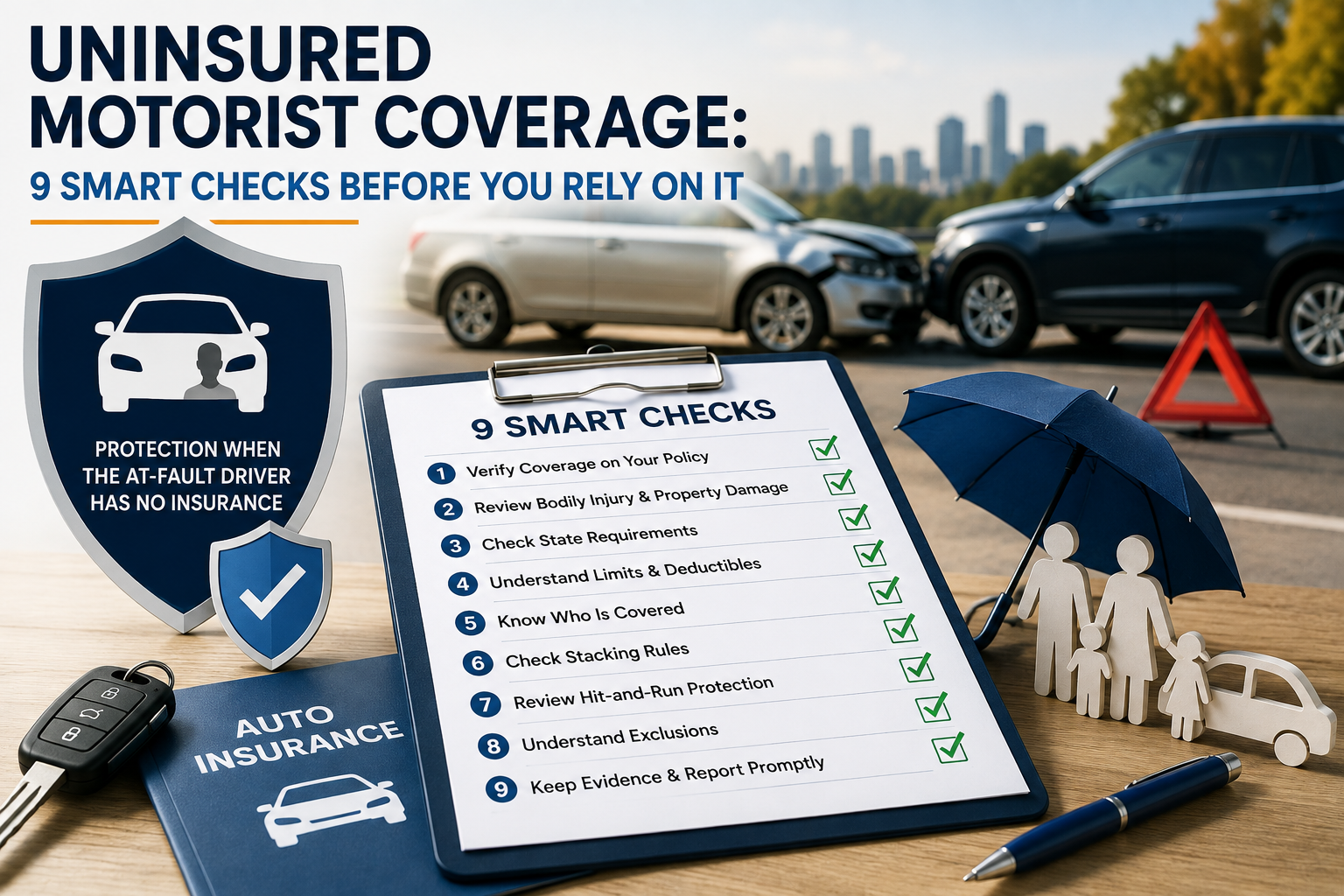
Uninsured Motorist Coverage can provide important protection when an at-fault driver has no applicable auto liability insurance.
Instead of relying entirely on the uninsured driver’s ability to pay, certain covered losses may be addressed through your own auto insurance policy.
Depending on the state and policy, Uninsured Motorist Coverage may involve:
- Bodily injury protection
- Property damage protection
- Hit-and-run accidents
- Passengers
- Pedestrians
- Cyclists
- Household members
- Stacked or unstacked limits
- State-specific selection or rejection rules
But Uninsured Motorist Coverage does not guarantee that every accident involving an uninsured driver will automatically be paid.
A claim can still depend on:
- Fault
- Policy definitions
- Coverage limits
- Exclusions
- State law
- Hit-and-run requirements
- Evidence
- Covered-driver status
- Covered-vehicle status
- Claim procedures
That is why the strongest approach is:
understand the coverage → understand the limits → check state rules → review exclusions → preserve evidence
This guide explains nine important checks drivers should make before buying, changing, rejecting, or relying on Uninsured Motorist Coverage.
Educational note: PolicyQuotesUS.com provides general U.S. personal auto insurance education only. We are not an insurer, insurance agency, broker, quote marketplace, claims service, law firm, financial adviser, or coverage approval service. We do not sell, issue, bind, approve, underwrite, recommend, or adjust insurance policies or claims. Uninsured motorist requirements, availability, limits, deductibles, stacking rules, exclusions, hit-and-run provisions, rejection procedures, premiums, eligibility, and claim rules vary by state, insurer, policy, vehicle, household, and circumstances. Review the declarations page, policy forms, endorsements, exclusions, and current state requirements before relying on coverage.
Decision Snapshot: The UM Protection Map
Uninsured Motorist coverage is easier to evaluate when the possible gap is separated into the type of uninsured-driver problem and the type of protection purchased.
| Problem | Coverage question |
|---|---|
| At-fault driver has no liability insurance | Does the policy include uninsured motorist bodily injury, property damage, or both where available? |
| At-fault driver has insurance but too little | This moves into the separate underinsured motorist question. |
| Hit-and-run | Does the state’s law and the policy treat the event as eligible for UM, and what evidence or contact requirements apply? |
| Injuries to occupants | Who qualifies as an insured person and what UMBI limit applies? |
| Damage to the insured vehicle | Is UMPD available, and how does it interact with collision coverage or deductibles? |
Decision rule: do not ask only “Do I have UM?” Ask which UM component you have, who it protects, which events qualify and what limit applies.
What Uninsured Motorist Coverage Actually Is
Uninsured Motorist Coverage is designed to provide certain protection when an insured person suffers a covered loss caused by an at-fault driver who has no applicable liability insurance.
The coverage exists because liability insurance normally depends on the responsible driver’s policy.
If that driver has no usable insurance, recovering compensation can become much harder.
Uninsured Motorist Coverage can create another possible source of recovery through the injured person’s own insurance policy.
That can be important after an accident involving:
- An uninsured driver
- A driver whose liability policy has lapsed
- A hit-and-run driver when applicable requirements are met
- Certain situations where the other driver’s insurer provides no applicable coverage
The exact answer depends on the policy and state.
Why Uninsured Motorist Coverage Exists
Liability insurance is designed to address covered injuries and property damage an at-fault driver causes to other people.
The what does liability car insurance cover guide explains that side of the insurance system.
But suppose an at-fault driver has no applicable liability coverage.
The injured person may face:
- Medical bills
- Lost income
- Rehabilitation expenses
- Vehicle damage
- Transportation problems
- Other financial losses
Recovering directly from an uninsured person may be difficult.
Uninsured Motorist Coverage transfers part of that risk back to the insured driver’s own policy when the coverage terms are satisfied.
It does not punish the uninsured driver.
It does not erase every loss.
It simply creates a possible contractual source of protection.
1. Understand the Difference Between UM and UIM
The first check is making sure you understand which problem the coverage addresses.
Uninsured Motorist Coverage
UM generally addresses a covered loss caused by an at-fault driver with no applicable liability insurance.
Underinsured Motorist Coverage
UIM generally addresses a different problem.
The at-fault driver has insurance, but the available liability limits may not be sufficient to address the covered loss.
Our underinsured motorist coverage guide owns that separate topic.
A simple way to remember it is:
UM → no usable insurance
UIM → not enough insurance
They are related, but they are not interchangeable.
Example
Driver A causes an accident and has no active liability policy.
That can create a potential UM situation.
Driver B causes a serious accident and has liability insurance, but the available limit is exhausted before the covered damages are fully addressed.
That can create a potential UIM situation.
Some policies or states combine the coverages.
Others show them separately.
Always check the declarations page.
2. Check Whether You Have UMBI, UMPD, or Both
Uninsured Motorist Coverage can involve more than one type of protection.
Uninsured Motorist Bodily Injury
Uninsured motorist bodily injury, often abbreviated UMBI, generally addresses certain covered injury damages caused by an uninsured at-fault driver.
Depending on the policy and applicable law, those damages may potentially involve:
- Medical treatment
- Rehabilitation
- Lost income
- Funeral expenses
- Certain pain-and-suffering damages
- Other legally recoverable bodily injury damages
Coverage remains subject to:
- Fault
- Limits
- Policy definitions
- Exclusions
- Evidence
- Claim conditions
A listed limit is not an automatic payment.
Uninsured Motorist Property Damage
Uninsured motorist property damage, often abbreviated UMPD, can address certain covered property or vehicle damage caused by an uninsured driver where the coverage is available.
UMPD is not universal.
It may have its own:
- Limit
- Deductible
- Eligibility requirements
- Hit-and-run rules
- Exclusions
Do not assume UMPD exists simply because the declarations page shows uninsured motorist bodily injury.
UMBI and UMPD Solve Different Problems
UMBI → bodily injury
UMPD → certain property damage where available
That distinction is essential when reviewing Uninsured Motorist Coverage.
3. Check State Requirements Before Accepting or Rejecting Coverage
Uninsured Motorist Coverage is strongly influenced by state law.
There is no single nationwide UM rule that applies identically to every policy.
Depending on the state, coverage may be:
- Required
- Required to be offered
- Optional
- Rejectable
- Available with different limits
- Subject to written or electronic selection requirements
The state car insurance laws pillar explains the broader legal framework.
The auto insurance by state hub explains why state location changes the insurance landscape.
Do Not Click Past a Rejection Form
A driver shopping quickly may see a choice to:
- Accept UM
- Reduce UM
- Reject UM
Do not treat that as routine paperwork.
Reducing or rejecting Uninsured Motorist Coverage can remove or reduce a potential source of protection for the policyholder and other covered people.
If you make a selection, keep a copy.
Store:
- Rejection form
- Lower-limit selection
- Declarations page
- Endorsements
- Renewal documents
State Minimums Do Not Answer Everything
The minimum car insurance requirements page explains the legal baseline.
But state-minimum liability coverage primarily addresses what you must carry to protect others from losses you cause.
Uninsured Motorist Coverage addresses a different question:
What protection do you have when someone without insurance causes a covered loss to you?
4. Understand How Hit-and-Run Accidents Are Handled
Hit-and-run accidents can create Uninsured Motorist Coverage questions because the responsible driver may never be identified.
But this does not mean every unidentified incident automatically becomes a covered UM claim.
State law and policy language may impose requirements involving:
- Proof another vehicle was involved
- Police reporting
- Prompt insurer notification
- Physical contact
- Independent witnesses
- Photos
- Video
- Dash-camera footage
- Other evidence
The rules vary.
Example: Direct Collision
An unidentified vehicle strikes your car and leaves the scene.
You have:
- Vehicle damage
- Photos
- Witnesses
- Police report
That may present a stronger evidence trail than a claim where no other vehicle can be identified.
Example: No-Contact Accident
Another vehicle forces you off the road but never physically touches your car.
Whether Uninsured Motorist Coverage applies can depend on state law, policy wording, evidence, and applicable claim requirements.
Do not assume.
Preserve Evidence Immediately
After a hit-and-run, where safe and appropriate:
- Photograph the scene
- Photograph vehicle damage
- Record witness details
- Preserve dash-camera footage
- Look for nearby surveillance cameras
- Make required reports
- Notify the insurer promptly
- Keep medical and repair documents
Evidence can become extremely important when the other driver is unknown.
5. Understand Your Coverage Limits
Uninsured Motorist Coverage has limits just like liability insurance.
Those limits may be shown as:
- Split limits
- Combined single limits
- Separate bodily injury and property damage limits
Split Limits
A policy may show one amount applying to one injured person and another amount applying to all covered bodily injury claims from one accident.
If multiple people are injured, the per-accident limit may need to be shared.
Higher Limits Mean More Potential Protection
Higher Uninsured Motorist Coverage limits can provide more potential insurance protection.
They can also increase the premium.
The right limit depends on circumstances such as:
- Income
- Dependents
- Household drivers
- Passenger exposure
- Health insurance
- Disability protection
- Savings
- Driving frequency
- Premium affordability
There is no single perfect limit for every household.
A Limit Is Not a Guaranteed Settlement
A $100,000 limit, for example, does not automatically mean a claimant receives $100,000.
The insurer may still evaluate:
- Fault
- Injuries
- Damages
- Medical evidence
- Other applicable insurance
- Exclusions
- Policy conditions
- Offsets
- Claim facts
The limit establishes the maximum available under the applicable part of coverage, subject to the policy.
6. Check Whether Coverage Is Stacked or Unstacked
Stacking is one of the more complicated areas of Uninsured Motorist Coverage.
In simple terms, stacking can allow limits from more than one insured vehicle or policy to be combined when permitted by the state and contract.
Intra-Policy Stacking
This can involve combining limits associated with multiple vehicles insured under one policy.
Inter-Policy Stacking
This can involve limits across more than one insurance policy.
Unstacked Coverage
Unstacked coverage generally restricts the claim to one applicable limit.
Example
Suppose a household insures three vehicles.
Each shows uninsured motorist protection.
It would be a mistake to automatically assume:
three vehicles = three limits combined
Whether stacking is permitted depends on:
- State law
- Policy wording
- Vehicle involved
- Claimant status
- Premiums
- Anti-stacking provisions
- Other policy conditions
Ask the insurer whether the coverage is stacked or unstacked and what that means in practice.
7. Check Who Qualifies as an Insured
One of the most important parts of Uninsured Motorist Coverage is the policy definition of insured.
Potentially covered people can vary by policy and circumstances.
They may include:
- Named insured
- Spouse
- Resident relatives
- Household members
- Passengers
- Certain permissive users
- Pedestrians
- Cyclists
- People occupying a covered vehicle
But those categories are not universal guarantees.
Household Relationships Matter
Questions can become more complicated when the household includes:
- College students
- Adult children
- Separated spouses
- Relatives with vehicles insured elsewhere
- Excluded drivers
- Multiple policies
Do not assume someone is covered simply because they are related to the policyholder.
Check the definition.
Person-Based and Vehicle-Based Coverage
People sometimes say Uninsured Motorist Coverage “follows the person.”
That can sometimes help explain the concept, but it is too simple to use as a universal rule.
Coverage may still depend on:
- Which vehicle was involved
- Whether the claimant is an insured
- Household status
- Vehicle ownership
- Policy exclusions
- State law
Read the policy rather than relying on shorthand.
8. Check Vehicle Restrictions and Regular-Use Exclusions
Another major area involves the vehicle occupied at the time of the loss.
Some policies may restrict Uninsured Motorist Coverage when an insured person is occupying:
- A personally owned vehicle not insured under the policy
- A vehicle regularly available for use
- An employer-provided vehicle
- Another household vehicle
- Certain motorcycles or recreational vehicles
- Vehicles insured elsewhere
This is sometimes described as an owned-but-uninsured vehicle issue.
Example
A household owns two cars.
Only one appears on the policy containing Uninsured Motorist Coverage.
A household member is injured while driving the other personally owned vehicle.
Do not assume the UM coverage automatically transfers.
The policy and state law need to be checked.
Regular-Use Vehicles
A similar issue can arise when someone regularly drives:
- Employer vehicle
- Relative’s vehicle
- Household vehicle
- Another vehicle available for routine use
Occasional borrowing can be treated differently from constant access.
Disclose regular-use arrangements accurately.
9. Compare the Coverage With the Rest of Your Auto Policy
Uninsured Motorist Coverage does one specific job.
It should be evaluated beside the other coverages rather than in isolation.
Liability Coverage
Liability generally protects against covered harm you cause to other people.
Uninsured Motorist Coverage
UM generally addresses certain covered losses caused to an insured person by an uninsured at-fault driver.
Underinsured Motorist Coverage
UIM can address situations where the at-fault driver has insurance but not enough available liability coverage.
Collision
Collision can protect against certain covered crash damage to your own vehicle.
Comprehensive
Comprehensive can protect against certain covered non-collision losses.
PIP and MedPay
Personal injury protection and medical payments address different injury-related expenses.
Our personal injury protection insurance guide explains PIP separately.
The broader what coverage do I need for auto insurance guide helps place these pieces together.
Uninsured Motorist Coverage vs Collision Coverage
UMPD and collision can sometimes both appear relevant after an accident with an uninsured driver.
But they should not be treated as identical.
Collision Coverage
Collision can generally apply to covered crash damage regardless of whether the other driver is insured, subject to the policy and deductible.
UMPD
UMPD generally depends on the other driver being uninsured and may involve different:
- Limits
- Deductibles
- Availability
- Hit-and-run conditions
- Identification requirements
The comprehensive vs collision insurance guide explains physical-damage coverage in greater detail.
Do Not Drop Collision Just Because You Have UMPD
Before changing collision coverage, compare:
- Covered events
- Deductibles
- Limits
- Total-loss treatment
- Hit-and-run rules
- Vehicle-financing requirements
UMPD is not a universal substitute for collision.
Uninsured Motorist Coverage and Financed or Leased Vehicles
A lender or lessor may require physical-damage protection such as:
- Collision
- Comprehensive
That requirement is separate from Uninsured Motorist Coverage.
A financed or leased vehicle can therefore have:
- Liability
- Collision
- Comprehensive
- UM
- UIM
- Other coverages
at the same time.
Each solves a different risk.
Do not assume the lender’s physical-damage requirement automatically includes UM.
Likewise, do not assume UM satisfies collision requirements.
What Evidence Can Matter in a UM Claim?
Uninsured Motorist Coverage claims can require substantial documentation.
Useful evidence can include:
- Police report
- Incident number
- Other driver’s details
- Vehicle information
- Insurance information
- Witness statements
- Photographs
- Dash-camera footage
- Surveillance footage
- Medical records
- Medical bills
- Wage-loss records
- Repair estimates
- Vehicle-damage photographs
- Correspondence with insurers
- Policy documents
No single document guarantees payment.
The evidence needs to support the issue being investigated.
A High-Level Uninsured Motorist Claim Process
A possible claim process might look like this:
1. Address Immediate Safety and Medical Needs
Obtain appropriate assistance and medical attention.
2. Document the Accident
Preserve photos, video, witness information, vehicle information, and other evidence.
3. Make Required Reports
A police report or other report may be important, especially in hit-and-run situations.
4. Notify the Insurer
Provide prompt notice according to the policy.
5. Confirm the Other Driver’s Insurance Status
The insurer may investigate whether the other vehicle was actually uninsured.
6. Review the Policy
Check:
- UM coverage
- UIM coverage
- Limits
- Deductibles
- Definitions
- Exclusions
- Conditions
- Endorsements
7. Document the Loss
Keep records of:
- Medical treatment
- Wage loss
- Vehicle repairs
- Other claimed damages
8. Cooperate With Reasonable Investigation Requirements
Provide accurate requested information.
9. Review Settlement or Dispute Procedures
Depending on the policy and state, special procedures may apply to settlement, arbitration, consent, or other disputes.
Reporting a claim does not guarantee approval.
Common Exclusions and Conditions to Check
The name Uninsured Motorist Coverage does not reveal every limitation.
Potential issues can include:
- Owned-but-uninsured vehicles
- Regular-use vehicles
- Excluded drivers
- Excluded vehicles
- Commercial use
- Delivery driving
- Rideshare activity
- Territorial limitations
- Racing
- Intentional acts
- Fraud
- Misrepresentation
- Late notice
- Failure to cooperate
- Policy lapse
- Settlement without required insurer consent
Not every policy contains every exclusion.
The important lesson is:
read beyond the declarations page.
Check the:
- Definitions
- Exclusions
- Conditions
- Endorsements
Uninsured Motorist Coverage and Rideshare or Delivery Work
Personal auto policies may restrict commercial activity.
That can include:
- Rideshare
- Food delivery
- Package delivery
- Courier work
- Other compensated driving
Platform insurance may apply only during certain periods.
Do not assume your personal Uninsured Motorist Coverage continues unchanged during every phase of commercial use.
Tell the insurer how the vehicle is actually used.
Ask whether:
- An endorsement is needed
- Platform coverage applies
- A commercial policy is necessary
- UM protection changes during work activity
What Can Affect the Premium?
The cost of Uninsured Motorist Coverage can depend on numerous factors.
Possible factors include:
- Coverage limits
- UIM selection
- UMPD selection
- Stacking
- Number of vehicles
- Number of drivers
- Location
- Driving history
- Claims history
- Policy structure
- Other coverages
- Discounts
- Payment arrangement
There is no reliable universal price.
Instead of relying on an average, request otherwise equivalent quotes and change only the UM option you want to evaluate.
That isolates the cost more clearly.
How to Compare Uninsured Motorist Coverage Quotes
A proper comparison should keep the policy structure consistent.
Use the same:
- Drivers
- Household information
- Vehicles
- Garaging address
- Mileage
- Vehicle use
- Liability limits
- UM limits
- UIM limits
- UMPD choice
- Collision deductible
- Comprehensive deductible
- PIP or MedPay choices
- Policy term
- Payment frequency
Then compare:
- Total premium
- UM limits
- UIM limits
- UMPD
- Deductibles
- Stacking
- Hit-and-run provisions
- Exclusions
- Covered drivers
- Covered vehicles
- Payment fees
The cheap car insurance quotes guide explains the broader quote-shopping process.
Do not judge value by premium alone.
Choosing Uninsured Motorist Coverage Limits
There is no single correct UM limit for every driver.
Factors worth considering include:
- Liability limits
- Income
- Savings
- Dependents
- Household drivers
- Passenger exposure
- Health insurance
- Disability insurance
- Driving frequency
- Vehicle use
- Premium affordability
- State requirements
Some drivers choose UM limits similar to their bodily injury liability limits.
That can create a balanced structure, but it is not automatically required or right for every household.
The goal is not to find a universal formula.
The goal is to understand:
what risk am I transferring to the insurer, and what risk am I keeping myself?
Five Uninsured Motorist Coverage Scenarios
Scenario 1: Uninsured Driver Injures a Passenger
A covered vehicle is struck by an uninsured at-fault driver.
A passenger is injured.
Potential coverage can depend on:
- Whether the passenger qualifies as an insured
- Fault
- Bodily injury
- Limits
- Evidence
- Exclusions
Scenario 2: Hit-and-Run Injures a Pedestrian
A pedestrian is struck by an unidentified vehicle.
Witnesses and nearby video support the account.
Whether Uninsured Motorist Coverage applies can still depend on:
- State law
- Policy definition
- Reporting
- Evidence
- Claim conditions
Scenario 3: Multiple Vehicles and Stacking
A household has three insured vehicles.
The policy offers stacked and unstacked UM options.
The household compares:
- Premium
- Available limits
- State rules
- Vehicle eligibility
- Policy language
rather than simply assuming all limits always combine.
Scenario 4: Vehicle Damage With Collision but No UMPD
An uninsured driver damages the insured car.
The policy includes collision but not UMPD.
Collision may be the relevant vehicle-damage coverage, subject to its deductible and policy terms.
Scenario 5: College Student Using a Family Vehicle
A student lives away during the school term and regularly uses a family vehicle.
The household confirms:
- Driver status
- Residency
- Vehicle listing
- Coverage
- Household definitions
before an accident occurs.
These examples are educational only.
Actual results depend on the policy, state, evidence, fault, limits, exclusions, and claim circumstances.
Common Uninsured Motorist Coverage Mistakes
Assuming Every Accident With an Uninsured Driver Is Automatically Covered
Coverage still depends on the policy and facts.
Confusing UM With UIM
UM generally means no applicable insurance.
UIM generally means insufficient insurance.
Assuming UMBI Repairs Your Car
UMBI addresses bodily injury.
Vehicle damage can involve UMPD or collision.
Assuming UMPD Exists Everywhere
It does not.
Dropping Collision Because UMPD Appears on the Policy
Compare the protections carefully first.
Ignoring Hit-and-Run Requirements
Evidence and reporting can matter.
Rejecting UM Without Understanding the Consequence
Read the selection carefully.
Comparing Different UM Limits
Match the limits before judging premium differences.
Ignoring Stacking
Know whether the policy is stacked or unstacked.
Failing to Disclose Household Vehicles
Owned or regularly used vehicles can matter.
Failing to Preserve Evidence
Documentation may become critical.
Assuming an Umbrella Policy Automatically Includes UM
Check the actual umbrella policy.
Looking Only at Price
Coverage structure matters more than the cheapest number.
Uninsured Motorist Coverage Checklist
Before buying or changing coverage, check:
| Uninsured Motorist Coverage Question | Checked? |
|---|---|
| UM included | Yes / No |
| UIM included | Yes / No |
| UMBI limit reviewed | Yes / No |
| UMPD available | Yes / No |
| UMPD deductible reviewed | Yes / No |
| State requirements checked | Yes / No |
| Rejection requirements checked | Yes / No |
| Stacked or unstacked confirmed | Yes / No |
| Hit-and-run rules reviewed | Yes / No |
| Definition of insured reviewed | Yes / No |
| Household drivers disclosed | Yes / No |
| Owned vehicles disclosed | Yes / No |
| Regular-use vehicles disclosed | Yes / No |
| Rideshare/delivery use disclosed | Yes / No |
| Exclusions reviewed | Yes / No |
| Total premium compared | Yes / No |
Questions to Ask Before Buying or Changing Coverage
Ask:
- Does this policy include UM?
- Does it also include UIM?
- Does it include UMBI and UMPD?
- What limits apply?
- Is there a deductible?
- Is UM required in my state?
- Can I reject it?
- Does rejection require a signed or electronic form?
- Is stacking available?
- How does hit-and-run coverage work?
- Is physical contact required in some situations?
- Who qualifies as an insured?
- How are passengers treated?
- How are pedestrians and cyclists treated?
- How are college students treated?
- How are household vehicles treated?
- Are owned-but-uninsured vehicles excluded?
- How are employer vehicles handled?
- Does rideshare or delivery work change the coverage?
- Which documents control the claim?
Keep the answers with the policy documents.
Final Takeaway
Uninsured Motorist Coverage can provide an important layer of protection when the person responsible for an accident has no applicable liability insurance.
Its purpose is fundamentally different from liability coverage.
Liability → protects others from covered harm you cause.
Uninsured Motorist Coverage → can protect you and other covered people from certain losses caused by an uninsured at-fault driver.
But the coverage needs careful review.
Check:
- UMBI
- UMPD
- UM vs UIM
- State requirements
- Limits
- Stacking
- Hit-and-run rules
- Covered people
- Covered vehicles
- Exclusions
- Evidence requirements
The strongest process is:
understand what UM does → confirm what your policy includes → check state rules → choose appropriate limits → preserve evidence → review exclusions
That gives drivers a much clearer understanding of Uninsured Motorist Coverage than simply seeing “UM” on a declarations page and assuming every uninsured-driver accident is automatically protected.
Questions and Answers About Uninsured Motorist Coverage
What Is Uninsured Motorist Coverage?
Uninsured Motorist Coverage generally provides certain protection for covered losses caused by an at-fault driver who has no applicable liability insurance, subject to state law and policy terms.
Is Uninsured Motorist Coverage Required?
It depends on the state. Some states require it, while others require insurers to offer it or permit consumers to reject it under specified procedures.
Is UM the Same as UIM?
No. UM generally addresses an at-fault driver with no applicable liability insurance. UIM generally addresses an at-fault driver whose available liability limits are insufficient for the covered loss.
Does Uninsured Motorist Coverage Pay for Vehicle Damage?
Not automatically. Vehicle damage may require UMPD, collision coverage, or another applicable protection.
Does Uninsured Motorist Coverage Apply to Hit-and-Run Accidents?
It can in some circumstances, but state law and the policy may impose reporting, evidence, physical-contact, witness, or other requirements.
Does Uninsured Motorist Coverage Protect Passengers?
Passengers may qualify under some policies, subject to definitions, vehicle involvement, limits, exclusions, and state law.
What Is Stacked Uninsured Motorist Coverage?
Stacking may allow UM or UIM limits associated with multiple vehicles or policies to be combined where permitted by the law and contract.
Does UMPD Have a Deductible?
It may. Availability, limits, deductibles, and hit-and-run treatment vary.
Should UM Limits Match My Liability Limits?
Some drivers choose matching limits, but it is not a universal requirement or recommendation. State rules, household risk, available options, and affordability matter.
Does Health Insurance Replace UMBI?
Not necessarily. Health insurance may address medical treatment but may not address every type of loss potentially available under applicable UMBI coverage.
Can an Owned-but-Uninsured Vehicle Cause a Coverage Problem?
Yes. Some policies may limit Uninsured Motorist Coverage when the insured is injured while occupying a personally owned vehicle that is not insured under that policy.
Can Rideshare or Delivery Driving Affect UM Coverage?
Yes. Personal-policy exclusions, endorsements, platform insurance, commercial coverage, and the phase of compensated driving may affect which coverage applies.
Helpful Official Resources
- National Association of Insurance Commissioners — What Does Auto Insurance Cover?
- National Association of Insurance Commissioners — Consumer Auto Insurance
- National Association of Insurance Commissioners — Uninsured Motorists
- National Association of Insurance Commissioners — State Insurance Departments
Author Bio
PolicyQuotesUS.com Editorial Team
The PolicyQuotesUS.com Editorial Team creates clear, neutral educational content for U.S. consumers researching uninsured motorist coverage, underinsured motorist coverage, liability insurance, policy limits, claims, auto insurance quotes, state requirements, and related insurance decisions.
Copyright Notice
© 2026 – PolicyQuotesUS.com. All rights reserved.
This article about Uninsured Motorist Coverage is protected by copyright and may not be copied, scraped, spun, republished, reproduced, distributed, or used commercially without prior written permission from PolicyQuotesUS.com. Brief quotations may be used with clear attribution and a link to the original article.
PolicyQuotesUS.com publishes original educational information about U.S. personal auto insurance, Uninsured Motorist Coverage, underinsured motorist protection, liability coverage, collision coverage, comprehensive coverage, personal injury protection, medical payments coverage, deductibles, policy limits, premiums, claims, and related consumer insurance topics.
Unauthorized reuse, including AI rewriting, automated extraction, content spinning, bulk scraping, database collection, or republication on another website, is prohibited.
Disclaimer
This Uninsured Motorist Coverage article provides general educational information intended for people living in the United States.
It is not personalized insurance, legal, financial, medical, tax, claims, underwriting, or accounting advice.
Uninsured motorist requirements, UM/UIM rules, bodily injury and property damage coverage, limits, deductibles, stacking, rejection procedures, hit-and-run requirements, exclusions, definitions, premiums, eligibility, policy terms, and claim procedures vary by state, insurer, driver, vehicle, household, and circumstances.
PolicyQuotesUS.com does not sell insurance, issue policies, bind coverage, determine eligibility, guarantee insurance prices, approve claims, determine fault, or determine whether a particular loss is covered.
Review the declarations page, policy forms, endorsements, exclusions, definitions, limits, applicable state requirements, and actual claim circumstances before relying on coverage.
When necessary, confirm policy-specific or state-specific questions with the insurer, a licensed insurance professional, attorney, claims representative, or appropriate state insurance regulator.