
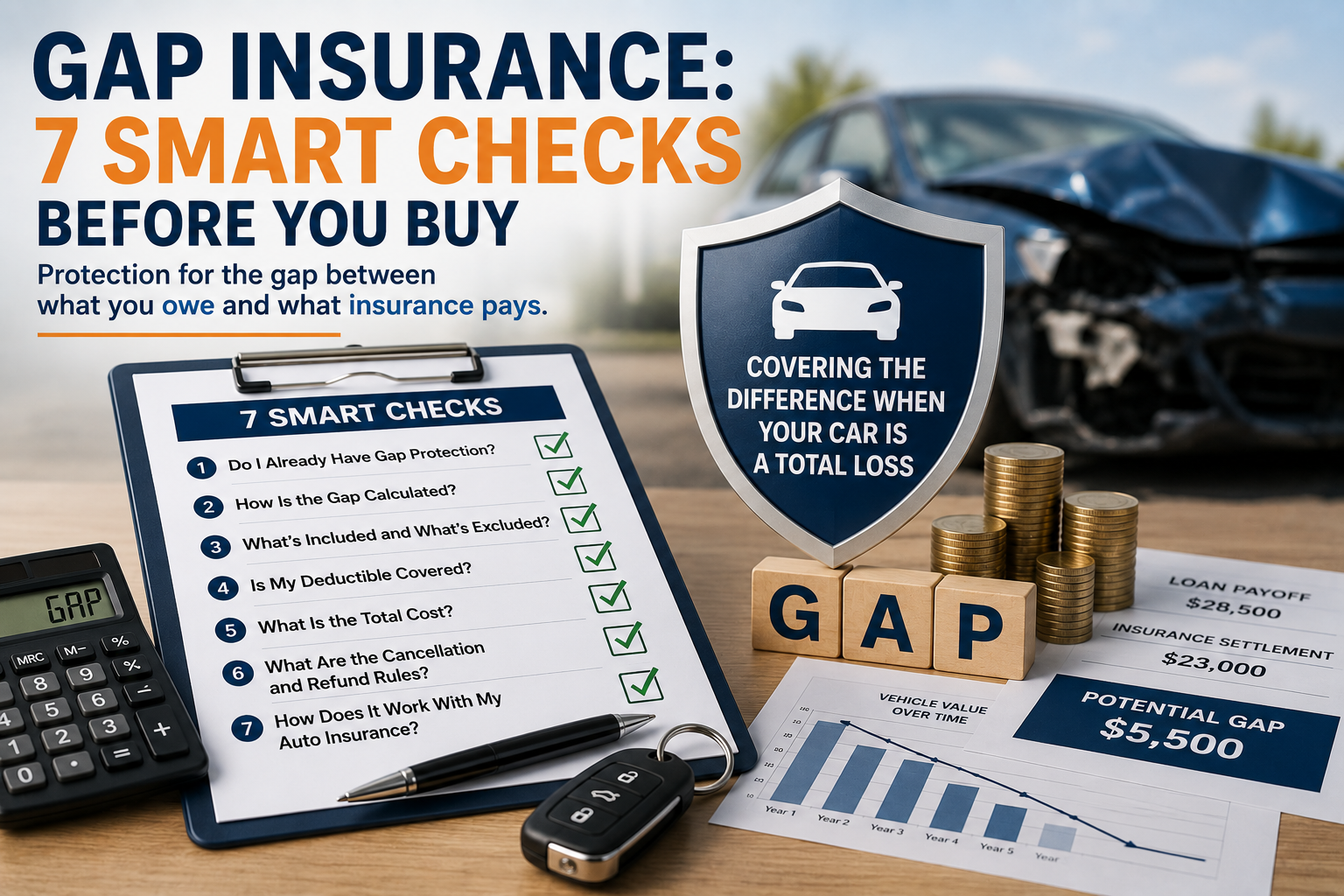
Gap insurance is designed for one specific financial risk: owing more on a financed or leased vehicle than the vehicle is worth after a covered total loss.
It does not replace ordinary auto insurance.
It does not normally pay routine repair bills.
And it does not automatically erase every dollar remaining on a vehicle loan or lease.
Instead, gap insurance may help cover some or all of the eligible difference between:
what the primary auto insurer pays for a totaled or stolen vehicle
and
the eligible amount still owed under the loan or lease
That difference is the “gap.”
Gap insurance may deserve closer attention when a driver:
- Makes a small down payment
- Uses a long loan term
- Finances a vehicle that depreciates quickly
- Rolls negative equity into a new loan
- Finances taxes, fees, or optional products
- Leases a vehicle
- Owes substantially more than the vehicle’s current value
But gap insurance is not automatically useful forever.
As the loan balance falls, the financial gap can shrink or disappear.
This guide explains seven important checks to make before buying gap insurance, including how it works after a total loss, what it may exclude, how it interacts with collision and comprehensive coverage, and when it may no longer be needed.
Educational note: PolicyQuotesUS.com provides general U.S. personal auto insurance education only. We are not an insurer, insurance agency, broker, lender, dealer, leasing company, quote marketplace, claims service, financial adviser, or coverage approval service. We do not sell, issue, bind, approve, underwrite, recommend, or administer gap products. Gap insurance, waivers, debt-cancellation products, eligibility, limits, exclusions, refunds, deductibles, loan balances, lease requirements, premiums, and claim procedures vary by provider, state, vehicle, finance contract, lease, and circumstances. Always review the gap contract, auto policy, finance or lease agreement, declarations page, and applicable terms before relying on protection.
Decision Snapshot: The Gap Exposure Test
Gap protection is worth evaluating when a covered total-loss settlement could be lower than the amount owed on a vehicle finance or lease obligation. Before buying, run the Gap Exposure Test.
- Estimate the exposure: compare the current loan or lease payoff with a realistic vehicle value range, while recognizing that an actual insurance settlement depends on the policy and loss.
- Check existing protection: confirm whether the lease, lender, dealer product or existing policy already includes a gap waiver or insurance benefit.
- Check the broader coverage structure: gap does not replace the core decision about what coverage you may need for auto insurance.
- Check state and product rules: use the auto insurance by state framework to identify the appropriate regulator and remember that gap products can be structured differently.
- Compare cost with exposure: evaluate the total price and important exclusions against the size and likely duration of the financing gap.
Decision rule: the case for gap protection is strongest when there is a material loan-or-lease shortfall that you would struggle to absorb yourself and the product terms actually address that exposure.
What Gap Insurance Actually Does
Gap insurance can become relevant when two numbers are different:
1. The vehicle’s covered settlement value
and
2. The eligible amount still owed on the vehicle
Suppose a financed vehicle is declared a total loss.
The primary auto insurer evaluates the vehicle according to the settlement provisions of the auto policy.
The vehicle’s settlement may be less than the outstanding loan payoff.
Gap insurance may then help address an eligible portion of that difference.
Simple Example
Imagine:
- Remaining eligible loan balance: $31,000
- Covered vehicle settlement: $27,000
The potential gap is:
$4,000
A qualifying gap product may address some or all of that eligible difference, subject to its:
- Limits
- Exclusions
- Deductible treatment
- Contract wording
- Loan eligibility
- Claim requirements
This example is deliberately simple.
Real calculations can be more complicated.
Why a Vehicle Loan Can Create a Gap
Vehicle values and loan balances do not always decline at the same speed.
A new vehicle can lose value faster than the borrower pays down the loan.
That can create negative equity.
Negative equity means:
you owe more than the vehicle is currently worth.
Several factors can make that more likely.
Small Down Payment
A small initial payment means a larger portion of the purchase price remains financed.
Long Loan Term
Longer financing can reduce the monthly payment while keeping the outstanding balance higher for longer.
Rapid Depreciation
Some vehicles lose value faster than others.
Financed Add-Ons
A borrower may finance:
- Taxes
- Fees
- Service contracts
- Extended warranties
- Other products
Those costs can increase the loan balance without increasing the vehicle’s market value by the same amount.
Rolled-In Negative Equity
A borrower may trade in an older vehicle while still owing more than it is worth.
The unpaid amount may be rolled into the next loan.
That can create a larger gap from the beginning.
1. Check Whether You Already Have Gap Protection
Before buying gap insurance, first check whether protection already exists.
This is especially important for leased vehicles.
A lease agreement may already contain:
- Gap waiver
- Gap protection
- Debt-cancellation provisions
- Similar contractual protection
The leased car insurance guide explains why lease documents need to be reviewed alongside the insurance policy.
Avoid Duplicate Protection
Buying a second gap product does not automatically mean you will receive two payments after the same loss.
Before paying for additional protection, check:
- Lease agreement
- Finance documents
- Existing auto policy
- Dealer paperwork
Ask:
Do I already have protection against this exact financial gap?
If yes, understand what it covers before buying anything else.
2. Understand Who Is Actually Providing the Protection
Gap insurance can be offered through several channels.
Possible sources include:
- Auto insurer
- Lender
- Dealer
- Leasing company
- Separate administrator
The company selling the product and the company responsible for administering a claim may not always be the same.
Before buying, identify:
- Product provider
- Claims administrator
- Contact information
- Cancellation procedure
- Refund procedure
- Contract number
Keep those details with your vehicle records.
Insurance vs Waiver
Not every product called “gap” is structured identically.
You may encounter:
- Gap insurance
- Gap waiver
- Debt cancellation
- Similar financial products
The legal and contractual structure can differ.
Read the actual agreement rather than relying only on the sales description.
3. Understand Which Balance the Gap Product Uses
This is one of the most important parts of gap insurance.
The amount you owe the lender may not automatically equal the amount the gap contract recognizes.
A loan payoff could contain amounts relating to:
- Vehicle financing
- Taxes
- Fees
- Late charges
- Missed payments
- Deferred payments
- Service contracts
- Extended warranties
- Negative equity
- Other financed products
The gap agreement may exclude some of these.
Example
Suppose the loan payoff is $32,000.
But $2,000 of that balance represents amounts excluded under the gap contract.
The eligible balance used in the calculation may therefore be lower than the total amount shown on the lender’s payoff statement.
That is why gap insurance should never be described as:
“It automatically pays off whatever you owe.”
That is too broad.
The contract determines the eligible amount.
4. Check How the Deductible Is Treated
The vehicle policy deductible can affect the amount remaining after a total loss, so review the best deductible for auto insurance decision separately from the gap product. Do not assume the gap contract automatically reimburses every deductible.
A collision or comprehensive policy normally has a deductible.
Suppose:
- Vehicle settlement before deductible: $25,000
- Collision deductible: $1,000
The primary insurance payment may be reduced by the deductible.
Does the gap product cover that $1,000?
Maybe.
Maybe not.
Different contracts can treat deductibles differently.
Some may:
- Cover the deductible
- Cover part of it
- Exclude it completely
- Limit the amount available
Before buying gap insurance, ask:
Does this product cover my collision or comprehensive deductible after a qualifying total loss?
Do not assume.
5. Understand What Gap Insurance Does Not Replace
Gap protection sits on top of other insurance and finance arrangements. It does not replace the legal baseline explained in minimum car insurance requirements, and it does not substitute for physical-damage coverage required by a lender or lease.
Gap insurance does not replace your underlying auto insurance.
This distinction is critical.
A gap product generally depends on a qualifying covered total loss.
It does not normally pay for ordinary vehicle damage.
Collision Coverage
Collision coverage can address certain covered crash damage to the insured vehicle.
Comprehensive Coverage
Comprehensive coverage can address certain covered non-collision losses such as:
- Theft
- Fire
- Hail
- Flood
- Vandalism
- Falling objects
- Animal contact
The comprehensive vs collision insurance guide explains these protections in more detail.
Gap Insurance Comes After the Vehicle-Loss Question
A simple way to think about the relationship is:
Collision/comprehensive → addresses the covered vehicle loss
Gap insurance → may address an eligible financial shortfall after a qualifying total loss
They solve different problems.
Gap Does Not Replace Liability Insurance
Gap insurance also does not replace liability coverage.
Liability generally addresses covered injuries or property damage you cause to other people.
Gap protection concerns the financial difference associated with your financed or leased vehicle.
The liability vs full coverage auto insurance guide explains how the broader pieces fit together.
6. Review Every Important Exclusion and Limit
The word “gap” can sound broader than the product really is.
Before buying, look for limits involving:
- Maximum benefit
- Maximum loan-to-value ratio
- Vehicle age
- Vehicle value
- Loan term
- Loan amount
- Eligible vehicle use
- Commercial use
- Rideshare
- Delivery
- Refinancing
- Negative equity
- Late payments
- Missed payments
- Deferred payments
- Deductibles
- Optional add-ons
- Total-loss definition
Not every contract contains every limitation.
That is exactly why the actual agreement matters.
Negative Equity Is Particularly Important
Suppose you owed $5,000 more on your old vehicle than it was worth.
That $5,000 is added to the next vehicle loan.
Your new loan balance is immediately higher.
Do not assume gap insurance automatically covers that rolled-in debt.
Check the contract.
7. Compare the Total Cost, Not Just the Monthly Payment
If gap is offered as part of an insurance quote, compare the complete policy on equal terms using the same discipline described in car insurance quotes online. A small monthly add-on can still represent a different total cost over the life of the protection.
Gap insurance can look inexpensive when it is presented as a small addition to a monthly payment.
But the monthly amount can hide the total cost.
If the product is financed into the vehicle loan, you may also pay interest on that additional amount.
Example
A dealer might describe a product as:
“only a few dollars more each month.”
That does not tell you:
- Total product price
- Interest added
- Length of financing
- Cancellation rights
- Refund rules
- Alternative prices elsewhere
Always ask for the full price.
Then compare gap protection from other available sources where appropriate.
The best decision is based on:
total cost + actual protection
not merely the smallest monthly increase.
What Gap Insurance May Not Cover
Depending on the contract, gap insurance may exclude or limit:
- Collision deductible
- Comprehensive deductible
- Past-due payments
- Missed payments
- Deferred installments
- Late fees
- Loan penalties
- Rolled-in negative equity
- Extended warranties
- Service contracts
- Credit products
- Other financed add-ons
- Amounts above the maximum benefit
- Non-covered vehicle losses
- Repairable vehicles
- Certain vehicle uses
- Claims involving misrepresentation
- Balances after protection expires
These are examples, not universal exclusions.
Always review your specific contract.
Gap Insurance and Total Losses
Gap insurance is normally associated with a vehicle being declared a total loss.
A vehicle can become a total loss after events such as:
- Serious collision
- Theft where the vehicle is not recovered
- Fire
- Flood
- Other covered event
The underlying auto insurer first determines whether the loss is covered and how the vehicle settlement is calculated.
Gap protection may then become relevant if:
eligible balance > covered vehicle settlement
Repairable Damage Is Different
Suppose your vehicle suffers $8,000 in covered damage but can be repaired.
Gap insurance normally is not designed to pay ordinary repair bills.
The primary collision or comprehensive policy handles the repair question.
Gap protection generally becomes relevant only after an eligible total loss.
Can Gap Insurance Cover a Stolen Car?
It can potentially apply when:
- Theft is covered by the primary auto policy
- The vehicle is not recovered
- The insurer declares the vehicle a total loss
- The gap contract’s requirements are satisfied
Again, the key is that the underlying loss must qualify.
Gap insurance is not standalone theft insurance.
Comprehensive coverage is normally the coverage that addresses covered vehicle theft.
When Gap Insurance May Be Worth Reviewing
Gap insurance deserves the most attention when there is a realistic chance that:
loan or lease balance > vehicle settlement value
This can happen with:
Low Down Payment
Little equity is created at purchase.
Long Loan Term
The balance may decline slowly.
Rapidly Depreciating Vehicle
Value can fall faster than debt.
Negative Equity
Old vehicle debt may be rolled into the new loan.
Large Financed Add-Ons
The loan balance includes costs beyond the vehicle itself.
Lease Arrangement
The lease may contain gap-related obligations or protection.
The larger and longer-lasting the potential difference, the more relevant the gap question becomes.
When Gap Insurance May Become Less Useful
Gap protection may become less important after:
vehicle value ≥ eligible outstanding loan balance
At that point, there may no longer be a meaningful gap.
But estimating this requires care.
Vehicle-value websites are only estimates.
Actual claim settlements can differ.
Loan payoff amounts can also change.
Before canceling gap insurance, check:
- Current loan payoff
- Approximate vehicle value
- Contract cancellation terms
- Refund eligibility
- Remaining finance term
Do not cancel purely because one online estimate suggests the vehicle is worth slightly more than the loan balance.
Gap Insurance on a Leased Vehicle
Leasing creates a special case.
Some leases include gap protection automatically or through a waiver.
Others may handle the risk differently.
Before buying separate gap insurance for a leased vehicle, read:
- Lease agreement
- Insurance requirements
- Gap provisions
- Total-loss provisions
Ask the leasing company:
Does this lease already contain gap protection or a gap waiver?
This can prevent unnecessary duplicate cost.
Gap Insurance on a Financed Vehicle
Financed vehicles can create a gap when the loan balance exceeds the vehicle value.
That risk can be larger when:
- Down payment is small
- Loan term is long
- Interest rate is high
- Add-ons are financed
- Negative equity is rolled in
But gap insurance does not automatically make a poor financing decision safe.
It addresses only a specific total-loss risk.
Drivers should still understand:
- Purchase price
- Loan amount
- APR
- Loan term
- Monthly payment
- Total borrowing cost
Gap Insurance and Refinancing
Refinancing can affect gap protection.
A gap contract may:
- Continue
- End
- Require replacement
- Provide a refund
- Exclude refinanced balances
Do not assume the old protection automatically follows the new loan.
If refinancing:
- Check the existing gap contract.
- Ask whether refinancing terminates it.
- Check for refund eligibility.
- Review the new loan.
- Decide whether new protection is appropriate.
Gap Insurance and Early Loan Payoff
If a vehicle loan is paid off early, the gap risk disappears because there is no remaining loan balance.
Depending on the contract, cancellation may produce a:
- Full refund
- Partial refund
- Prorated refund
- No refund
Review the terms.
The same applies if you:
- Sell the vehicle
- Trade the vehicle
- Refinance
- Pay the loan early
Do not assume unused gap protection automatically produces a refund.
Ask.
Common Gap Insurance Mistakes
Mistake 1: Thinking It Pays Ordinary Repair Bills
It generally concerns a qualifying total-loss shortfall.
Mistake 2: Thinking It Replaces Collision or Comprehensive
It does not.
Mistake 3: Assuming It Pays the Entire Loan Balance
The contract may exclude some amounts.
Mistake 4: Ignoring Negative Equity
Rolled-in debt may not be fully covered.
Mistake 5: Buying Duplicate Protection
Check the lease or finance documents first.
Mistake 6: Focusing Only on Monthly Cost
Compare total product cost.
Mistake 7: Financing Gap Without Considering Interest
Adding the cost to the loan can increase total borrowing cost.
Mistake 8: Keeping It Long After the Gap Disappears
Review the need periodically.
Mistake 9: Canceling Without Checking Refund Rules
Read the contract first.
Mistake 10: Assuming Every Provider Uses the Same Terms
They do not.
Gap Insurance Buying Checklist
Before purchasing gap insurance, check:
| Gap Insurance Question | Checked? |
|---|---|
| Existing gap protection checked | Yes / No |
| Lease agreement reviewed | Yes / No |
| Finance agreement reviewed | Yes / No |
| Provider identified | Yes / No |
| Claims administrator identified | Yes / No |
| Eligible balance definition reviewed | Yes / No |
| Deductible treatment checked | Yes / No |
| Negative equity treatment checked | Yes / No |
| Financed add-ons checked | Yes / No |
| Maximum benefit reviewed | Yes / No |
| Vehicle-use restrictions reviewed | Yes / No |
| Expiration rules checked | Yes / No |
| Cancellation rules checked | Yes / No |
| Refund rules checked | Yes / No |
| Total cost compared | Yes / No |
Questions to Ask Before Buying Gap Insurance
Ask:
- Do I already have gap protection?
- Is this insurance, a waiver, or another debt-cancellation product?
- Who provides the protection?
- Who administers claims?
- What events qualify?
- Must my primary auto insurer declare the vehicle a total loss?
- How is the eligible loan or lease balance calculated?
- Is my collision or comprehensive deductible covered?
- Is rolled-in negative equity covered?
- Are late or missed payments excluded?
- Are service contracts or extended warranties excluded?
- Is there a maximum benefit?
- Does refinancing cancel the protection?
- Does selling or trading the vehicle end it?
- Can I cancel the product?
- Could I receive a refund?
- What is the full price?
- Am I financing the cost and paying interest on it?
- What documents would I need after a total loss?
Those questions are far more useful than simply asking:
“How much is it per month?”
Final Takeaway
Gap insurance serves one specific purpose.
It can help address an eligible financial shortfall when:
a financed or leased vehicle suffers a qualifying total loss
and
the eligible amount owed is greater than the covered vehicle settlement
It does not replace:
- Liability insurance
- Collision coverage
- Comprehensive coverage
- Medical coverage
- Uninsured motorist protection
- Ordinary vehicle maintenance
Before buying gap insurance:
check existing protection → identify the provider → understand the eligible balance → review exclusions → check deductible treatment → compare total cost
Then review the coverage periodically.
Once the loan balance falls below the vehicle’s approximate covered value, the gap risk may have disappeared.
The best gap insurance decision is not:
“Should everybody buy it?”
It is:
“Do I currently have a meaningful financial gap, and does this particular contract protect the part of that gap I actually care about?”
Questions and Answers About Gap Insurance
What Is Gap Insurance?
Gap insurance is protection designed to address an eligible difference between the amount owed on a financed or leased vehicle and the amount paid under the primary auto insurance settlement after a qualifying total loss.
Is Gap Insurance Required by Law?
Gap insurance is generally an optional product rather than a standard state auto insurance requirement. A lease or finance agreement may contain separate requirements or gap-related provisions.
Does Gap Insurance Pay for Repairs?
Usually not. Gap insurance generally concerns an eligible financial shortfall after a total loss rather than ordinary repairable damage.
Does Gap Insurance Cover a Stolen Car?
It may apply when theft is covered under the primary auto policy, the vehicle is not recovered, the loss becomes a covered total loss, and the gap contract’s requirements are satisfied.
Does Gap Insurance Cover My Deductible?
It depends on the product. Some contracts may cover all or part of the deductible, while others exclude it.
Does Gap Insurance Cover Negative Equity From My Old Car?
Do not assume so. Rolled-in negative equity can be excluded or limited depending on the contract.
Do I Need Gap Insurance on a Leased Vehicle?
Possibly, but first check the lease. Some leases already contain gap protection or a gap waiver.
Do I Need Gap Insurance for the Entire Loan?
Not necessarily. It may become less useful after the outstanding eligible balance falls below the vehicle’s approximate covered value.
Can I Cancel Gap Insurance?
Many products allow cancellation, but refund rules and procedures vary. Review the contract.
Can I Buy Gap Insurance Somewhere Other Than the Dealer?
Depending on availability, gap protection may be offered by insurers, lenders, dealers, lessors, or other providers. Compare terms and total cost before buying.
Does Financing Gap Insurance Cost More?
If the product price is added to the vehicle loan, it increases the amount financed and can increase the total interest paid over the life of the loan.
Helpful Official Resources
- National Association of Insurance Commissioners — Consumer Resources
- National Association of Insurance Commissioners — State Insurance Departments
- Insurance Information Institute — Auto Insurance
Author Bio
PolicyQuotesUS.com Editorial Team
The PolicyQuotesUS.com Editorial Team creates clear, neutral educational content for U.S. consumers researching gap insurance, financed and leased vehicles, collision and comprehensive coverage, deductibles, auto insurance, policy limits, and related insurance decisions.
Copyright Notice
© 2026 – PolicyQuotesUS.com. All rights reserved.
This article about gap insurance is protected by copyright and may not be copied, scraped, spun, republished, reproduced, distributed, or used commercially without prior written permission from PolicyQuotesUS.com. Brief quotations may be used with clear attribution and a link to the original article.
PolicyQuotesUS.com publishes original educational information about U.S. personal auto insurance, gap insurance, leased car insurance, liability coverage, collision coverage, comprehensive coverage, uninsured motorist coverage, underinsured motorist coverage, policy limits, premiums, deductibles, claims, and related consumer insurance topics.
Unauthorized reuse, including AI rewriting, automated extraction, content spinning, bulk scraping, database collection, or republication on another website, is prohibited.
Disclaimer
This gap insurance article provides general educational information intended for people living in the United States.
It is not personalized insurance, financial, legal, tax, lending, leasing, claims, underwriting, or accounting advice.
Gap insurance, gap waivers, debt-cancellation products, eligibility, exclusions, maximum benefits, deductibles, refunds, cancellation rights, loan balances, lease requirements, premiums, provider practices, and claim procedures vary by provider, state, vehicle, driver, loan, lease, and circumstances.
PolicyQuotesUS.com does not sell insurance, issue policies, provide loans, sell vehicles, administer gap claims, determine eligibility, guarantee benefits, approve claims, or determine whether a particular shortfall is covered.
Review the gap contract or waiver, auto insurance policy, finance agreement, lease agreement, declarations page, endorsements, exclusions, and actual claim circumstances before relying on protection.
When necessary, confirm product-specific questions with the gap provider, lender, lessor, insurer, licensed insurance professional, or appropriate state regulator.