
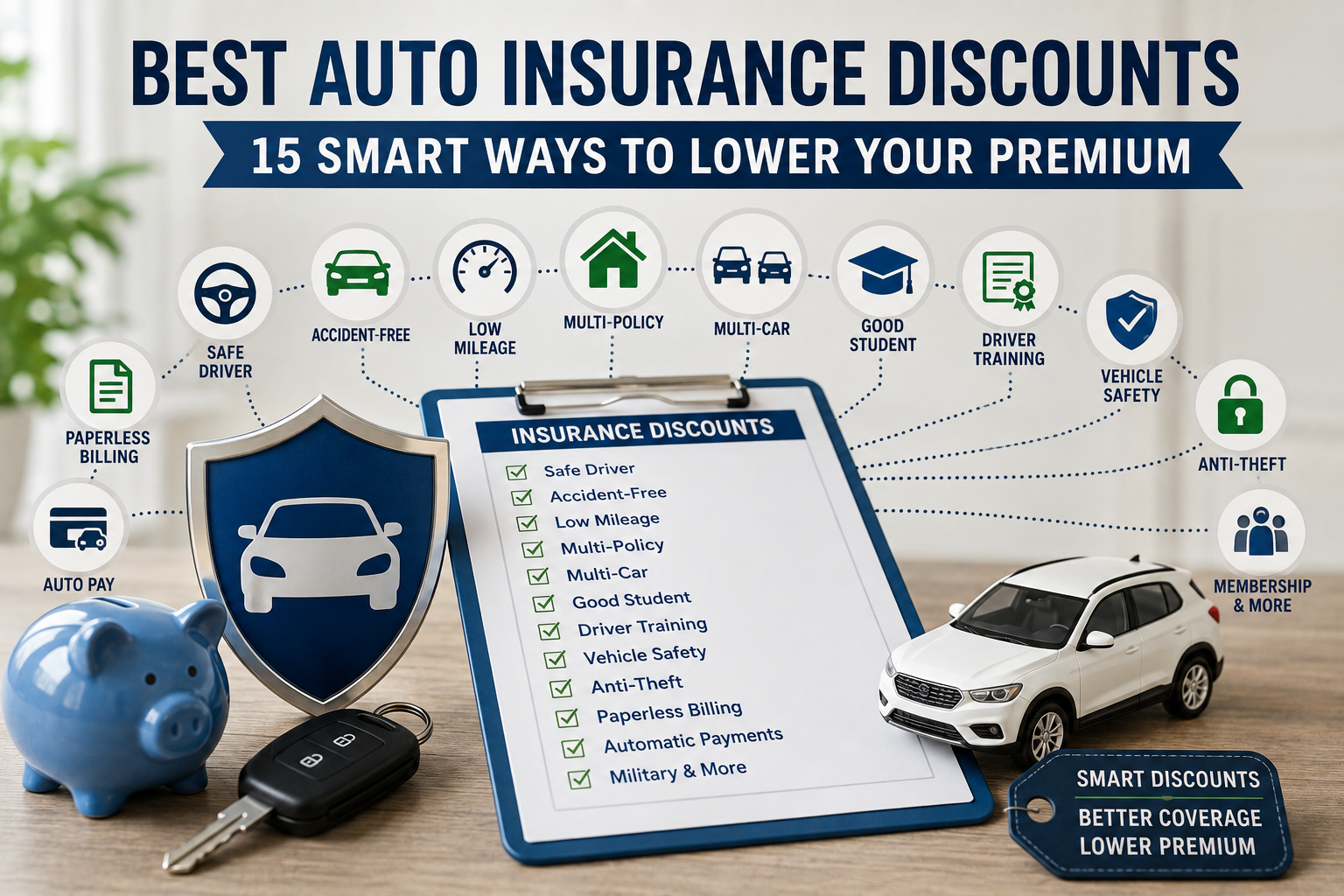
The best auto insurance discounts can reduce the cost of a policy without forcing a driver to weaken important coverage, choose an unaffordable deductible, or accept lower liability limits.
But the biggest advertised discount is not automatically the best deal.
A policy showing five or six discounts can still cost more than another policy showing only two.
That happens because insurers:
- Start with different base rates
- Use different rating methods
- Apply discounts differently
- Offer different coverage limits
- Use different deductibles
- Treat vehicles and drivers differently
- Apply discounts to different parts of the premium
That is why the best auto insurance discounts should always be judged by the final price for equivalent coverage.
A safe-driver discount can be valuable.
A multi-policy discount can be valuable.
A good-student discount can be valuable.
A low-mileage or telematics program can also be useful.
But no discount is worth weakening protection simply to make a quote look cheaper.
This guide explains 15 common auto insurance discount categories, how they may work, which drivers may benefit, what conditions to check, and how to compare discounted quotes properly.
Educational note: PolicyQuotesUS.com provides general U.S. personal auto insurance education only. We are not an insurer, insurance agency, broker, quote marketplace, claims service, or coverage approval service. We do not sell, issue, bind, approve, recommend, underwrite, or administer insurance policies. Auto insurance premiums, discounts, deductibles, limits, eligibility requirements, underwriting rules, exclusions, telematics programs, and coverage options vary by insurer, state, vehicle, driver, household, and policy. Always review insurer documentation and the actual policy before purchasing or changing coverage.
Decision Snapshot: The Discount Value Test
The best discount is not necessarily the largest advertised percentage. Use the Discount Value Test to judge what a discount actually does to the final policy.
| Test | What to check |
|---|---|
| Final-premium test | What is the total premium after all confirmed discounts? |
| Coverage-preservation test | Are limits, deductibles and optional coverages unchanged while comparing the discounted quote? |
| Eligibility test | Do you actually meet the discount conditions, and can the insurer verify them? |
| Durability test | Is the discount ongoing, first-term only, behavior-based, mileage-based or dependent on another policy? |
| Privacy/behavior test | For telematics or app-based programs, what data is collected and what happens if driving results change? |
Decision rule: rank discounts by the amount they reduce the final cost of an equivalent policy—not by the marketing percentage attached to them.
Best Auto Insurance Discounts at a Glance
The best auto insurance discounts to investigate commonly include:
- Safe driver discount
- Accident-free or claims-free discount
- Defensive driving discount
- Usage-based or telematics discount
- Low-mileage discount
- Multi-policy discount
- Multi-car discount
- Good student discount
- Driver training discount
- Distant student discount
- Vehicle safety equipment discount
- Anti-theft discount
- New-vehicle discount
- Payment and account-management discounts
- Employer, military, affinity, or membership discounts
Not every insurer offers every discount.
Not every state allows every discount.
And not every driver will qualify.
The goal is therefore not to collect the largest number of discounts.
The goal is to find the best auto insurance discounts that actually reduce your final premium while preserving the coverage you need.
What “Best Auto Insurance Discounts” Really Means
The phrase best auto insurance discounts can be misleading if it is interpreted only as:
- Biggest advertised percentage
- Longest discount list
- Cheapest opening quote
- Lowest monthly payment
- Highest deductible
- Fewest optional coverages
Those things do not automatically create the best policy.
Suppose one insurer advertises:
25% in available discounts
while another advertises only:
10% in available discounts
The second insurer can still have the lower final premium.
Why?
Because it may begin with a lower base rate.
That is why discount percentages should never be compared in isolation.
Compare the Result, Not the Advertising
A useful discount should reduce the premium without requiring you to make a bad coverage decision.
For example:
Good saving:
A legitimate multi-car discount reduces your premium while keeping the same limits and deductibles.
Not really a discount:
Your quote falls because you reduce your liability limit.
Not really a discount:
Your quote falls because you increase the collision deductible from $500 to $2,000.
Not really a discount:
Your quote falls because you remove collision coverage completely.
Those changes may reduce cost, but they transfer additional financial risk back to you.
The minimum car insurance requirements guide explains why minimum legal coverage should not automatically be treated as the ideal protection level.
How Auto Insurance Discounts Work
Insurers calculate premiums using their own approved rating methods.
Discounts may then be applied according to insurer-specific rules.
A discount might apply to:
- Liability coverage
- Collision coverage
- Comprehensive coverage
- Part of the policy
- Several coverages
- A defined portion of the total premium
That means three advertised discounts do not necessarily equal their percentages added together.
Simple Example
Imagine a policy qualifies for:
- 10% safe-driver discount
- 10% multi-car discount
- 5% paperless discount
You should not automatically assume the premium will fall by 25%.
The discounts may:
- Apply to different coverages
- Be calculated in sequence
- Be capped
- Have state restrictions
- Apply only to eligible portions of the premium
The insurer’s rating system determines the actual reduction.
That is another reason the best auto insurance discounts should be judged using the final verified premium.
1. Safe Driver Discount
A safe-driver discount may be available to drivers with a favorable driving record.
The insurer may review:
- Traffic violations
- At-fault accidents
- Claims
- Licence history
- Other permitted driving information
The exact qualification period varies.
One insurer may review several years of driving history.
Another may use different standards.
Questions to Ask
Ask:
- What driving events are reviewed?
- How far back does the insurer look?
- Does one violation remove the discount?
- Does an accident affect eligibility?
- Is the discount reviewed at renewal?
- Does every household driver need a clean record?
For many experienced drivers, safe-driver programs can be among the best auto insurance discounts to investigate first.
2. Accident-Free or Claims-Free Discount
Accident-free and claims-free are not always identical.
A driver may have:
- No at-fault accidents
- But one comprehensive claim
Another driver may have:
- No insurance claims
- But a traffic violation
Insurers can define the categories differently.
Do Not Avoid a Necessary Claim Just to Protect a Discount
A discount should not automatically discourage you from making a legitimate insurance claim.
If you suffer a significant covered loss, evaluate:
- Repair cost
- Deductible
- Policy terms
- Claim value
- Possible future pricing effect
The best auto insurance discounts should lower unnecessary cost—not pressure you into ignoring protection you already paid for.
3. Defensive Driving Discount
Some insurers may offer a discount after completion of an approved defensive-driving course.
Eligibility can depend on:
- State
- Insurer
- Driver age
- Course provider
- Course type
- Completion date
Check Before Paying for the Course
Do not assume any course qualifies.
Before enrolling, ask:
- Is this course approved?
- Is my driver category eligible?
- What documentation is required?
- How long will the discount last?
- Does the course need to be repeated?
A defensive-driving course can still have educational value even when no discount applies.
But if your main reason for taking it is savings, verify eligibility first.
4. Usage-Based or Telematics Discount
Usage-based insurance can monitor driving through:
- Smartphone application
- Vehicle technology
- Plug-in device
- Other tracking technology
Depending on the program, collected information may involve:
- Mileage
- Braking
- Acceleration
- Time of day
- Speed patterns
- Phone use
- Location
- Trip information
Telematics Can Involve a Trade-Off
The potential attraction is lower pricing for qualifying driving behavior.
The trade-off is data collection.
Before joining, check:
- What information is collected?
- How long is it stored?
- Who can access it?
- What affects the driving score?
- Can the program increase the premium?
- Can you withdraw?
- What happens at renewal?
- Does every household driver need to participate?
For some drivers, telematics can be one of the best auto insurance discounts available.
For others, the monitoring or pricing uncertainty may make it less attractive.
5. Low-Mileage Discount
A low-mileage discount may be relevant for:
- Remote workers
- Retirees
- Occasional drivers
- Households with a second vehicle
- People with short commutes
Eligibility may depend on:
- Annual mileage
- Vehicle use
- Odometer readings
- Telematics data
- Other verification
Accuracy Matters
Do not understate mileage to obtain a lower quote.
Tell the insurer how the vehicle is actually used.
If you previously drove 15,000 miles per year but now work remotely and drive 5,000, update the information.
That may create a legitimate opportunity.
The best auto insurance discounts come from accurate information—not manipulating application details.
6. Multi-Policy Discount
A multi-policy discount may apply when you place more than one type of insurance with the same company.
Examples can include:
- Auto + homeowners
- Auto + renters
- Auto + another eligible policy
This is commonly called bundling.
Bundling Is Not Automatically Cheapest
Suppose:
Insurer A bundled total: $2,700
Separate policies:
Auto with Insurer B = $1,500
Home with Insurer C = $1,050
Separate total = $2,550.
Even if Insurer A advertises a large bundle discount, the separate policies may still cost less overall.
Compare:
total household insurance cost
not just the discount percentage.
The best auto insurance discounts from bundling are the ones that improve the combined result.
7. Multi-Car Discount
A household insuring several vehicles with one insurer may qualify for a multi-car discount.
Eligibility can depend on:
- Ownership
- Household relationship
- Garaging
- Drivers
- Vehicle use
- Policy structure
The Vehicles Still Matter Individually
One household may insure:
- Older commuter car
- New SUV
- Teen driver’s vehicle
Each vehicle can produce very different premiums.
The multi-car discount may help, but:
- Vehicle value
- Driver assignment
- Mileage
- Collision coverage
- Comprehensive coverage
- Deductibles
still affect the total.
Do not assume adding every household vehicle to one insurer automatically produces the best result.
8. Good Student Discount
A good-student discount may be available to qualifying younger drivers who meet insurer requirements.
Possible requirements may include:
- Age range
- Full-time student status
- Academic performance
- School enrollment
- Documentation
Proof may involve:
- Report card
- Transcript
- School documentation
The cheap car insurance for young drivers guide explains why student discounts should be considered alongside vehicle choice, coverage, household arrangements, and quote comparison.
Compare the Whole Household Policy
Adding a young driver can materially change the total premium.
A 10% student discount is useful.
But it does not mean that insurer automatically produces the best household price.
Compare the final cost.
9. Driver Training Discount
Some insurers may offer discounts for approved driver education or training programs.
This can be particularly relevant to newer drivers.
The car insurance for new drivers guide explains the broader new-driver decision.
Before enrolling in training for insurance savings, confirm:
- Approved provider
- Eligible driver
- Required course
- Documentation
- Discount duration
Training can improve knowledge and driving habits even if no discount results.
But do not assume every driving course generates insurance savings.
10. Distant Student Discount
A distant-student discount may apply when a student:
- Is included on a household policy
- Lives away from home
- Attends school
- Does not regularly have access to an insured vehicle
Requirements can vary significantly.
The insurer may consider:
- Distance from home
- Student age
- Enrollment status
- Access to a vehicle
- School location
Describe the Situation Accurately
If the student regularly drives the family vehicle, do not describe them as having no vehicle access simply to obtain a discount.
Eligibility should match the real circumstances.
11. Vehicle Safety Equipment Discount
Some insurers may offer discounts for qualifying safety equipment.
Possible examples may involve certain:
- Restraint systems
- Driver-assistance technology
- Safety systems
- Factory-installed equipment
Not every safety feature earns a discount.
Modern safety technology can also make vehicles more expensive to repair because of:
- Sensors
- Cameras
- Calibration
- Specialized parts
That means a safety discount does not automatically make the vehicle inexpensive to insure.
Verify Using the Correct Vehicle Information
Provide the correct VIN and vehicle specifications.
Ask:
- Which features qualify?
- Is the discount automatic?
- Which coverage receives it?
- Is documentation required?
12. Anti-Theft Discount
Anti-theft equipment may qualify for insurance discounts.
Possible systems can include:
- Alarms
- Immobilizers
- Tracking systems
- Recovery technology
- Other recognized theft-deterrent equipment
An anti-theft discount may primarily affect comprehensive coverage because comprehensive commonly addresses vehicle theft.
Not Every Device Qualifies
Before installing equipment solely for insurance savings, ask:
- Does this device qualify?
- What documentation is needed?
- What part of the premium is affected?
- How much is the actual reduction?
The equipment cost may be greater than the insurance saving.
The broader theft-prevention benefit can still be valuable.
13. New-Vehicle Discount
Some insurers may offer a discount associated with newer vehicles.
Eligibility can depend on:
- Vehicle age
- Model year
- Insurer rules
- State
But newer does not automatically mean cheaper to insure.
A newer vehicle may contain:
- Expensive sensors
- Cameras
- Advanced lighting
- Specialized body panels
- Driver-assistance systems
Repair costs can be high.
The best auto insurance discounts should therefore be judged against the final premium, not a single new-car discount.
14. Payment and Account-Management Discounts
Insurers may offer savings for certain account arrangements.
Possible categories include:
- Automatic payment
- Paperless billing
- Paying the policy term in full
- Early quote
- Electronic documents
- Other account-management options
Check Fees and Cash Flow
Paying in full may reduce installment fees or qualify for a discount.
But that does not mean everyone should use a large amount of cash upfront if doing so would strain the household budget.
Check:
- Full-term premium
- Installment fees
- Automatic-payment conditions
- Refund rules
- Cancellation terms
The best auto insurance discounts should improve total cost without creating avoidable financial stress.
15. Employer, Military, Affinity or Membership Discounts
Some insurers may offer discounts connected with:
- Employer
- Profession
- Alumni group
- Professional association
- Military connection
- Approved membership
- Other affinity arrangement
Eligibility varies.
Include Membership Costs in the Calculation
Suppose joining an organization costs $120 per year and produces an $80 insurance saving.
Joining purely for that insurance discount would not produce a net saving.
Always consider:
discount value − membership cost
And confirm the discount before joining anything solely for insurance purposes.
Can the Best Auto Insurance Discounts Be Stacked?
Sometimes multiple discounts can appear on one policy.
For example, a household might qualify for:
- Multi-car
- Good student
- Paperless billing
- Safe driver
But do not simply add the advertised percentages together.
They may apply:
- In a particular order
- To different coverages
- Subject to caps
- Only to eligible vehicles
- Only to eligible drivers
An insurer with five discounts can still charge more than an insurer offering two.
Again:
final premium wins—not discount count.
Best Auto Insurance Discounts Can Vary by State
Auto insurance is heavily regulated at the state level.
That means discount programs can vary by:
- State
- Insurer
- Rating rules
- Program availability
- Driver eligibility
- Required documentation
Drivers should review auto insurance by state and state car insurance laws when state-specific rules are relevant.
Avoid relying on a static national chart that claims every insurer offers the same discount everywhere.
Direct verification is stronger.
Discounts vs Other Ways to Lower Auto Insurance Costs
Not every premium reduction is technically an insurance discount.
There are four important categories.
1. Actual Discount
Example:
You qualify for an insurer’s multi-car program.
2. Rating Change
Example:
Your annual mileage decreases materially.
3. Coverage Reduction
Example:
You remove collision coverage.
4. Higher Retained Risk
Example:
You increase your deductible.
These are not the same.
Higher Deductible Is Not a Discount
Increasing a deductible can reduce the premium.
But you are agreeing to pay more after a covered loss.
The best deductible for auto insurance guide explains that trade-off.
Removing Coverage Is Not a Discount
Removing comprehensive or collision may reduce cost.
But it also reduces protection.
Likewise, lowering liability limits can reduce premiums while increasing financial exposure.
Do not count weaker coverage as one of the best auto insurance discounts.
How to Compare Discounted Auto Insurance Quotes
This is where many drivers make mistakes.
Before comparing price, match the policy.
Keep these consistent:
- Drivers
- Vehicles
- Garaging address
- Mileage
- Vehicle use
- Liability limits
- Collision selection
- Comprehensive selection
- Collision deductible
- Comprehensive deductible
- UM/UIM limits
- PIP or MedPay
- Rental reimbursement
- Roadside assistance
- Other endorsements
- Policy term
Then ask every insurer about available discounts.
The Right Order
Use this process:
1. Choose the coverage.
2. Match the limits.
3. Match the deductibles.
4. Provide identical driver and vehicle information.
5. Apply legitimate discounts.
6. Compare the final premium.
That produces a real comparison.
The cheap car insurance quotes guide covers the broader price-comparison process.
Best Auto Insurance Discounts and Telematics Privacy
Telematics deserves extra attention because the discount can involve ongoing data collection.
Before joining, ask:
- What is collected?
- Is location tracked?
- Is phone use monitored?
- Is speed monitored?
- Is braking monitored?
- Is acceleration monitored?
- Are nighttime trips treated differently?
- How long is data retained?
- Who receives the data?
- Can pricing increase?
- Can you leave the program?
- What happens after withdrawal?
- What happens at renewal?
For some drivers, telematics may produce meaningful savings.
For others, the privacy or pricing trade-off may not be worthwhile.
A telematics discount is only one of the best auto insurance discounts when you understand and accept the program terms.
Best Auto Insurance Discounts for Young Drivers
Young drivers may investigate:
- Good student
- Driver training
- Distant student
- Multi-car
- Vehicle safety
- Telematics
- Low mileage
But discounts are only one part of the cost.
Also consider:
- Vehicle choice
- Collision deductible
- Comprehensive deductible
- Household policy structure
- Accurate mileage
- Driver experience
- Coverage limits
Do not reduce important coverage just to offset the cost of adding a young driver.
Best Auto Insurance Discounts for New Drivers
New drivers may have less driving and insurance history.
Possible discount areas include:
- Training
- Telematics
- Good student
- Vehicle safety
- Multi-car
- Household policies
But accurate disclosure matters more than chasing every available discount.
Make sure the insurer knows:
- Who drives
- Which vehicle they use
- Where the vehicle is garaged
- How much it is driven
- Whether it is used for work or school
Best Auto Insurance Discounts for Experienced Drivers
Experienced drivers with favorable records may investigate:
- Safe-driver
- Accident-free
- Claims-free
- Defensive-driving
- Low-mileage
Long-term customers should still compare the market periodically.
Loyalty does not automatically guarantee the strongest price.
Best Auto Insurance Discounts for Remote Workers
Remote workers may drive fewer miles than traditional commuters.
That can make:
- Low-mileage programs
- Usage-based programs
worth investigating.
But be accurate.
If work circumstances change and mileage rises again, update the insurer.
Best Auto Insurance Discounts for Multi-Vehicle Households
A multi-vehicle household should investigate:
- Multi-car
- Multi-policy
- Safe-driver
- Student
- Vehicle safety
- Anti-theft
But compare the total household cost.
Different vehicles can have very different:
- Values
- Drivers
- Coverages
- Deductibles
- Mileage
- Uses
The best household arrangement is not automatically the one with the most discounts.
Best Auto Insurance Discounts for Homeowners and Renters
Drivers with homeowners or renters insurance may investigate bundling.
Compare:
Bundled total
against
Best separate-policy total
Keep coverage equivalent.
A bundle is useful when it genuinely reduces the combined household cost.
Best Auto Insurance Discounts for Financed or Leased Cars
Discounts do not cancel lender or leasing requirements.
A finance or lease agreement may require:
- Collision
- Comprehensive
- Certain deductibles
- Specified liability limits
Do not remove required protection to obtain a lower quote.
The correct objective is:
meet the contract + preserve suitable protection + then find discounts
Five Auto Insurance Discount Scenarios
Scenario 1: Remote Worker
A driver previously commuted 50 miles every weekday but now works from home.
Annual mileage drops substantially.
The driver asks insurers about:
- Low-mileage pricing
- Telematics
The best option depends on the final premium, verification requirements, and privacy preferences.
Scenario 2: Family Adds a Student
A household adds a teenage driver.
They investigate:
- Good student
- Driver training
- Multi-car
- Vehicle safety
- Distant student eligibility
One insurer advertises more discounts.
Another insurer still produces the lower final premium.
The family chooses based on equivalent coverage and final cost.
Scenario 3: Three-Car Household
A household owns three vehicles.
The insurer offers multi-car savings.
But one vehicle is driven by a new driver and another has comprehensive and collision with low deductibles.
The household compares the entire policy rather than assuming the multi-car discount guarantees the cheapest outcome.
Scenario 4: Home and Auto Bundle
A driver receives a large advertised bundle discount.
After comparing equivalent coverage, another combination of separate auto and homeowners policies produces a lower combined cost.
The larger advertised discount did not produce the best result.
Scenario 5: Telematics Program
A driver is offered a telematics discount.
Before enrolling, the driver asks:
- What data is collected?
- Can the premium increase?
- Does phone use matter?
- Is location recorded?
- Can participation be ended?
The driver makes the decision after understanding both savings and privacy conditions.
Common Auto Insurance Discount Mistakes
Mistake 1: Comparing Discount Percentages
Compare final premiums.
Mistake 2: Assuming More Discounts Means Cheaper Insurance
It does not.
Mistake 3: Adding Percentages Together
Discount calculations may not work that way.
Mistake 4: Changing Mileage Inaccurately
Provide truthful information.
Mistake 5: Failing to Disclose Drivers
List household and regular drivers accurately.
Mistake 6: Misrepresenting Vehicle Use
Disclose commuting, delivery, rideshare, or business use accurately.
Mistake 7: Taking a Course Before Checking Eligibility
Verify the discount first.
Mistake 8: Joining Telematics Without Reading the Terms
Understand the data and pricing rules.
Mistake 9: Increasing the Deductible Just for a Cheaper Quote
Make sure you could pay it after a claim.
Mistake 10: Reducing Liability Limits
That is weaker protection, not a true discount.
Mistake 11: Removing Collision or Comprehensive
That transfers risk back to you.
Mistake 12: Assuming Bundling Is Always Cheaper
Compare the combined total.
Mistake 13: Ignoring Payment Fees
Installment charges can change the real cost.
Mistake 14: Forgetting to Recheck Discounts
Eligibility can change.
Mistake 15: Staying With One Insurer Forever Without Comparing
A long relationship does not guarantee the best price.
Complete Best Auto Insurance Discounts Audit
At renewal, review:
Driver Information
- Driving records
- Claims
- Household drivers
- Student status
- Training
- Defensive-driving courses
Vehicle Information
- Mileage
- Vehicle use
- Safety equipment
- Anti-theft equipment
- VIN accuracy
- Garaging
Household Information
- Multiple vehicles
- Homeowners policy
- Renters policy
- Eligible memberships
- Employer programs
- Military eligibility
Payment Information
- Automatic payments
- Paperless documents
- Pay-in-full
- Installment fees
Telematics
- Current participation
- Driving score
- Data rules
- Renewal effect
Coverage
- Liability limits
- Collision
- Comprehensive
- Deductibles
- UM/UIM
- Medical coverage
- Optional endorsements
Final Price
After reviewing everything, ask:
What is the final premium for the protection I actually want?
That is how you identify the best auto insurance discounts.
Information to Prepare Before Requesting Quotes
Gather:
- Driver licence information
- Vehicle identification numbers
- Garaging address
- Current mileage
- Estimated annual mileage
- Vehicle use
- Household-driver information
- Current declarations page
- Prior insurance information
- Driving history
- Claims information
- Student records
- Training certificates
- Safety equipment information
- Anti-theft information
- Other insurance policies
- Employer or membership information
- Desired limits
- Desired deductibles
- Lender information
- Lease information
Complete information makes quote comparisons more reliable.
If you use instant auto insurance quotes, remember that an instant result may still change after verification.
Questions to Ask About the Best Auto Insurance Discounts
Ask each insurer:
- Which discounts are currently applied?
- Which additional discounts might I qualify for?
- What proof is required?
- Which coverage does each discount affect?
- Can discounts be combined?
- Is there a maximum total discount?
- Does eligibility need to be verified at renewal?
- Which driving events can remove a discount?
- How does telematics affect future pricing?
- What telematics data is collected?
- Are there low-mileage options?
- Are student discounts available?
- Are approved training discounts available?
- Does my vehicle qualify for safety discounts?
- Does my vehicle qualify for anti-theft discounts?
- Would bundling reduce my combined household cost?
- Are installment fees included?
- Is paying in full cheaper?
- Are all drivers and vehicles correctly listed?
- Is the final quote based on equivalent coverage?
Those questions turn discount advertising into information you can actually use.
Final Takeaway
The best auto insurance discounts are not simply the biggest percentages advertised by insurers.
They are the legitimate savings you qualify for that reduce the final premium without weakening the protection you intentionally selected.
Start by checking:
safe driver → claims history → mileage → telematics → multi-policy → multi-car → student → training → vehicle equipment → payment options → membership eligibility
Then compare equivalent policies.
Remember:
more discounts does not automatically mean lower insurance
and
a lower premium does not automatically mean a better policy.
Do not confuse:
- Higher deductibles with discounts
- Lower liability limits with discounts
- Removed collision coverage with discounts
- Removed comprehensive coverage with discounts
Those changes can reduce price by transferring more financial risk back to you.
The strongest process is:
choose the protection → match the quotes → find every legitimate discount → compare the final premium
That is how to find the best auto insurance discounts without sacrificing the coverage that matters.
Questions and Answers About the Best Auto Insurance Discounts
What Are the Best Auto Insurance Discounts to Ask About?
Common categories include safe-driver, accident-free, claims-free, low-mileage, telematics, multi-policy, multi-car, good-student, driver-training, vehicle-safety, anti-theft, payment, and membership discounts.
Do More Auto Insurance Discounts Always Mean a Lower Premium?
No. Insurers start with different base rates and apply discounts differently. A policy with fewer discounts can still produce the lower final premium.
Can Auto Insurance Discounts Be Stacked?
Several discounts may appear together, but they may apply to different coverage components or be limited by insurer rules. Do not simply add advertised percentages.
Do Discounts Apply to the Entire Premium?
Not necessarily. Some discounts may apply only to certain coverage components.
Can a Telematics Program Increase My Premium?
Depending on the insurer, program, state rules, and driving data, participation may affect pricing differently. Review the program terms before enrolling.
Are Good-Student Discounts Available Everywhere?
No. Eligibility, grades, age requirements, enrollment rules, documentation, insurer availability, and state rules vary.
Does Defensive Driving Guarantee a Discount?
No. The course may need to be approved and additional eligibility requirements may apply.
Is Raising My Deductible an Auto Insurance Discount?
No. Raising the deductible can lower the premium because you agree to retain more financial risk after a covered loss.
Is Dropping Collision Coverage a Discount?
No. Removing coverage can lower the premium, but it also removes protection.
Can Auto Insurance Discounts Change at Renewal?
Yes. Changes involving driving history, mileage, student status, payment method, vehicle, household drivers, program rules, or documentation can affect eligibility.
Are Bundled Auto and Home Policies Always Cheaper?
No. Compare the combined cost of bundled policies against equivalent separate policies.
Are Low-Mileage Discounts Good for Remote Workers?
They may be. Eligibility and savings vary, so report mileage accurately and compare the final premium.
Are There Auto Insurance Discounts for Young Drivers?
Possible categories include good-student, training, distant-student, telematics, multi-car, and vehicle-safety programs.
Are There Discounts for Anti-Theft Devices?
Some insurers may offer them for eligible equipment, but qualifying devices and savings vary.
What Is the Best Way to Compare Discounted Policies?
Use the same drivers, vehicles, mileage, vehicle use, liability limits, deductibles, physical-damage coverage, optional protection, and policy term. Then compare the final premium.
Helpful Official Resources
- National Association of Insurance Commissioners — Consumer Resources
- National Association of Insurance Commissioners — State Insurance Departments
- Federal Trade Commission — Consumer Advice
Author Bio
PolicyQuotesUS.com Editorial Team
The PolicyQuotesUS.com Editorial Team creates clear, neutral educational content for U.S. consumers researching the best auto insurance discounts, auto insurance premiums, safe-driver programs, telematics, student discounts, multi-car discounts, bundling, deductibles, coverage limits, and related insurance decisions.
Copyright Notice
© 2026 – PolicyQuotesUS.com. All rights reserved.
This article about the best auto insurance discounts is protected by copyright and may not be copied, scraped, spun, republished, reproduced, distributed, or used commercially without prior written permission from PolicyQuotesUS.com. Brief quotations may be used with clear attribution and a link to the original article.
PolicyQuotesUS.com publishes original educational information about U.S. personal auto insurance, car insurance discounts, premiums, liability coverage, collision coverage, comprehensive coverage, uninsured motorist coverage, deductibles, policy limits, claims, and related consumer insurance topics.
Unauthorized reuse, including AI rewriting, automated extraction, content spinning, bulk scraping, database collection, or republication on another website, is prohibited.
Disclaimer
This best auto insurance discounts article provides general educational information intended for people living in the United States.
It is not personalized insurance, financial, legal, tax, claims, underwriting, data-privacy, or accounting advice.
Discount categories, qualification standards, documentation requirements, telematics programs, premiums, coverage limits, deductibles, exclusions, endorsements, policy terms, and insurer practices vary by state, insurer, driver, vehicle, household, policy, driving history, claims history, vehicle use, mileage, payment arrangement, and circumstances.
PolicyQuotesUS.com does not sell insurance, issue policies, bind coverage, determine eligibility, guarantee discounts, guarantee premiums, guarantee savings, approve claims, or guarantee continuation of any insurance program.
Review the insurance application, declarations page, coverage forms, endorsements, exclusions, discount conditions, telematics terms, payment terms, and policy documents before buying, renewing, canceling, or changing coverage.
When necessary, confirm insurer-specific questions with the insurer, licensed insurance professional, or appropriate state insurance regulator.