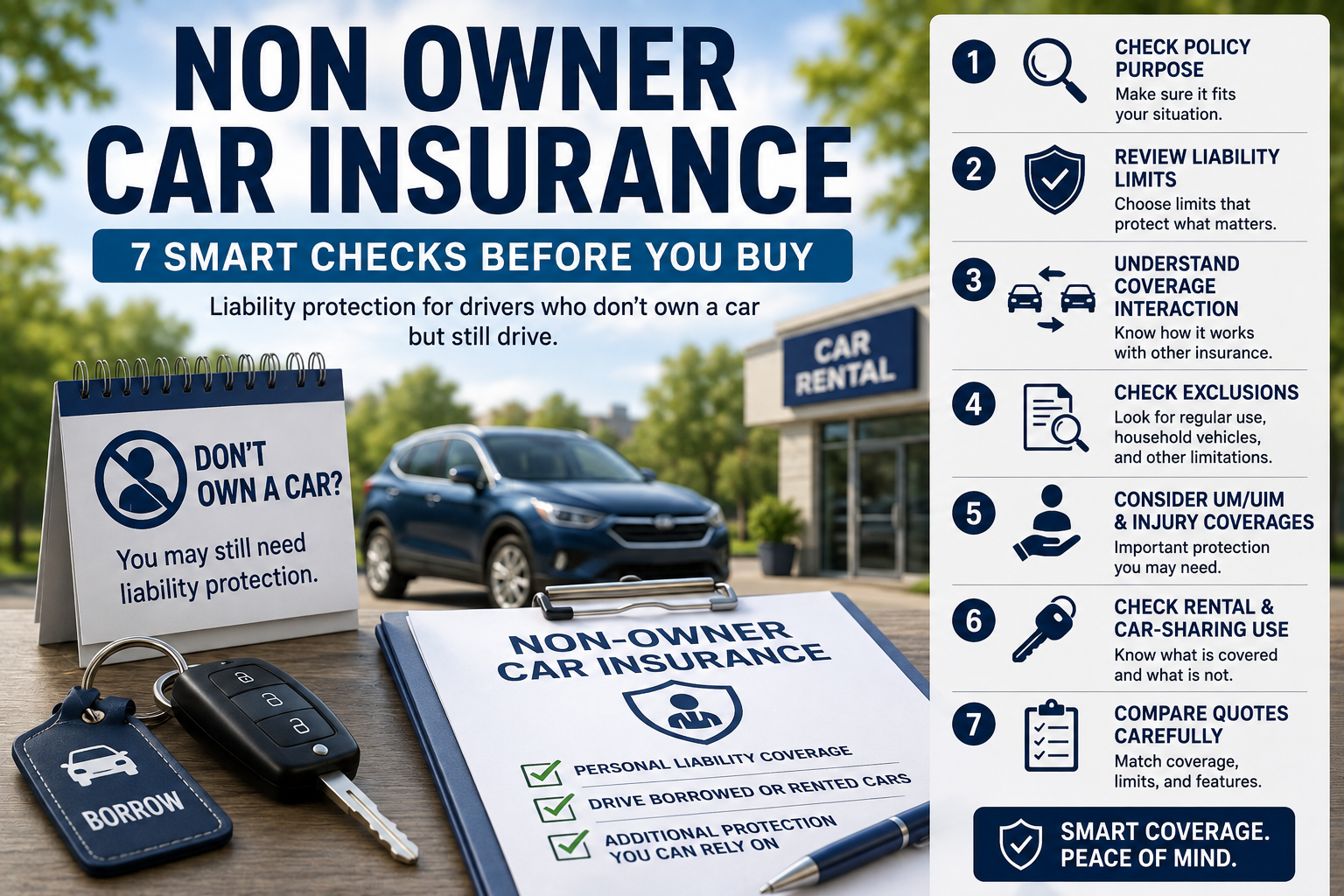
Non Owner Car Insurance can provide personal auto liability protection for certain licensed drivers who do not own a vehicle but still borrow, rent, or occasionally drive cars belonging to other people.
Unlike a standard personal auto policy, a non-owner policy generally follows the named driver rather than a personally owned vehicle.
That makes it potentially useful for someone who:
- Does not own a car
- Occasionally borrows vehicles
- Rents vehicles during the year
- Uses certain car-sharing services
- Wants to maintain an insurance history between vehicles
- Needs a qualifying financial-responsibility filing without owning a vehicle
But Non Owner Car Insurance has important limitations.
It generally should not be treated as a substitute for insuring a vehicle you own, regularly drive, or have routine access to.
It also commonly focuses on liability rather than collision or comprehensive protection for the borrowed vehicle itself.
The key is determining whether the policy actually matches how you drive.
This guide explains seven practical checks to make before buying Non Owner Car Insurance, including who may need it, what it may cover, what it normally does not cover, how borrowed-car insurance can interact with the vehicle owner’s policy, and when a standard auto policy may be more appropriate.
Educational note: PolicyQuotesUS.com provides general U.S. personal auto insurance education only. We are not an insurer, insurance agency, broker, quote marketplace, claims service, financial adviser, or coverage approval service. We do not sell, issue, bind, approve, underwrite, recommend, or adjust insurance policies. Non-owner insurance availability, eligibility, coverage, premiums, limits, exclusions, required filings, and policy terms vary by insurer, state, driver, vehicle use, household, and circumstances. Review the application, declarations page, coverage forms, endorsements, exclusions, and applicable state requirements before relying on coverage.
Decision Snapshot: The Non-Owner Eligibility Test
Non-owner insurance is a narrow product for people who drive but do not own the vehicle they are trying to insure. Use this Non-Owner Eligibility Test before assuming the policy fits your situation.
- Do you own a vehicle? If yes, a standard owner policy may be the relevant starting point instead.
- Do you have regular access to one household or employer vehicle? Regular-use situations may not fit a basic non-owner policy.
- Are you mainly borrowing or renting vehicles occasionally? That is closer to the typical non-owner use case, subject to insurer rules.
- Do you need an SR-22 or similar filing without owning a car? A non-owner filing policy may be relevant where available, but state and insurer rules must be confirmed.
- Do you need protection for damage to the borrowed or rented vehicle itself? Non-owner liability coverage usually does not solve every physical-damage question.
Decision rule: non-owner insurance fits the driver, not a personally owned vehicle. Regular access, household vehicles and rental-car damage can change the answer substantially.
What Non Owner Car Insurance Actually Is
A standard personal auto insurance policy normally insures one or more specified vehicles.
Non Owner Car Insurance works differently.
The policy is generally written for a licensed driver who does not own a vehicle.
Its main purpose is usually to provide certain liability protection when that person drives an eligible vehicle they do not own.
For example, the driver might:
- Borrow a friend’s vehicle occasionally
- Rent a vehicle
- Use an eligible car-sharing vehicle
- Drive different vehicles infrequently
The exact protection depends on the policy.
Non Owner Car Insurance should therefore be understood as a specialized driver-focused policy, not a miniature version of every protection available on a standard vehicle policy.
What Non Owner Car Insurance May Cover
The central protection is normally liability.
Liability coverage can include:
Bodily Injury Liability
This can address covered injuries the insured driver causes to other people in an accident, subject to the policy terms and limits.
Property Damage Liability
This can address covered damage the insured driver causes to another person’s property.
The broader guide on what does liability car insurance cover explains these protections in more detail.
Depending on the state, insurer, and policy, Non Owner Car Insurance may also offer or include coverage such as:
- Uninsured motorist coverage
- Underinsured motorist coverage
- Medical payments coverage
- Personal injury protection
- Other state-required or optional injury-related protection
Do not assume every non-owner policy automatically includes all of these.
Check the declarations page and actual policy.
What Non Owner Car Insurance Usually Does Not Do
The largest limitation involves the vehicle itself.
Non Owner Car Insurance generally does not provide the same collision and comprehensive protection that would normally be purchased on a vehicle you own.
That distinction matters.
Suppose you borrow a friend’s vehicle and damage it in an accident.
Your non-owner liability policy should not automatically be assumed to pay for physical damage to that borrowed vehicle.
Possible protection may instead depend on:
- The vehicle owner’s insurance
- Collision or comprehensive coverage on that vehicle
- The circumstances of the accident
- Permission to use the vehicle
- Policy exclusions
- A rental agreement
- A rental damage waiver
- A car-sharing agreement
- Another applicable insurance arrangement
The comprehensive vs collision insurance guide explains how physical-damage coverage normally works on insured vehicles.
The simple distinction is:
Non-owner policy → primarily protects the named driver’s liability exposure
Vehicle policy → can include protection attached directly to the insured vehicle
1. Make Sure You Really Qualify as a Non-Owner Driver
The first question is not price.
It is:
Does a non-owner policy fit my actual situation?
This type of insurance is designed for people who genuinely do not own a vehicle.
It may be worth investigating when you:
- Hold a driver’s license
- Do not own a car
- Occasionally drive vehicles belonging to other people
- Rent cars periodically
- Need continuing liability insurance for another legitimate reason
But several situations can make a non-owner policy a poor fit.
You Own a Vehicle
If a vehicle is titled or registered in your name, you generally need to discuss appropriate vehicle insurance rather than trying to rely on Non Owner Car Insurance.
You Regularly Drive One Particular Vehicle
A car you drive every day or several times each week is different from a vehicle you borrow occasionally.
Regular access may need to be disclosed to the insurer.
You Regularly Drive a Household Vehicle
Suppose you live with a spouse, partner, parent, sibling, or roommate who owns a vehicle.
If you regularly drive that vehicle, the insurer may require or expect you to be addressed under that vehicle’s policy.
Do not assume buying a separate non-owner policy solves the issue.
Household-driver rules vary.
Accurately disclose the arrangement and ask the insurer how the driver should be insured.
2. Understand How Coverage May Interact With the Vehicle Owner’s Insurance
This is one of the most important Non Owner Car Insurance questions.
When you borrow another person’s vehicle with permission, more than one insurance policy may potentially be relevant.
The vehicle owner’s policy may respond first in some circumstances.
A non-owner policy may then provide additional liability protection when its own terms apply.
But this should never be reduced to a universal rule that applies to every accident.
Coverage can depend on:
- Vehicle ownership
- Permission
- Driver status
- Household relationship
- Vehicle availability
- Policy definitions
- Exclusions
- Liability limits
- State law
- The facts of the accident
Example
Jordan does not own a vehicle.
Jordan occasionally borrows a friend’s car.
The friend has an active personal auto policy.
Jordan also has Non Owner Car Insurance.
After a covered accident, the friend’s policy may be relevant because it insures the vehicle.
Jordan’s non-owner coverage may also be relevant depending on the loss and both policies.
But the correct result cannot be determined simply from the fact that Jordan owns a non-owner policy.
The actual policy language and accident facts matter.
Ask This Before Buying
Ask the insurer:
When I drive a borrowed vehicle, how does this policy interact with insurance carried by the vehicle owner?
That is much more useful than assuming “my non-owner policy covers everything.”
3. Compare Liability Limits Carefully
State-required liability limits are only the legal starting point.
The minimum car insurance requirements guide explains why minimum insurance differs across the United States.
Non-owner drivers should consider available liability limits just as vehicle owners do.
Liability claims after a serious accident can involve:
- Medical treatment
- Lost income
- Injury claims
- Damage to multiple vehicles
- Damage to buildings or other property
- Legal costs
Once a policy limit is exhausted, additional financial exposure may remain.
That does not mean every driver needs the highest available limit.
It means the decision should not be made solely by choosing the lowest premium.
Compare Like With Like
If you obtain several Non Owner Car Insurance quotes, request the same liability limits from each insurer.
For example:
Quote A: lower liability limits
Quote B: higher liability limits
You cannot conclude that Quote A is simply the better bargain.
The policies are different.
First match the limits.
Then compare the premiums.
4. Find Every Important Exclusion
A short exclusion can matter more than a long list of benefits.
Before buying Non Owner Car Insurance, ask specifically how the policy treats:
- Vehicles you own
- Vehicles available for regular use
- Household vehicles
- Business use
- Delivery work
- Rideshare driving
- Employer-provided vehicles
- Rental vehicles
- Car-sharing vehicles
- Vehicles outside the permitted territory
- Certain vehicle types
Do not rely solely on a summary page.
Read the policy’s:
- Definitions
- Insuring agreements
- Exclusions
- Conditions
- Endorsements
Regular Use Is Particularly Important
There is a major difference between:
borrowing different cars occasionally
and
using the same car nearly every day
Suppose Taylor lives with a sibling and drives the sibling’s car Monday through Friday.
That is not an obvious example of occasional borrowing.
The arrangement needs to be disclosed.
Trying to fit frequent use into a policy intended for occasional non-owner driving can create a serious mismatch.
5. Check Uninsured Motorist and Injury-Related Protection
Non Owner Car Insurance may involve more than liability.
Depending on state law and the policy, additional protection may include:
- Uninsured motorist coverage
- Underinsured motorist coverage
- Personal injury protection
- Medical payments coverage
The uninsured motorist coverage guide explains the problem of being involved in a covered loss with a driver who has no usable liability insurance.
The underinsured motorist coverage guide addresses situations where the at-fault driver’s liability limits may not be sufficient for the covered loss.
These coverages are state-sensitive.
They may be:
- Required
- Optional
- Required to be offered
- Rejectable
- Subject to particular forms
- Available with different limits
Our state car insurance laws guide explains why these questions need to be checked against the applicable state requirements.
Do Not Assume
When comparing policies, ask:
Is UM included?
Is UIM included?
Is PIP or MedPay included or available?
Can any of these be rejected?
What limits apply?
That gives you a much clearer picture of the policy.
6. Separate Liability Coverage From Rental-Car Damage
Frequent renters are one group that may investigate Non Owner Car Insurance.
But a non-owner policy and rental-car damage protection are not the same thing.
A non-owner policy may provide liability-related protection for eligible rental use.
It should not automatically be assumed to pay for damage to the rented vehicle.
Rental agreements can involve separate issues such as:
- Collision damage
- Theft
- Loss of use
- Administrative charges
- Diminished value
- Towing
- Other contractual responsibilities
Coverage for those items can potentially come from different sources depending on the situation, including:
- Rental-company products
- A credit-card benefit
- Another insurance policy
- Separate contractual protection
Read Both Contracts
If you rent a car, review:
1. Your Non Owner Car Insurance policy
and
2. The rental agreement
Do not assume one document automatically satisfies everything required by the other.
Non-Owner Insurance Is Not “Rental Car Insurance”
They solve different problems.
Non Owner Car Insurance: an ongoing personal auto liability policy for an eligible named driver without a personally owned vehicle.
Rental-company coverage or waiver: protection or contractual arrangements associated with a particular rental.
The distinction matters.
7. Compare Non Owner Car Insurance Quotes on Equal Terms
Once you know the coverage fits your situation, compare quotes carefully.
For a fair non-owner car insurance comparison, use the same liability limits, optional coverages, driver information, and effective date across each quote.
Use the same:
- Name and address
- Driver information
- Driving history
- Expected vehicle use
- Liability limits
- Optional coverage
- Required financial-responsibility filing
- Desired effective date
for every insurer.
The instant auto insurance quotes guide explains why a fast estimate still requires verification.
Compare More Than Premium
For each Non Owner Car Insurance quote, check:
- Liability limits
- UM/UIM coverage
- PIP or MedPay where applicable
- Policy exclusions
- Regular-use restrictions
- Household-vehicle provisions
- Rental treatment
- Car-sharing treatment
- Business-use restrictions
- Required filing
- Total premium
- Payment fees
- Effective date
- Cancellation terms
The lowest quote can be poor value if it does not match the intended driving situation.
Who Might Benefit From Non Owner Car Insurance?
Here are several common situations worth discussing with an insurer.
Occasional Borrowers
A licensed driver does not own a vehicle but occasionally borrows a friend’s car.
A non-owner policy can be worth reviewing for personal liability protection.
Frequent Renters
Someone who rents cars repeatedly throughout the year may want an ongoing personal liability policy rather than evaluating liability protection from scratch on every trip.
Damage to the rental vehicle remains a separate issue that must be checked.
Drivers Between Cars
Someone sells a vehicle and expects to remain without one for several months.
Non Owner Car Insurance may provide a way to maintain insurance during that period while continuing to drive eligible borrowed or rented vehicles.
Do not assume maintaining continuous insurance guarantees a particular future premium.
Drivers Requiring an SR-22 or Other Filing
Some drivers may need proof of financial responsibility even though they do not own a vehicle.
Depending on the jurisdiction, circumstances, and insurer, a non-owner arrangement may sometimes be used with a required filing.
This is highly state-specific.
Confirm the actual requirement with:
- The insurer
- State insurance regulator
- Motor vehicle agency
Do not assume a generic non-owner policy automatically satisfies every filing requirement.
When Non Owner Car Insurance Is Probably the Wrong Tool
This policy is specialized.
It should not be stretched to cover situations it was not designed for.
You Own the Car
A personally owned vehicle normally needs appropriate vehicle insurance.
You Drive a Household Car Regularly
Tell the vehicle’s insurer.
You may need to be listed or otherwise addressed on that policy.
You Need Collision and Comprehensive for a Car
A non-owner liability policy generally is not the right mechanism for insuring physical damage to a personally owned vehicle.
You Use a Vehicle for Rideshare or Delivery Work
Personal non-owner coverage should not automatically be assumed to cover compensated driving.
Current NAIC guidance warns that personal auto policies frequently do not cover commercial rideshare activity in the same way as ordinary personal use.
Specialized or supplemental coverage may be needed.
Your Employer Gives You a Vehicle
Business and employer vehicle arrangements can involve commercial policies, employer insurance, and separate coverage rules.
If the vehicle use is commercial, compare the situation with guides such as GEICO commercial auto insurance and GEICO commercial vehicle insurance rather than assuming a non-owner policy is enough.
Do not assume a personal non-owner policy fills every gap.
Non Owner Car Insurance and Household Drivers
Household access deserves special attention because it is easy to misunderstand.
Imagine Chris does not own a car.
Chris lives with a partner who owns a sedan.
Chris drives the sedan once every few months.
That situation may be treated differently from Chris driving it to work every weekday.
Frequency and regular access matter.
The insurer may ask:
- Who lives in the household?
- Who is licensed?
- Who regularly drives the vehicle?
- How often does each person drive?
- Is the vehicle regularly available to the applicant?
Answer accurately.
Do not buy Non Owner Car Insurance specifically to avoid disclosing a regular household driver to the vehicle’s insurer.
Non Owner Car Insurance and Rideshare or Delivery Work
A non-owner policy is generally a personal auto insurance product.
Rideshare and delivery activity can create different insurance risks.
Do not assume an ordinary personal non-owner policy covers:
- Transporting passengers for payment
- Food delivery
- Package delivery
- Courier activity
- Other commercial driving
If you intend to use borrowed or rented vehicles for compensated driving, disclose that activity before purchasing coverage.
The insurer can explain whether:
- The activity is excluded
- An endorsement exists
- Another policy is required
- Coverage changes depending on when an app is active
Trying to hide commercial use to obtain a cheaper policy is not a smart shortcut.
Non Owner Car Insurance and Car Sharing
Car-sharing services can look similar to traditional rental cars, but the contractual arrangement can differ.
Before using Non Owner Car Insurance with a car-sharing service, check both:
Your personal policy
and
The car-sharing agreement
Questions can include:
- Is car-sharing use eligible?
- What liability protection does the platform provide?
- Is physical damage included?
- What deductible applies?
- Are fees or exclusions involved?
- Does your non-owner policy provide additional coverage?
Do not assume all car-sharing arrangements are treated identically.
What Happens When You Eventually Buy a Car?
A non-owner policy is intended for a driver who does not own a vehicle.
If you buy a car, contact the insurer before or at the time ownership changes.
Do not simply continue relying on the old policy.
You may need a standard personal auto policy listing:
- The vehicle
- VIN
- Garaging address
- Driver information
- Liability limits
- Collision
- Comprehensive
- Other selected coverage
The transition should be planned so you do not accidentally create an insurance gap.
If the vehicle purchase requires coverage to start immediately, the same day car insurance guide explains the separate issue of confirming the exact effective date and time.
Three Simple Non Owner Car Insurance Scenarios
Scenario 1: The Occasional Borrower
Jordan owns no vehicle.
Once or twice each month, Jordan borrows a friend’s car with permission.
Jordan wants personal liability protection beyond simply assuming the friend’s policy will solve every potential problem.
Non Owner Car Insurance may be worth investigating.
Jordan should still confirm:
- Eligible vehicles
- Policy limits
- How the owner’s insurance interacts
- Regular-use restrictions
- Physical-damage limitations
Scenario 2: The Frequent Renter
Casey does not own a car but rents vehicles several times each year.
Non Owner Car Insurance may help with personal liability for eligible rental use.
But Casey should separately investigate:
- Rental vehicle damage
- Theft
- Loss of use
- Rental agreement obligations
- Any credit-card protections
The non-owner policy is only one part of the decision.
Scenario 3: The Household Vehicle
Taylor owns no car but lives with a sibling.
Taylor drives the sibling’s car to work four days each week.
That is regular access.
Instead of assuming a non-owner policy solves the issue, Taylor should disclose the arrangement to the insurer covering the sibling’s car and ask how Taylor needs to be handled under that policy.
Common Non Owner Car Insurance Mistakes
Assuming It Covers Every Vehicle
It does not automatically cover every vehicle or driving situation.
Assuming It Pays for Damage to the Borrowed Car
Liability protection and physical-damage protection are different.
Using It Instead of Insuring a Car You Own
A non-owner policy is not a substitute for properly insuring a personally owned vehicle.
Hiding Regular Vehicle Access
Tell the insurer about household vehicles and regular driving.
Assuming the Vehicle Owner’s Insurance Never Matters
The owner’s policy may be highly relevant after an accident.
Assuming the Non-Owner Policy Is Always Primary
Policy priority can depend on the policies, state rules, and circumstances.
Ignoring Exclusions
Read them.
Assuming Rental Coverage Is Complete
Rental vehicle damage and contractual fees may require separate protection.
Using It for Undisclosed Commercial Driving
Rideshare, delivery, and business use may require different insurance.
Canceling Existing Coverage Before the New Policy Starts
Confirm the effective date first.
Non Owner Car Insurance Buying Checklist
Before purchasing, confirm:
| Question | Checked? |
|---|---|
| I do not own a vehicle | Yes / No |
| Household vehicle access disclosed | Yes / No |
| Regular vehicle use disclosed | Yes / No |
| Liability limits reviewed | Yes / No |
| UM/UIM reviewed | Yes / No |
| PIP/MedPay reviewed where relevant | Yes / No |
| Rental use checked | Yes / No |
| Car-sharing use checked | Yes / No |
| Rideshare/delivery restrictions checked | Yes / No |
| Vehicle-damage limitation understood | Yes / No |
| Financial-responsibility filing confirmed if required | Yes / No |
| Important exclusions reviewed | Yes / No |
| Effective date confirmed | Yes / No |
| Total premium understood | Yes / No |
| Policy documents saved | Yes / No |
If several answers remain unclear, resolve them before relying on the policy.
Documents to Keep
After buying Non Owner Car Insurance, save:
- Application
- Quote
- Declarations page
- Insurance identification information
- Policy forms
- Endorsements
- Exclusions
- Coverage selection or rejection forms
- Payment schedule
- Financial-responsibility filing information where applicable
- Relevant correspondence
Do not rely solely on a quote screen or payment receipt.
The issued policy documents matter.
Questions to Ask Before Buying
Ask the insurer or licensed representative:
- Am I eligible for this policy if I do not own a vehicle?
- How does the policy treat household vehicles?
- What counts as regular vehicle access?
- What liability limits are available?
- Does the policy include UM or UIM?
- Is PIP or MedPay included or available?
- How does coverage interact with the vehicle owner’s insurance?
- Are rental cars eligible?
- Are car-sharing vehicles eligible?
- Does the policy cover physical damage to the vehicle I drive?
- Is delivery or rideshare use excluded?
- How are employer vehicles treated?
- Can the policy support my required state filing if applicable?
- When does coverage become effective?
- What happens if I later buy a car?
Those questions expose the important differences between policies quickly.
Final Takeaway
Non Owner Car Insurance can be valuable for the right driver.
Its clearest use is for someone who:
does not own a vehicle + still drives eligible vehicles + wants personal auto liability protection
It may be useful for:
- Occasional borrowers
- Frequent renters
- Some car-sharing users
- Drivers temporarily between cars
- Certain drivers needing a financial-responsibility filing
But it is not a universal substitute for standard car insurance.
Be especially careful if:
- You own a vehicle
- You regularly drive one specific car
- You regularly use a household vehicle
- You need collision or comprehensive protection
- You drive for rideshare, delivery, or business purposes
The strongest approach is simple:
confirm eligibility → disclose actual vehicle access → compare liability limits → check exclusions → understand physical-damage limitations → review optional coverage → verify the final policy
Buy the policy that matches your real driving situation rather than trying to make your driving situation fit the cheapest policy.
Questions and Answers About Non Owner Car Insurance
What Is Non Owner Car Insurance?
Non Owner Car Insurance is a personal auto policy designed for certain licensed drivers who do not own a vehicle. It generally focuses on liability protection when the named insured drives an eligible vehicle they do not own.
Does Non Owner Car Insurance Cover a Rental Car?
It may provide liability-related protection for eligible rental use, subject to the policy. It should not automatically be assumed to cover physical damage to the rental vehicle or every contractual charge imposed by the rental company.
Does Non Owner Car Insurance Cover Borrowed Cars?
It may apply when the insured drives certain borrowed vehicles with permission, but policy definitions, exclusions, regular-use restrictions, other insurance, and the circumstances of the loss matter.
Does It Cover Damage to the Car I Am Driving?
Generally, a non-owner liability policy should not be assumed to provide collision or comprehensive coverage for the borrowed vehicle. Check the vehicle owner’s insurance and any other applicable coverage.
Can I Get Non Owner Car Insurance if I Live With Someone Who Owns a Car?
Possibly, but household vehicle access can affect eligibility and coverage. Tell the insurer who lives in the household, which vehicles are available, and how often you drive them.
Can Non Owner Car Insurance Help Maintain Continuous Insurance?
It may help some drivers maintain an insurance history while they do not own a vehicle. Do not treat that as a guarantee of lower future premiums or eligibility.
Can I Get an SR-22 With Non Owner Car Insurance?
In some situations and jurisdictions, an insurer may be able to provide a required financial-responsibility filing with a qualifying non-owner policy. Requirements vary, so confirm the exact state requirement and insurer capability.
Is Non Owner Car Insurance the Same as Rental Car Insurance?
No. A non-owner policy is an ongoing personal policy for an eligible driver without a personally owned vehicle. Rental-company products and waivers are separate contractual arrangements associated with a rental.
Does Non Owner Car Insurance Cover Rideshare Driving?
Do not assume so. Personal insurance policies may exclude or restrict rideshare, delivery, or other commercial activity. Discuss the intended use with the insurer before driving for compensation.
What Happens if I Buy a Car?
Contact the insurer and arrange appropriate insurance for the newly owned vehicle. A non-owner policy is not intended to replace a standard vehicle policy once you become a vehicle owner.
Helpful Official Resources
- NAIC — Consumer Auto Insurance Resources
- NAIC — Auto Insurance
- NAIC — State Insurance Department Directory
- NAIC — Ridesharing Insurance Consumer Guidance
Author Bio
Related Auto Insurance Guides
PolicyQuotesUS.com Editorial Team
The PolicyQuotesUS.com Editorial Team creates clear, neutral educational content for U.S. consumers researching personal auto insurance, non-owner coverage, liability insurance, policy limits, deductibles, quotes, state requirements, and related insurance decisions.
Copyright Notice
© 2026 – PolicyQuotesUS.com. All rights reserved.
This article about Non Owner Car Insurance is protected by copyright and may not be copied, scraped, spun, republished, reproduced, distributed, or used commercially without prior written permission from PolicyQuotesUS.com. Brief quotations may be used with clear attribution and a link to the original article.
PolicyQuotesUS.com publishes original educational information about U.S. personal auto insurance, Non Owner Car Insurance, car insurance quotes, liability coverage, collision coverage, comprehensive coverage, uninsured motorist coverage, underinsured motorist coverage, personal injury protection, medical payments coverage, deductibles, policy limits, premiums, claims, and related consumer insurance topics.
Unauthorized reuse, including AI rewriting, automated extraction, content spinning, bulk scraping, database collection, or republication on another website, is prohibited.
Disclaimer
This Non Owner Car Insurance article provides general educational information intended for people living in the United States.
It is not personalized insurance, legal, financial, tax, claims, underwriting, licensing, registration, or rental-car advice.
Policy availability, eligibility, liability limits, required coverage, optional coverage, exclusions, household-driver treatment, regular-use provisions, financial-responsibility filings, rental-car protection, premiums, and insurer practices differ by state, insurer, driver, household, vehicle, and circumstances.
PolicyQuotesUS.com does not sell insurance, issue policies, bind coverage, determine eligibility, provide insurance quotes, guarantee savings, approve claims, or determine whether a particular loss is covered.
Review the application, declarations page, policy forms, endorsements, exclusions, limits, state requirements, and any rental or car-sharing contract before relying on coverage.
When necessary, confirm situation-specific questions with the insurer, a licensed insurance professional, the appropriate state insurance regulator, or another qualified professional.