
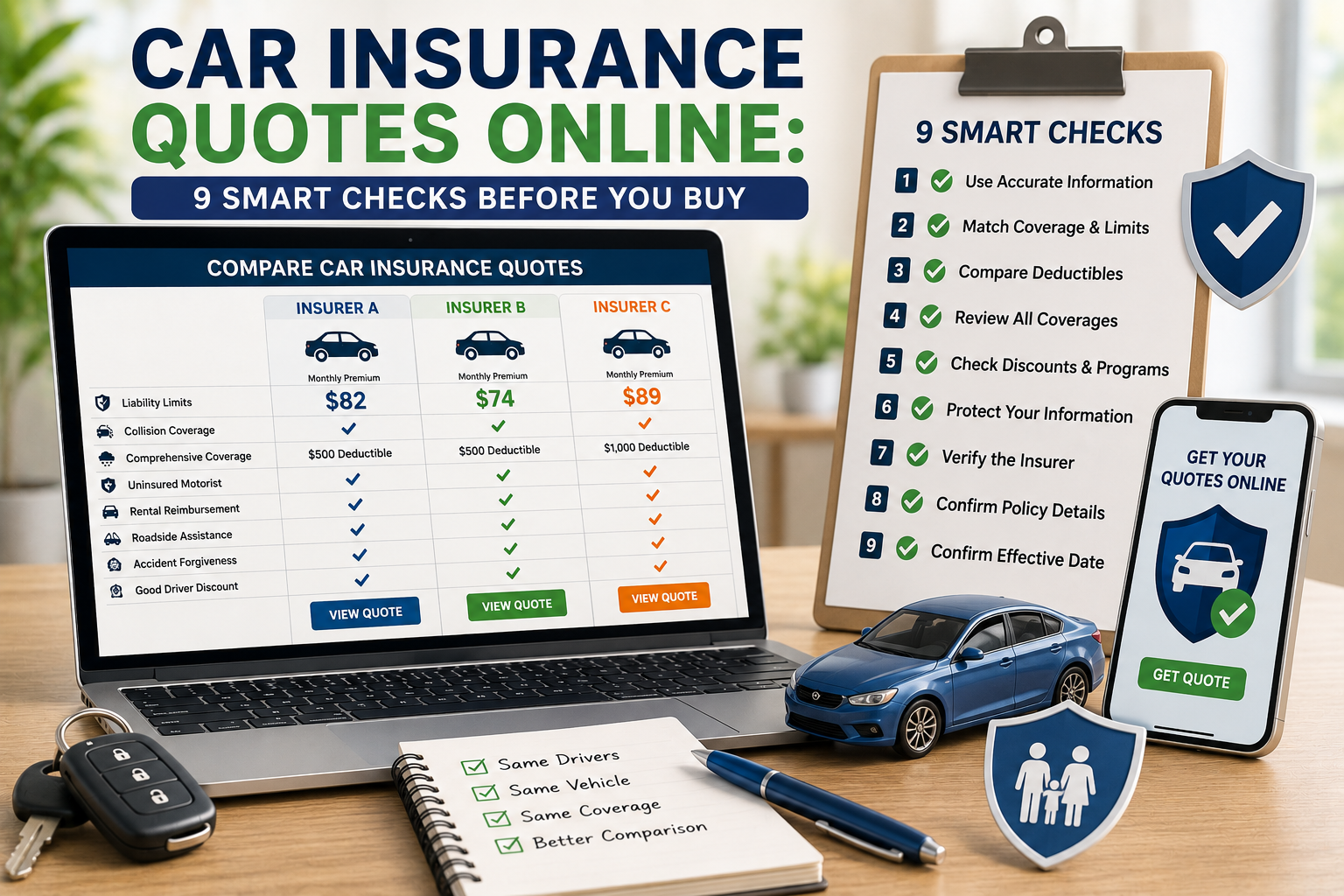
Car Insurance Quotes Online give U.S. drivers a fast way to research auto insurance prices and coverage options without relying on one insurer or one policy configuration.
But speed creates a trap.
A quote that appears cheaper may use lower liability limits, higher deductibles, fewer optional coverages, different discounts, or assumptions that do not match another quote.
The goal is therefore not simply to find the smallest displayed premium.
The stronger goal is to compare:
the same driver + the same vehicle + the same coverage + the same deductibles + the same basic circumstances
That produces a much cleaner comparison.
Car Insurance Quotes Online should also be treated as estimates rather than automatic proof that coverage has been issued. An insurer may verify driver, vehicle, claims, prior-insurance, eligibility, household, or other information before confirming the policy and final premium.
This guide explains how online car insurance quotes work, what information to prepare, how to compare policies fairly, how to protect personal information, how discounts and telematics can affect quotes, how to check the insurer, and what to confirm before driving away believing you are insured.
Educational note: PolicyQuotesUS.com provides general U.S. personal auto insurance education only. We are not an insurer, insurance agency, broker, quote marketplace, claims service, financial adviser, or coverage approval service. We do not sell, issue, bind, approve, underwrite, recommend, or adjust insurance policies. Quotes, premiums, discounts, eligibility, coverage options, underwriting decisions, deductibles, limits, exclusions, and policy terms vary by state, insurer, driver, vehicle, household, and policy. Always review the final application, declarations page, policy forms, endorsements, exclusions, deductibles, limits, and confirmed effective date before relying on coverage.
Decision Snapshot: The Five-Part Quote Integrity Test
Before treating any online quote as a serious buying option, run it through the Five-Part Quote Integrity Test. The purpose is simple: make sure a lower price is not being created by a different risk profile, weaker protection, a larger deductible, hidden payment assumptions, or a quote that has not yet become active coverage.
| Integrity check | What must match or be confirmed | Why it matters |
|---|---|---|
| 1. Identity | Drivers, vehicles, garaging address, mileage, vehicle use and household information | A price built on different facts is not a fair comparison. |
| 2. Protection | Liability limits, collision, comprehensive, UM/UIM, PIP or MedPay where relevant, and optional coverages | A cheaper quote may simply insure less. |
| 3. Deductibles | Collision and comprehensive deductibles and any special deductibles | A lower premium can shift more claim-day cost back to the policyholder. |
| 4. Total cost | Full policy-term premium, payment schedule, fees and discount assumptions | The first payment or monthly amount may not reveal the true total cost. |
| 5. Activation | Verification status, insurer acceptance, required payment, effective date and proof of insurance | A quote is not the same thing as an active policy. |
Fast decision rule: if one of these five layers is materially different, pause the price comparison and correct the mismatch first. The strongest online quote is not automatically the lowest number. It is the quote that survives a like-for-like comparison and is clear enough for the driver to understand what will actually be insured, what it will cost, and when coverage will begin.
What Car Insurance Quotes Online Actually Provide
Car Insurance Quotes Online generally provide an estimated insurance price based on information entered by the shopper and the insurer’s rating process.
An online system may ask about:
- Drivers
- Vehicles
- Garaging address
- Mileage
- Driving history
- Prior insurance
- Vehicle use
- Coverage limits
- Deductibles
- Optional protection
- Possible discounts
The system then uses that information to calculate an estimated premium or provide the next step in obtaining one.
Not every website works the same way.
A website may belong to:
- One insurance company
- An insurance agency
- A broker
- A comparison service
- A lead-generation service
- Another insurance-related business
That distinction matters.
A site showing Car Insurance Quotes Online may not represent every insurer available in the market.
Before submitting sensitive information, identify who operates the website and read information about how your data may be used or shared.
Where to Get Car Insurance Quotes Online in the U.S.
If you want an actual price for your own vehicle, start with an insurance provider or licensed intermediary rather than assuming every site that discusses quotes can generate one. PolicyQuotesUS.com is an educational resource, not a quote engine or insurance agency. There are three practical ways to request prices:
- Insurer websites: Request a quote directly from an insurer. This shows that insurer’s available products, subject to eligibility and state availability.
- Licensed independent insurance agents: Ask which insurers they represent and whether they can compare policies using the same coverage limits and deductibles. Verify the agent’s license with your state insurance department.
- Online comparison services: Check whether the service presents actual estimates, transfers you to another provider, or collects your details for follow-up. Read its privacy notice before sharing personal information.
Use one written coverage baseline. Keep the drivers, vehicle, garaging address, use, estimated mileage, liability insurance limits, optional coverages, deductibles, and payment assumptions consistent across providers. If a price is lower only because the coverage or information is different, ask for a revised, like-for-like quote before comparing costs.
Know what happens after submitting a form. Some services produce an estimate immediately; others arrange an insurer or agent follow-up. A displayed price does not itself activate insurance. Confirm the final premium, insurer acceptance, effective date and proof of coverage directly with the issuing provider. The National Association of Insurance Commissioners’ guidance on comparing online quotes explains these distinctions and why matching coverages matters.
How Car Insurance Quotes Online Work
Although individual systems differ, the basic process often follows a similar path.
Step 1: Enter Driver Information
The system may request information about the people who will drive the vehicle.
Step 2: Enter Vehicle Information
You may be asked about the year, make, model, vehicle identification number, ownership, mileage, garaging location, and vehicle use.
Step 3: Enter Driving and Insurance History
Questions can include prior coverage, accidents, claims, tickets, licensing history, or other information relevant to the insurer.
Step 4: Select Coverage
The system may present liability limits, collision, comprehensive, deductibles, uninsured or underinsured motorist protection, injury-related coverage, and optional features.
Step 5: Apply Available Discounts
Potential discounts or programs may be considered.
Step 6: Receive a Quote
The system may show an estimated premium, coverage summary, payment arrangement, or instructions for obtaining additional information.
Step 7: Verification and Purchase
The insurer may still verify information, request documents, collect payment, require electronic signatures, or perform additional review before issuing coverage.
That last step is important.
Car Insurance Quotes Online are not automatically the same thing as an active insurance policy.
1. Prepare Accurate Information Before Starting
The easiest way to make several Car Insurance Quotes Online comparable is to prepare the information before opening multiple quote forms.
Driver Information
Gather the requested information for relevant drivers, potentially including:
- Legal name
- Date of birth
- Driver’s license information
- Current address
- Licensing history
- Driving history
Insurers may also ask about licensed household members.
Do not intentionally omit someone merely to make the displayed premium smaller.
Vehicle Information
Prepare:
- Year
- Make
- Model
- Trim where relevant
- Vehicle identification number
- Ownership information
- Finance or lease information
- Garaging address
- Current or expected mileage
- Typical use
Vehicle details should be accurate.
Two trims carrying the same model name can have different equipment, values, repair costs, or other characteristics.
Vehicle Use
Be ready to describe whether the vehicle is used for:
- Personal driving
- Commuting
- School
- Business-related travel
- Delivery
- Rideshare
- Other regular purposes
Do not intentionally describe commercial or platform-related use as ordinary personal driving if that does not reflect reality.
Prior Insurance and Driving History
Have prior policy information available when applicable.
Your current declarations page can be particularly helpful because it shows existing limits and deductibles.
2. Build One Coverage Baseline
Before requesting several Car Insurance Quotes Online, decide what you want each insurer to quote.
This is your comparison baseline.
For example, decide on the same:
- Liability limits
- Collision coverage
- Comprehensive coverage
- Collision deductible
- Comprehensive deductible
- UM/UIM selections
- PIP or MedPay selections where applicable
- Rental reimbursement
- Roadside assistance
- Other optional features
Without a baseline, online systems may produce different policy combinations that appear comparable only because each screen ends with a dollar figure.
The underlying policies may be substantially different.
Our what coverage do I need for auto insurance guide explains how the major personal auto coverage categories fit together.
3. Compare Liability Limits Before Comparing Price
Liability protection deserves special attention.
A quote with lower liability limits may naturally appear cheaper than one with substantially higher limits.
That does not mean the insurer is necessarily offering better value.
It means the insurer may be accepting less potential financial responsibility under that policy.
Car Insurance Quotes Online should therefore use matching liability limits whenever possible.
Start by understanding the applicable minimum car insurance requirements.
Then remember an important distinction:
Legal minimum coverage is a baseline, not a guarantee that every accident will fit comfortably inside those limits.
A serious crash can involve:
- Several vehicles
- Property damage
- Medical treatment
- Lost income
- Legal claims
Use matching limits before deciding which quote is genuinely less expensive.
4. Match Collision, Comprehensive and Deductibles
Collision and comprehensive are different forms of physical-damage protection.
Collision generally concerns covered collision-related damage to the insured vehicle.
Comprehensive generally concerns certain covered non-collision events such as theft, vandalism, fire, weather, falling objects, or animal contact.
The comprehensive vs collision insurance guide explains the distinction in more detail.
Deductibles Can Distort the Comparison
Imagine two Car Insurance Quotes Online:
Quote A: $500 collision deductible
Quote B: $1,000 collision deductible
Quote B may have the lower premium partly because the policyholder is accepting more potential claim-day expense.
For the first comparison, keep deductibles the same.
Only after that should you deliberately test alternative deductible levels.
The best deductible for auto insurance guide explains that tradeoff in greater detail.
A simple test is:
Could I comfortably pay this deductible if an eligible claim occurred this week?
If not, a lower premium may not make the higher deductible a sensible choice.
5. Review Every Optional Coverage
Car Insurance Quotes Online can package optional protection differently.
Depending on the state and insurer, you may encounter:
- Uninsured motorist coverage
- Underinsured motorist coverage
- Personal injury protection
- Medical payments coverage
- Rental reimbursement
- Roadside assistance
- Glass options
- Other endorsements
Some coverages may be required in particular circumstances.
Others may be optional.
Some may not be available in the same form everywhere.
When comparing quotes, record whether each coverage is:
included / declined / unavailable / optional
Do not assume two similar labels mean the policy wording is identical.
The declarations page, policy forms, and endorsements ultimately matter more than the label shown on a quote screen.
6. Check State-Specific Requirements
Auto insurance rules vary across the United States.
The correct state and garaging location should therefore be used when requesting Car Insurance Quotes Online.
The auto insurance by state hub explains why location can affect:
- Required coverage
- Liability requirements
- Injury-related protection
- UM/UIM rules
- Proof requirements
- Consumer protections
- Available policy structures
Do not intentionally obtain a quote using a former address or different location simply because the price appears lower.
If you are moving to another state, inform the insurer and confirm what needs to change.
State insurance departments are useful official sources for current requirements and licensing information.
7. Examine Discounts and Telematics Carefully
Discounts can make Car Insurance Quotes Online look very attractive.
Potential discount categories may include:
- Multi-policy
- Multiple vehicles
- Good-student programs
- Driver education
- Safe-driving programs
- Low mileage
- Safety equipment
- Anti-theft equipment
- Automatic payment
- Paperless billing
- Other insurer-specific programs
Our best auto insurance discounts guide explains common categories.
But compare the final premium, not the number of discount labels.
An insurer offering six named discounts can still cost more than one offering three.
Telematics Deserves Its Own Check
Some insurers offer telematics or usage-based insurance programs.
Depending on the particular program, driving-related information may be collected through:
- A mobile app
- A plug-in device
- Connected vehicle technology
Before joining, check what the program says about:
- Information collected
- Monitoring period
- Driving behaviors measured
- Location information
- Other household drivers
- Pricing effects
- Withdrawal
- Data handling
Do not assume an introductory telematics benefit guarantees the same price later.
Program rules differ.
8. Protect Your Personal Information
Car Insurance Quotes Online may involve significant personal information.
Quote forms can request information connected with:
- Identity
- Driver’s licenses
- Vehicles
- Address
- Insurance history
- Contact details
- Payment
Use basic online-security habits.
Check the domain carefully.
Use the insurer’s or organization’s genuine website rather than an unsolicited link.
Read the privacy notice.
Identify who operates the site.
Look for information about whether your details may be shared with other companies, agents, or marketing partners.
A professional-looking website is not automatically an insurer.
Some websites may be comparison services or lead-generation businesses.
Pay particular attention to wording near forms and submission buttons.
It may explain consent relating to telephone calls, text messages, emails, or data sharing.
Provide sensitive information only when it is genuinely required for a legitimate quote process.
9. Check the Insurer Before Purchasing
The lowest quote should not automatically win.
The company behind the policy matters too.
Before purchasing, confirm that the insurer is licensed or authorized where the policy will be issued.
The National Association of Insurance Commissioners provides consumer tools that can help people research insurers, including information relating to licensing, complaints, and financial condition.
State insurance departments can also provide official information.
Consider questions such as:
- Is the insurer licensed in the state?
- Can the insurer’s identity be verified?
- Is customer-service information easy to find?
- Is the claims contact process clear?
- Are policy documents available?
- Can coverage questions be answered before purchase?
Complaint information and financial-strength information can provide useful context, but neither should be treated as a perfect single-number verdict.
Why Car Insurance Quotes Online Can Change
A preliminary quote may not always become the final policy premium.
Changes can happen if information is corrected or verified.
Examples can include:
- Incorrect vehicle details
- Different trim or VIN
- Missing household drivers
- Incorrect mileage
- Incorrect vehicle use
- Driving-record information
- Claims information
- Prior insurance differences
- Garaging changes
- Unverified discounts
- Different deductibles
- Coverage changes
- Payment-plan changes
- Underwriting review
That is why accuracy matters from the beginning.
Do not intentionally enter incomplete information just to see how low the quote can go.
A cheap estimate based on inaccurate information is not a useful result.
How Many Car Insurance Quotes Online Should You Compare?
There is no magic number of quotes every driver must obtain, but relying on only one quote gives very little information about the wider market.
A practical approach is to compare several reliable insurers using the same driver information, vehicle, coverage limits, deductibles, and major policy choices.
The purpose is not to collect the largest possible pile of quotes.
It is to identify whether meaningful differences exist in:
- Total premium
- Liability limits
- Deductibles
- Optional coverage
- Discounts
- Payment arrangements
- Policy conditions
- Insurer requirements
Three carefully matched Car Insurance Quotes Online can be more useful than ten quotes based on different assumptions.
If one quote uses different liability limits, deductibles, mileage, vehicle use, or optional coverage, correct those differences before judging which policy is cheaper.
A simple comparison process is:
- Create one coverage baseline.
- Request several quotes using that baseline.
- Correct quotes that are not genuinely comparable.
- Compare the total policy premium.
- Review deductibles and coverage differences.
- Check legitimate discounts.
- Review the insurer before purchasing.
If several quotes are close in price, the final decision may depend more on deductible affordability, coverage details, payment terms, available policy features, and how clearly the insurer explains the policy.
The goal is not to gather endless Car Insurance Quotes Online.
The goal is to obtain enough reliable comparisons to understand the real choices available.
What to Do if an Online Quote Changes After Verification
Car Insurance Quotes Online can sometimes change after an insurer verifies information.
That does not automatically mean something has gone wrong.
The insurer may have confirmed or corrected information relating to:
- Driving history
- Claims history
- Vehicle details
- Household drivers
- Prior insurance
- Mileage
- Vehicle use
- Garaging
- Discount eligibility
- Other underwriting information
If the premium changes, do not simply accept the new number without looking at what changed.
Compare the revised quote with the earlier version.
Ask:
- Did the liability limits change?
- Did a deductible change?
- Was a discount removed?
- Was another driver added?
- Was mileage corrected?
- Did the vehicle-use classification change?
- Was the vehicle trim corrected?
- Did prior insurance information change?
- Did the payment arrangement change?
If the revised information is accurate, use the updated quote when comparing insurers.
If something appears incorrect, contact the insurer or licensed representative and ask for the information to be corrected before purchasing.
Keep copies of important records such as:
- Original quote
- Revised quote
- Application
- Payment confirmation
- Policy confirmation
- Final declarations page
That creates a simple record of what was originally quoted and what ultimately became part of the policy.
A changing quote is another reason Car Insurance Quotes Online should be treated as estimates until the insurer confirms the actual policy.
How to Know When an Online Quote Is Ready to Buy
Shopping eventually needs to turn into a decision.
Once you have several properly matched Car Insurance Quotes Online, the final review can be kept simple.
First, confirm that all driver and vehicle information is accurate.
Second, confirm that the quote contains the liability limits and coverage you actually intended to compare.
Third, make sure the collision and comprehensive deductibles are amounts you could realistically manage.
Fourth, check that the discounts shown are legitimate and understand any conditions attached to them.
Fifth, review the total policy premium rather than concentrating only on the first or monthly payment.
Sixth, verify the insurer and make sure you know how to contact the company if you need policy or claims assistance.
Seventh, confirm exactly when the new coverage will become effective.
Do not rush simply because an online system presents a purchase, continue, or payment screen.
The final decision should come after the comparison is complete.
Before buying, you should be able to answer three simple questions:
What am I paying?
What protection am I receiving?
When does the policy become active?
If all three answers are clear and the information is accurate, the quote is much closer to being a sensible purchase option.
If any answer remains unclear, review the quote or contact the insurer before paying.
Car Insurance Quotes Online are most useful when they make insurance easier to understand—not merely faster to purchase.
Online Quotes vs Instant Quotes
These are related, but they should not be treated as identical search intents.
Car Insurance Quotes Online is the broad online-shopping process.
It covers:
- Preparing information
- Using quote systems
- Comparing policies
- Privacy
- Discounts
- Telematics
- State differences
- Quote verification
- Insurer checks
- Purchasing
Instant auto insurance quotes owns the narrower intent involving how quickly quote information can be obtained.
That page focuses on speed.
This page focuses on the complete online process.
Online Quotes vs Cheap Quotes
There is another important separation.
Cheap car insurance quotes focuses primarily on:
finding and comparing lower-cost quotes
Car Insurance Quotes Online focuses on:
using online systems safely and correctly from start to finish
A driver can therefore want an online quote without specifically searching for the cheapest possible policy.
Keeping those intents separate prevents the pages from becoming duplicates.
When an Online Quote Becomes Actual Coverage
This is one of the most important distinctions in the article.
A displayed quote is not automatically proof that insurance is active.
Depending on the insurer and transaction, additional steps may include:
- Selecting an effective date
- Completing the application
- Making payment
- Signing documents
- Completing outstanding verification
- Receiving a policy number
- Receiving insurance documents
Before assuming Car Insurance Quotes Online have turned into active coverage, confirm the insurer has actually issued the policy.
Check for:
- Correct named insured
- Correct drivers
- Correct vehicles
- Correct VIN
- Correct garaging address
- Correct limits
- Correct deductibles
- Policy number
- Effective date
- Effective time where provided
- Payment confirmation
- Insurance identification documents where applicable
- Outstanding requirements
Drivers specifically needing rapid activation can see same day car insurance for the narrower effective-date and same-day-coverage topic.
Do Not Cancel Existing Coverage Too Early
If Car Insurance Quotes Online are being used to switch insurers, avoid creating an accidental insurance gap.
Use this order:
1. Select the replacement policy.
2. Confirm that the new policy has been issued.
3. Confirm its effective date and time.
4. Only then arrange cancellation of the old policy at the appropriate time.
A screenshot showing an estimated quote is not enough.
Confirm the new coverage.
Financed and Leased Vehicles Need Another Check
If the vehicle is financed or leased, the driver may have contractual insurance requirements in addition to state requirements.
A lender or lessor may require physical-damage protection such as collision and comprehensive coverage.
The agreement may also restrict deductible choices.
The Consumer Financial Protection Bureau recommends comparing insurance options and coverage as well as costs before buying a financed vehicle.
That is particularly useful because insurance becomes part of the ongoing cost of owning the car.
Do not build Car Insurance Quotes Online using a liability-only configuration when the finance or lease agreement requires physical-damage coverage.
A Simple Online Quote Comparison Example
Suppose one driver obtains three online quotes using the same car.
Quote A
- Lowest displayed premium
- Lower liability limits
- $1,000 collision deductible
- Telematics discount included
Quote B
- Middle premium
- Higher liability limits
- $500 collision deductible
- No telematics requirement
Quote C
- Highest premium
- Same limits as Quote B
- $500 collision deductible
- Rental reimbursement and roadside assistance included
Which is best?
You cannot answer correctly from price alone.
The first task is to make the coverage comparable.
The driver could request revised versions using:
- Same liability limits
- Same collision deductible
- Same comprehensive deductible
- Same optional coverage
- Same discount assumptions
Only then does the premium comparison become much more meaningful.
Common Car Insurance Quotes Online Mistakes
Accepting Default Coverage Without Checking It
Online forms may preselect limits or deductibles.
Review them.
Comparing Different Liability Limits
A weaker policy can look cheaper.
Changing Deductibles Between Companies
Keep them consistent during the first comparison.
Omitting Household Drivers
Answer insurer questions accurately.
Using the Wrong Garaging Address
Use the location requested by the insurer accurately.
Guessing at Mileage
Use a realistic estimate.
Hiding Rideshare, Delivery, or Business Use
Drivers comparing brand-specific business-use options can also review GEICO commercial auto insurance and GEICO commercial vehicle insurance before requesting quotes.
Describe how the vehicle is actually used.
Assuming Every Discount Is Guaranteed
Some require documentation or continued eligibility.
Ignoring Telematics Conditions
Understand what participation involves.
Looking Only at the First Payment
Compare the total premium and payment structure.
Assuming the Quote Is Final
Verification may still occur.
Treating the Quote as Proof of Insurance
Wait for actual policy confirmation.
Canceling Existing Coverage Too Soon
Confirm replacement coverage first.
Information Checklist Before Starting
Before requesting Car Insurance Quotes Online, gather:
- Driver information
- Driver’s license details
- Relevant household-driver information
- Vehicle year, make, model, and trim
- VIN
- Ownership information
- Finance or lease information
- Garaging address
- Mileage
- Vehicle use
- Current declarations page where applicable
- Prior insurance details
- Requested liability limits
- Collision deductible
- Comprehensive deductible
- Optional coverage choices
- Relevant discount information
Preparation makes the process faster and reduces accidental differences between quote requests.
Car Insurance Quotes Online Comparison Table
| Comparison Item | Quote A | Quote B | Quote C |
|---|---|---|---|
| Drivers identical | Check | Check | Check |
| Vehicle information identical | Check | Check | Check |
| Garaging accurate | Check | Check | Check |
| Vehicle use identical | Check | Check | Check |
| Liability limits identical | Check | Check | Check |
| Collision included | Check | Check | Check |
| Collision deductible identical | Check | Check | Check |
| Comprehensive included | Check | Check | Check |
| Comprehensive deductible identical | Check | Check | Check |
| UM/UIM selections matched | Check | Check | Check |
| PIP/MedPay matched | Check | Check | Check |
| Optional coverage matched | Check | Check | Check |
| Discounts verified | Check | Check | Check |
| Telematics terms reviewed | Check | Check | Check |
| Total premium compared | Check | Check | Check |
| Payment terms reviewed | Check | Check | Check |
| Insurer verified | Check | Check | Check |
| Effective date confirmed | Check | Check | Check |
This table makes hidden differences much easier to identify.
Questions to Ask Before Purchasing Online
Before purchasing, confirm:
- Are all drivers correct?
- Are all vehicles correct?
- Is the VIN correct?
- Is the garaging location correct?
- Is vehicle use described accurately?
- Are liability limits what I intended?
- What collision deductible applies?
- What comprehensive deductible applies?
- What UM/UIM coverage is included?
- What injury-related coverage is included?
- Which optional coverages are included?
- Which discounts have been verified?
- Does telematics apply?
- What is the total premium?
- Are there payment or installment fees?
- Is the insurer properly licensed?
- Is the policy number confirmed?
- What is the effective date?
- Is there an effective time?
- Are any documents or verification steps outstanding?
That final check takes Car Insurance Quotes Online from a convenient shopping tool to a much safer purchasing process.
Final Takeaway
Car Insurance Quotes Online can make auto insurance shopping faster and easier, but the strongest comparison is not simply the lowest price shown on a screen.
Start with accurate driver, vehicle, household, mileage, garaging, and use information.
Create one coverage baseline.
Keep liability limits, collision and comprehensive coverage, deductibles, UM/UIM, injury-related protection, and optional features as consistent as possible.
Then compare:
coverage + premium + deductibles + discounts + payment terms + insurer
Protect personal information when using online forms.
Understand any telematics program before joining.
Remember that a quote is not automatically active coverage.
Before driving under a newly purchased policy, confirm that the insurer has issued coverage and verify the policy number, drivers, vehicles, limits, deductibles, payment, and effective date.
The strongest approach is:
accurate information + identical coverage + careful comparison + legitimate insurer + confirmed policy
That is how Car Insurance Quotes Online become genuinely useful rather than simply fast.
Questions and Answers About Car Insurance Quotes Online
Are Car Insurance Quotes Online Final?
Not necessarily. A quote is generally an estimate based on information available at that point. The premium or eligibility may change after additional information is verified.
Are Car Insurance Quotes Online the Same as Insurance Coverage?
No. A quote alone does not mean a policy has been issued. Confirm the policy number, effective date, payment, and insurance documents before relying on coverage.
Why Do Online Car Insurance Quotes Differ?
Insurers can use different rating methods, eligibility rules, discounts, underwriting factors, and policy structures. Quotes can also differ because the limits, deductibles, optional coverage, or information entered are not identical.
Should I Use the Same Deductible on Every Quote?
Yes for the initial comparison. Matching deductibles make it easier to identify genuine premium differences. You can test alternative deductible levels afterward.
Is the Cheapest Online Car Insurance Quote Best?
Not automatically. A cheaper quote may have lower limits, higher deductibles, fewer coverages, or different conditions.
Can I Request Several Car Insurance Quotes Online?
Yes, many insurers and quote systems allow consumers to obtain estimates before purchasing. Privacy practices and information requirements can differ between websites.
Do Online Quotes Require Personal Information?
Many legitimate systems require driver, vehicle, address, insurance-history, or other information to develop an estimate. Check who operates the website and review its privacy information before submitting sensitive data.
Can Telematics Change an Online Insurance Quote?
It can, depending on the insurer and program. Understand what information is collected and how participation can affect pricing.
Can Car Insurance Quotes Online Start Immediately?
Some insurers may allow a policy to begin quickly after the application, payment, verification, and issuance process is completed. Do not assume coverage is active until the insurer confirms it.
Should I Check the Insurance Company Before Buying Online?
Yes. Confirm the insurer is authorized in the relevant state and use reliable regulatory information when evaluating licensing, complaints, and financial condition.
Helpful Official Resources
- National Association of Insurance Commissioners — Consumer Insurance Resources
- National Association of Insurance Commissioners — State Insurance Departments
- Federal Trade Commission — Online Privacy and Security
- Consumer Financial Protection Bureau — Auto Insurance When Financing a Vehicle
Author Bio
Related Car Insurance Guides
PolicyQuotesUS.com Editorial Team
The PolicyQuotesUS.com Editorial Team creates clear, neutral educational content for U.S. consumers researching personal auto insurance, online quotes, coverage, deductibles, premiums, discounts, policy comparisons, and related insurance decisions.
Copyright Notice
© 2026 – PolicyQuotesUS.com. All rights reserved.
This article about Car Insurance Quotes Online is protected by copyright and may not be copied, scraped, spun, republished, reproduced, distributed, or used commercially without prior written permission from PolicyQuotesUS.com. Brief quotations may be used with clear attribution and a link to the original article.
PolicyQuotesUS.com publishes original educational information about U.S. personal auto insurance, online insurance quotes, liability coverage, collision coverage, comprehensive coverage, uninsured motorist protection, underinsured motorist protection, deductibles, premiums, discounts, claims, policy limits, and related consumer insurance topics.
Unauthorized reuse, including AI rewriting, automated extraction, content spinning, bulk scraping, database collection, or republication on another website, is prohibited.
Disclaimer
This Car Insurance Quotes Online article provides general educational information intended for people living in the United States.
It is not personalized insurance, financial, legal, tax, privacy, claims, underwriting, or lending advice. It does not recommend a particular insurer, agency, broker, comparison service, policy, coverage limit, deductible, telematics program, or financial decision.
Insurance quotes, premiums, discounts, eligibility, underwriting practices, consumer-report use, telematics programs, coverage options, limits, deductibles, exclusions, endorsements, effective dates, and state requirements vary.
PolicyQuotesUS.com does not sell insurance, issue policies, bind coverage, provide or guarantee insurance quotes, determine eligibility, approve claims, make coverage decisions, or guarantee savings.
Review the complete application, declarations page, policy forms, endorsements, exclusions, coverage limits, deductibles, payment information, privacy disclosures, finance or lease requirements, and applicable state rules before purchasing or changing insurance.
When necessary, confirm policy-specific questions directly with the insurer, a licensed insurance professional, or the appropriate state insurance regulator.