
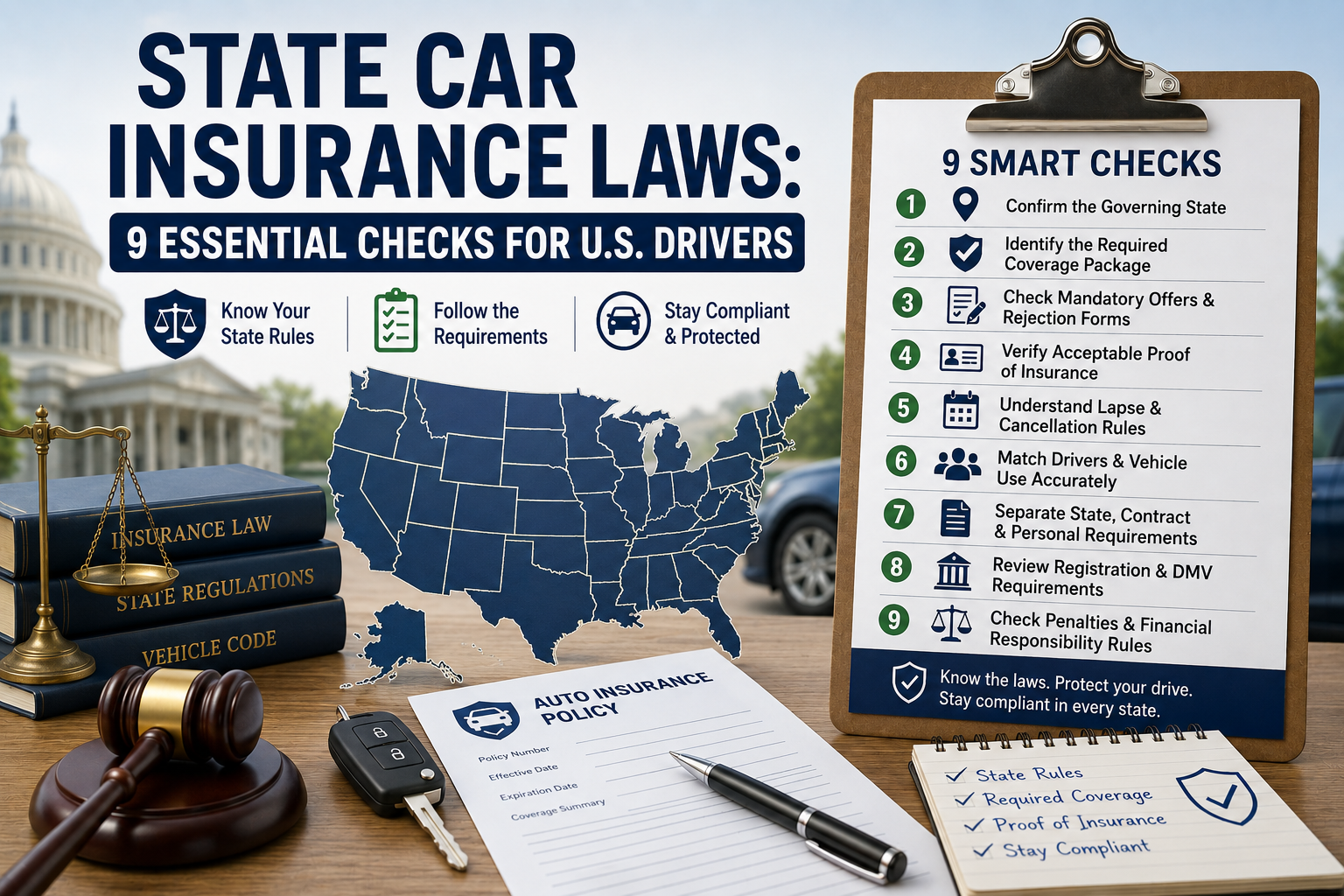
State Car Insurance Laws affect much more than whether a driver needs liability insurance.
Depending on the state, the law can affect:
- Required coverage
- Minimum liability limits
- Uninsured or underinsured motorist protection
- Personal injury protection
- Medical payments coverage
- Proof-of-insurance requirements
- Coverage selection or rejection forms
- Vehicle registration
- Consequences of an insurance lapse
- Cancellation and non-renewal procedures
- Financial-responsibility requirements
- Claims and consumer-protection procedures
The United States does not have one nationwide personal auto insurance rulebook.
Each state or jurisdiction has its own legal framework, and those requirements can change.
That means State Car Insurance Laws should be verified using current official state sources rather than relying indefinitely on an old chart, social-media post, forum answer, or article containing fixed numbers.
The safest approach is to understand what needs to be checked, then confirm the current rule with the appropriate state insurance department or motor vehicle agency.
This guide explains nine essential checks U.S. drivers can use to understand State Car Insurance Laws without confusing legal minimums with complete financial protection.
Educational note: PolicyQuotesUS.com provides general U.S. personal auto insurance education only. We are not an insurer, insurance agency, broker, quote marketplace, claims service, law firm, financial adviser, or coverage approval service. This article is not legal advice. State insurance laws, regulations, administrative procedures, coverage requirements, limits, forms, penalties, insurer practices, and policy terms can change. Always verify current requirements through the appropriate state insurance department, motor vehicle agency, insurer, or qualified licensed professional before relying on them.
Decision Snapshot: Law vs Policy vs Contract
A common insurance mistake is assuming that one rule controls everything. Before acting on any “required coverage” statement, identify which authority created the requirement.
| Source | What it can control | What to verify |
|---|---|---|
| State law or regulation | Financial responsibility, required coverages, mandatory offers, rejection forms and other legal obligations. | Current official state requirements. |
| Motor vehicle rules | Registration, proof of insurance and compliance procedures. | Deadlines, acceptable proof and consequences of noncompliance. |
| Insurance policy | The actual coverage contract, limits, exclusions, definitions and endorsements. | What the purchased policy does and does not cover. |
| Loan or lease contract | Physical-damage coverage and deductible obligations tied to the financed or leased vehicle. | Contract requirements separate from state minimums. |
Decision rule: when two sources appear to conflict, first check whether they are answering different questions. A state minimum can be legally sufficient while still failing a lender requirement or leaving a larger personal risk.
What State Car Insurance Laws Actually Control
State Car Insurance Laws create the legal framework under which personal auto insurance operates within a state.
That framework can address several different questions.
For example:
What insurance must a driver carry?
What minimum limits apply?
Must an insurer offer a particular coverage?
Can a driver reject that coverage?
Does the rejection need to be documented?
What proof of insurance is acceptable?
What happens if coverage lapses?
How does insurance interact with vehicle registration?
What notices must an insurer provide before certain policy actions?
Those are legal or regulatory questions.
They are different from asking what a particular insurance policy actually covers after an accident.
That distinction is one of the most important concepts in State Car Insurance Laws.
State Law and Policy Coverage Are Not the Same Thing
A state-law review asks:
What does the applicable law require or permit?
A coverage review asks:
What does this particular insurance contract cover?
Those questions overlap, but they are not identical.
A driver can satisfy State Car Insurance Laws and still carry coverage limits that leave substantial personal financial exposure after a serious accident.
Likewise, a driver can purchase broad optional coverage but still overlook an administrative requirement such as:
- Updating registration
- Providing acceptable proof
- Completing a required form
- Correcting the garaging address
- Responding to a state notice
The broader auto insurance by state hub explains how location changes the overall insurance landscape.
This State Car Insurance Laws pillar owns the legal and regulatory verification process.
1. Confirm Which State Actually Governs the Vehicle
The first check is location.
State Car Insurance Laws generally need to be considered in connection with the real facts surrounding the vehicle.
Important facts can include:
- Principal garaging location
- Vehicle registration
- Driver residence
- Regular vehicle use
- Permanent versus temporary location
- Vehicle ownership
Do not assume the correct state is simply whichever address produces the preferred insurance quote.
The application should accurately describe where the vehicle is principally kept and how it is used.
Temporary Travel Is Different From a Permanent Move
Driving into another state for a holiday or business trip is different from moving the vehicle there permanently.
A permanent relocation can trigger questions involving:
- Insurance
- Driver licensing
- Vehicle registration
- Title
- Garaging
- State-specific policy forms
A driver moving across a state line should tell the insurer and check the new state’s official motor vehicle and insurance requirements.
Special Living Arrangements
Some situations deserve direct confirmation, including:
- College students
- Military households
- Split residences
- Seasonal residences
- Vehicles kept away from the owner’s primary home
- Family members living in different states
Do not guess which State Car Insurance Laws apply in an unusual situation.
Give the insurer accurate facts and ask what policy and state requirements apply.
2. Identify the Required Coverage Package
Most U.S. jurisdictions impose some form of financial-responsibility or auto insurance requirement, but the required package is not identical nationwide.
State Car Insurance Laws may address coverage such as:
- Bodily injury liability
- Property damage liability
- Personal injury protection
- Medical payments
- Uninsured motorist coverage
- Underinsured motorist coverage
- Other state-specific protection
The exact requirement and limits can differ.
The minimum car insurance requirements pillar owns the detailed minimum-required-coverage search intent.
This article does not duplicate that page with a giant table of 50 changing legal limits.
Instead, use a durable process:
- Identify the applicable state.
- Find the official insurance regulator.
- Confirm the currently required coverages.
- Confirm the current minimum limits.
- Check whether special forms or selections apply.
- Confirm related motor vehicle requirements.
This is safer than treating an old national summary as permanent law.
3. Separate Minimum Requirements From Adequate Protection
State Car Insurance Laws establish legal requirements.
They do not automatically determine how much insurance is financially appropriate for every household.
Suppose a state requires a particular liability minimum.
A serious collision could still produce losses above that amount.
Potential losses can involve:
- Injuries
- Medical expenses
- Lost income
- Multiple vehicles
- Expensive property
- Legal claims
That is why drivers should separate two questions:
What is legally required?
and
How much financial protection do I want?
The first is a state-law question.
The second is an insurance and financial-risk decision.
Our what does liability car insurance cover guide explains the purpose of bodily injury and property damage liability coverage.
The legal minimum is a floor, not a promise that every accident will fit within the selected limits.
4. Check Mandatory Offers, Selections, and Rejection Forms
One of the less obvious areas of State Car Insurance Laws involves coverage that may have to be offered even when the driver is permitted to decline or reduce it.
Depending on the jurisdiction and coverage, the insurer may need to:
- Offer the coverage
- Explain available limits
- Obtain a selection
- Obtain a rejection
- Keep evidence of the driver’s choice
Uninsured and underinsured motorist protection is an important example of an area where state rules vary.
The uninsured motorist coverage guide explains the general purpose of protection involving an at-fault driver without usable liability insurance.
The underinsured motorist coverage guide covers the related problem of insufficient liability limits.
But State Car Insurance Laws determine whether those coverages are:
- Required
- Optional
- Required to be offered
- Rejectable
- Subject to state-specific limits or forms
Keep Selection and Rejection Documents
If you sign or electronically acknowledge a coverage selection or rejection, keep a copy.
Store it with:
- Declarations page
- Policy
- Endorsements
- Insurance correspondence
- Other important records
If expected coverage does not appear on the declarations page, ask why.
Was it:
- Not available?
- Optional?
- Rejected?
- Reduced?
- Omitted accidentally?
Do not assume.
5. Verify Proof-of-Insurance and Registration Requirements
Having a policy and being able to demonstrate insurance are related but different issues.
State Car Insurance Laws and motor vehicle rules may determine what proof is required during circumstances such as:
- Vehicle registration
- Traffic stops
- Accident reporting
- License or registration reinstatement
- Other administrative procedures
Depending on the jurisdiction, acceptable evidence may involve:
- Insurance identification cards
- Electronic proof
- Insurer reporting
- State databases
- Other approved documentation
Check the Details on the Proof
Confirm that any proof you rely on reflects the current policy.
Check:
- Named insured
- Insurer
- Vehicle where applicable
- Policy number
- Effective dates
Do not rely indefinitely on an expired card or an old screenshot.
Insurance Department vs Motor Vehicle Agency
These agencies can have different responsibilities.
A state insurance department generally regulates insurers, insurance producers, insurance practices, and consumer insurance issues.
A state motor vehicle agency generally handles matters such as:
- Driver licensing
- Vehicle registration
- Titles
- Vehicle records
- Other motor vehicle administration
A State Car Insurance Laws question may require checking both.
6. Understand Lapses, Cancellation, and Replacement Coverage
An insurance lapse can create more than a temporary absence of coverage.
Depending on the jurisdiction and circumstances, a lapse may interact with:
- Vehicle registration
- Driving privileges
- Fees
- Reinstatement requirements
- Financial-responsibility filings
- Future insurance pricing or eligibility
That makes continuity important.
Do Not Cancel Because You Have a Quote
A new quote is not the same as a replacement policy.
When switching insurers:
1. Complete the replacement application.
2. Confirm the new policy is issued.
3. Confirm its effective date and time.
4. Confirm the correct vehicle and drivers.
5. Obtain proof.
6. Only then arrange the previous policy to end appropriately.
That sequence helps prevent an unintended uninsured gap.
Drivers needing a policy to become active quickly can see same day car insurance for the narrower same-day activation topic.
State Rules and Contract Rules Can Both Matter
State Car Insurance Laws may regulate aspects of cancellation, non-renewal, notices, or administrative consequences.
The insurance contract can contain additional terms about:
- Payment
- Policy period
- Cancellation requests
- Reinstatement
- Other contractual matters
Review both.
7. Recheck the Law After Moving to Another State
Moving is one of the clearest reasons to review State Car Insurance Laws again.
Do not assume an old policy can simply continue indefinitely without changes after a permanent interstate move.
The driver may need to address:
- New garaging address
- Policy state
- Registration
- Driver license
- Required coverage
- Proof requirements
- State-specific forms
Use the broader auto insurance by state framework to understand the state-navigation question, while relying on the applicable official agencies for current legal requirements.
Then use official state sources for current legal requirements.
A Simple Moving Scenario
Imagine Taylor moves permanently from State A to State B for work.
The car is now kept overnight in State B, but the old address remains on the insurance application.
Several questions arise:
- When did the move occur?
- Where is the vehicle actually garaged?
- Has the insurer been notified?
- Which registration rules apply?
- Which policy form applies?
- Are coverage selections different?
- Are new proof requirements involved?
Those facts need to be corrected and verified.
State Car Insurance Laws should follow the real situation, not an outdated address.
8. Keep Driver and Vehicle-Use Information Accurate
State law is only part of an insurance policy.
Underwriting information also matters.
Applications may ask about:
- Household drivers
- Regular vehicle users
- Commuting
- School travel
- Mileage
- Delivery work
- Rideshare activity
- Business use
- Vehicle modifications
- Garaging
Do not assume satisfying State Car Insurance Laws makes inaccurate application information harmless.
An insurer may rely on application information when:
- Pricing the policy
- Determining eligibility
- Issuing coverage
- Renewing
- Investigating a claim
Household Drivers
If the application asks about licensed residents or regular users, answer accurately.
Do not intentionally omit someone simply to lower a quote.
Delivery and Rideshare Use
Personal auto policies may treat delivery, rideshare, or other commercial activity differently.
Tell the insurer how the vehicle is actually used.
State Car Insurance Laws can regulate insurance generally, but the policy’s coverage and exclusions still matter.
9. Separate State Requirements From Lender and Lease Requirements
This is another important distinction.
A state may not require collision or comprehensive coverage on an ordinary privately owned vehicle.
But a lender or leasing company can impose contractual requirements because it has a financial interest in the vehicle.
That means the driver may need to satisfy three separate layers:
STATE: What does the law require?
CONTRACT: What does the lender or lessor require?
PERSONAL RISK: What additional protection does the driver want?
Do not combine those into one question.
Physical-Damage Coverage
Financed or leased vehicles commonly involve requirements relating to collision and comprehensive coverage.
The comprehensive vs collision insurance guide explains the difference.
The finance agreement may also restrict deductible choices.
Check:
- Required coverages
- Deductible limits
- Lienholder information
- Lease provisions
- Proof requirements
State Car Insurance Laws establish one part of the framework.
The finance contract can add another.
How Fault and No-Fault Rules Can Differ by State
Another reason state matters is that states can use different legal and insurance structures for injuries resulting from motor vehicle accidents.
Terms such as:
- Fault
- No-fault
- Personal injury protection
- Medical payments
- Tort options
may appear depending on the state.
These systems can be complicated and state-specific.
Do not assume a rule from one state applies nationwide.
For example, personal injury protection may be required or structured differently depending on jurisdiction.
Our personal injury protection insurance guide explains the coverage concept, but current state law and policy wording need to be checked separately.
State Car Insurance Laws should therefore be verified when a driver changes states rather than relying on a previous state’s claim structure.
Financial-Responsibility Rules Are Not Identical Everywhere
Most jurisdictions require drivers to demonstrate financial responsibility through auto liability insurance or another permitted method.
But the exact structure varies.
This is another reason to avoid writing one sweeping statement such as:
“Every state requires exactly the same type of auto insurance.”
That would be wrong.
State Car Insurance Laws may distinguish between:
- Mandatory insurance
- Alternative financial-responsibility mechanisms
- Requirements following certain driving events
- Special filings
The current legal requirements should be checked directly with the applicable state.
The NAIC notes that requirements vary by jurisdiction and that states maintain their own frameworks for auto liability and related coverage.
What Happens After Driving Without Required Insurance?
Consequences differ by state and circumstances.
Potential consequences may involve areas such as:
- Registration
- Driver licensing
- Fines or fees
- Proof requirements
- Reinstatement
- Financial-responsibility filings
- Other administrative or legal consequences
This article deliberately does not publish a fixed nationwide penalty chart.
Those details can change and are highly state-specific.
If a driver receives an official notice involving insurance status, registration, suspension, or another compliance issue, use the contact information on the notice or contact the appropriate state agency.
Do not rely on a generic article for a live legal deadline.
How to Verify State Car Insurance Laws Correctly
This is the most useful long-term process.
Step 1: Start With the State Insurance Department
Use the official state insurance regulator for information involving:
- Insurance requirements
- Insurer licensing
- Insurance complaints
- Consumer guidance
- State-specific coverage questions
The NAIC provides a directory linking consumers to the relevant insurance departments.
Step 2: Check the State Motor Vehicle Agency
Use the official motor vehicle agency for issues involving:
- Registration
- Driver licenses
- Titles
- Proof procedures
- Vehicle administration
USA.gov provides a directory of state motor vehicle services.
Step 3: Review the Insurance Application and State Forms
Check:
- Coverage selections
- Rejections
- Driver information
- Vehicle information
- Garaging
- Required acknowledgments
Step 4: Review the Actual Policy
Then review:
- Declarations page
- Coverage forms
- Endorsements
- Exclusions
- Definitions
- Conditions
- Deductibles
- Limits
State Car Insurance Laws tell you the regulatory framework.
The policy tells you what the insurance contract says.
You need both.
A Four-Part State Insurance Paper Trail
A simple document system can make State Car Insurance Laws easier to manage.
Keep these four groups together.
1. Official State Information
Save important current information from the insurance regulator or motor vehicle agency when it relates directly to your situation.
2. Application and Selection Forms
Keep copies of:
- Application
- Coverage selections
- Coverage rejections
- Signed acknowledgments
3. Policy Documents
Keep:
- Declarations page
- Policy forms
- Endorsements
- Insurance card
- Other issued documents
4. Vehicle Finance or Lease Documents
If applicable, keep the insurance requirements from the lender or lessor.
This paper trail helps keep legal, contractual, and policy questions separate.
Events That Should Trigger a Fresh State-Law Check
Drivers do not need to research State Car Insurance Laws every week.
Check again when something important changes.
Good triggers include:
- Moving across a state line
- Changing principal garaging
- Registering a vehicle in another state
- Buying a vehicle
- Financing a vehicle
- Leasing a vehicle
- Adding a household driver
- Starting rideshare work
- Starting delivery work
- Changing business use
- Replacing insurance
- Receiving a cancellation or non-renewal notice
- Experiencing a coverage lapse
- Receiving a government notice
- Being told a special filing is required
This is much more practical than repeatedly checking laws when nothing has changed.
Comparing Quotes Without Losing the Legal Details
Quote shopping can accidentally hide legal differences.
Use the same:
- Drivers
- Vehicles
- Garaging address
- Mileage
- Vehicle use
- Liability limits
- Deductibles
- Optional coverage
for each quote.
Drivers using instant auto insurance quotes should remember that a fast estimate does not prove every state-specific requirement or form has been completed.
When reviewing quotes, compare:
- Required coverage
- Selected limits
- UM/UIM selections
- PIP or MedPay where applicable
- Collision
- Comprehensive
- Deductibles
- Optional endorsements
- Driver assumptions
- Vehicle-use assumptions
- Effective date
- Total premium
The lowest number may come from lower limits or a different policy structure.
Common State Car Insurance Laws Mistakes
Using an Outdated National Chart
National comparison charts can be useful for orientation, but current official state information should control important decisions.
Assuming Every State Has the Same Requirements
They do not.
Confusing Legal Minimum With Full Coverage
“Full coverage” is not a standardized state-law package.
Ignoring State-Specific Selection Forms
Some coverage choices may require specific documentation.
Using an Old Address
The policy should reflect the true situation requested by the insurer.
Forgetting to Update Insurance After Moving
A permanent interstate move can affect insurance and motor vehicle requirements.
Canceling Coverage Before the Replacement Is Active
Confirm the new policy first.
Assuming an Insurance Card Explains the Whole Policy
The card does not usually show every limit, exclusion, endorsement, or coverage term.
Ignoring Lender or Lease Requirements
Contract requirements can exceed the state minimum.
Assuming Compliance Guarantees Claim Payment
It does not.
Claim coverage still depends on the policy, facts, limits, exclusions, endorsements, applicable law, and insurer review.
State Car Insurance Laws Verification Checklist
Before buying, renewing, moving, or making a significant policy change, check:
| Item | Verified? |
|---|---|
| Correct state identified | Yes / No |
| Principal garaging accurate | Yes / No |
| Registration requirements checked | Yes / No |
| Required coverage identified | Yes / No |
| Minimum limits verified | Yes / No |
| Mandatory offers reviewed | Yes / No |
| Rejection/selection forms completed | Yes / No |
| Proof requirements checked | Yes / No |
| Household drivers accurate | Yes / No |
| Vehicle use accurate | Yes / No |
| Lender/lease requirements checked | Yes / No |
| Effective date confirmed | Yes / No |
| Replacement coverage confirmed before cancellation | Yes / No |
| Current declarations page reviewed | Yes / No |
| State regulator source checked | Yes / No |
That checklist keeps State Car Insurance Laws practical instead of overwhelming.
Questions to Ask Before Buying or Renewing
Ask:
- Which state’s rules apply to this vehicle?
- What coverage is legally required?
- What minimum limits apply?
- Which coverages must be offered?
- Which coverages can be rejected?
- Does a rejection need written or electronic acknowledgement?
- What proof of insurance is acceptable?
- Does the insurer report coverage electronically to the state?
- Are all household drivers described correctly?
- Is the garaging address correct?
- Is vehicle use accurate?
- What happens if the policy lapses?
- Does a lender or lease require additional coverage?
- Which policy documents control the actual protection?
- Which state agency should be contacted if a legal requirement is unclear?
Those questions separate genuine requirements from assumptions.
Final Takeaway
State Car Insurance Laws differ across the United States and can affect far more than a minimum liability number.
They may influence:
- Required coverage
- Coverage offers and rejections
- Proof procedures
- Registration
- Lapses
- Policy administration
- State-specific insurance forms
- Consumer protections
The safest process is not to memorize 50 sets of changing numbers.
Instead:
identify the correct state → check the official insurance regulator → check the motor vehicle agency where needed → review state-specific forms → review the actual policy
Keep state requirements separate from lender or lease requirements.
Keep legal minimums separate from the amount of financial protection you want.
And recheck State Car Insurance Laws when something material changes, especially after a move, vehicle purchase, coverage lapse, driver change, or new vehicle use.
That gives drivers a much more reliable system than treating a static national chart as permanent law.
Questions and Answers About State Car Insurance Laws
Are State Car Insurance Laws the Same Across the United States?
No. Coverage requirements, limits, proof procedures, policy rules, and administrative requirements can differ by jurisdiction.
Does Every State Require Exactly the Same Auto Insurance Coverage?
No. Required coverage types and limits differ. Check the applicable state’s official insurance regulator.
Does Meeting the State Minimum Mean I Have Full Coverage?
No. “Full coverage” is not a standardized legal term or one nationwide package. State minimum requirements can leave other risks outside the policy.
Can a Lender Require More Insurance Than State Law?
Yes. A lender or lessor can impose contractual requirements for protecting a financed or leased vehicle, including collision or comprehensive coverage and deductible conditions.
Do State Car Insurance Laws Control My Entire Claim?
Not by themselves. Claim coverage can depend on applicable law, policy wording, exclusions, endorsements, limits, deductibles, and the facts of the loss.
What Should I Do When Moving to Another State?
Notify the insurer, update the actual garaging information, and check the new state’s insurance, driver licensing, and vehicle registration requirements through official sources.
Can I Rely on an Online State Minimum Insurance Chart?
Use national charts as general educational references only. Confirm important current requirements through the official state insurance department or motor vehicle agency.
Can State Law Require an Insurer to Offer Coverage That I Can Reject?
In some jurisdictions and for some coverage types, yes. Requirements differ, and a formal selection or rejection may be required.
Is an Insurance Card Proof of Every Coverage I Have?
No. An insurance card generally does not describe every policy limit, deductible, exclusion, endorsement, or optional coverage. Review the declarations page and full policy.
What Happens if Auto Insurance Lapses?
Consequences vary by state and circumstances. A lapse may create an uninsured period and can interact with registration, licensing, filings, fees, insurance eligibility, or other requirements.
Helpful Official Resources
- National Association of Insurance Commissioners — State Insurance Departments
- National Association of Insurance Commissioners — Auto Insurance
- NAIC — Consumer Auto Insurance Resources
- USA.gov — State Motor Vehicle Services
Author Bio
Related State and Coverage Guides
PolicyQuotesUS.com Editorial Team
The PolicyQuotesUS.com Editorial Team creates clear, neutral educational content for U.S. consumers researching personal auto insurance, state requirements, coverage, policy limits, deductibles, quotes, claims, and related insurance decisions.
Copyright Notice
© 2026 – PolicyQuotesUS.com. All rights reserved.
This article about State Car Insurance Laws is protected by copyright and may not be copied, scraped, spun, republished, reproduced, distributed, or used commercially without prior written permission from PolicyQuotesUS.com. Brief quotations may be used with clear attribution and a link to the original article.
PolicyQuotesUS.com publishes original educational information about U.S. personal auto insurance, state insurance requirements, liability coverage, collision coverage, comprehensive coverage, uninsured motorist protection, underinsured motorist protection, personal injury protection, deductibles, premiums, policy limits, claims, and related consumer insurance topics.
Unauthorized reuse, including AI rewriting, automated extraction, content spinning, bulk scraping, database collection, or republication on another website, is prohibited.
Disclaimer
This State Car Insurance Laws article provides general educational information intended for people living in the United States.
It is not personalized insurance, legal, financial, tax, claims, underwriting, licensing, registration, or lending advice.
State statutes, regulations, insurance requirements, coverage mandates, minimum limits, proof rules, registration procedures, consumer protections, policy forms, insurer practices, and administrative requirements can change and differ by jurisdiction.
PolicyQuotesUS.com does not sell insurance, issue policies, provide legal advice, determine which state’s law applies to a particular person, guarantee coverage, determine eligibility, approve claims, or guarantee any legal or financial outcome.
Always verify current requirements directly through the appropriate state insurance department, state motor vehicle agency, insurer, licensed insurance professional, or qualified legal professional when necessary.
The actual policy, declarations page, coverage forms, endorsements, exclusions, limits, deductibles, and applicable law control specific coverage and claim questions.