
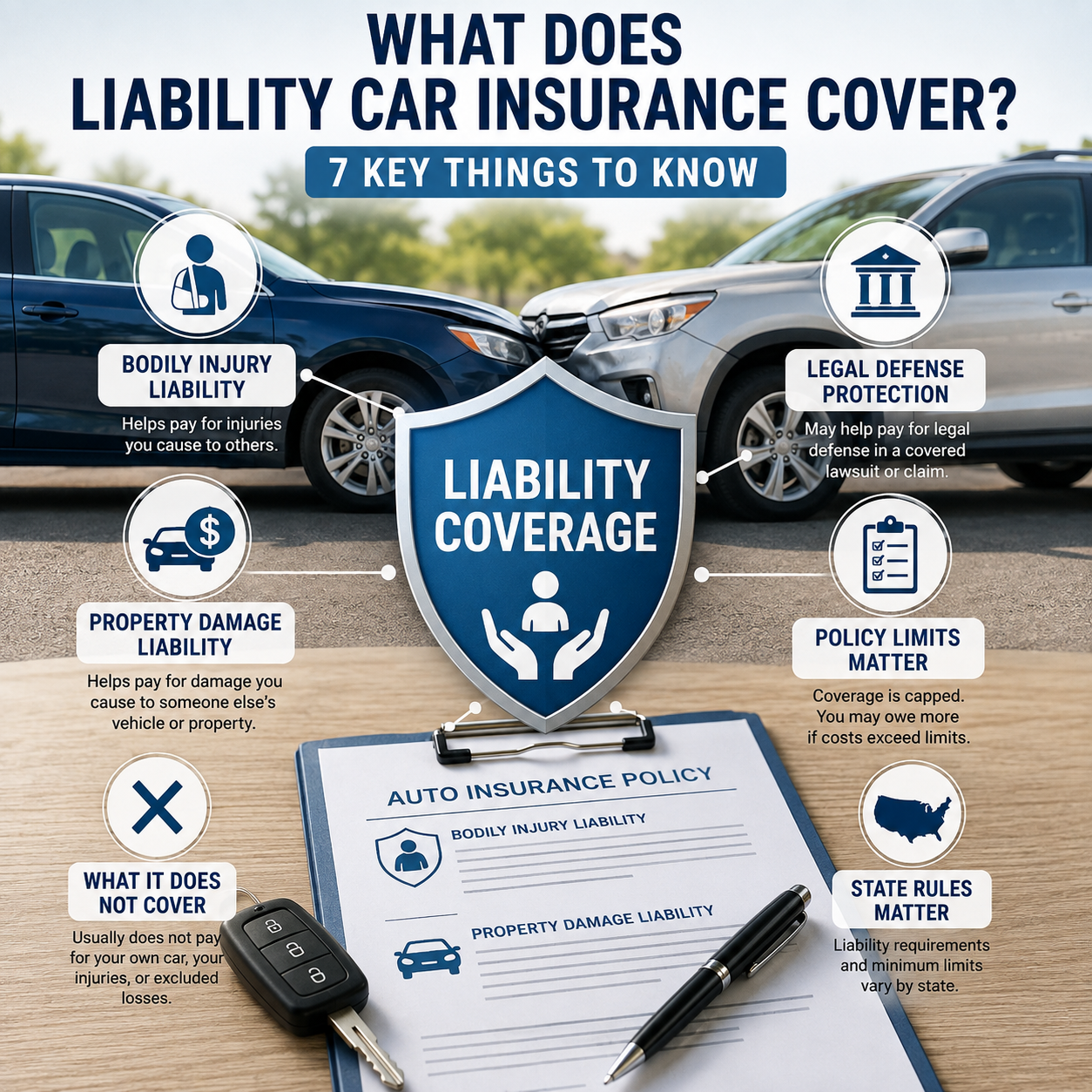
What does liability car insurance cover? In simple terms, liability car insurance generally helps protect you financially when you are legally responsible for covered injuries or property damage suffered by other people in an auto accident.
Liability coverage usually has two main parts:
- Bodily injury liability
- Property damage liability
It may also include certain legal defense obligations when a covered accident leads to a claim or lawsuit.
Understanding what does liability car insurance cover also requires knowing what liability insurance normally does not cover. It generally does not repair your own vehicle simply because you caused an accident, and it does not replace collision, comprehensive, personal injury protection, medical payments, uninsured motorist, or underinsured motorist coverage.
The basic idea is:
Liability insurance primarily protects against financial responsibility for injuries or property damage you cause to other people.
This guide explains seven important areas drivers should understand before choosing liability coverage.
Educational note: PolicyQuotesUS.com provides general U.S. personal auto insurance education only. We are not an insurer, insurance agency, broker, quote marketplace, claims service, financial adviser, law firm, or coverage approval service. We do not sell, issue, bind, approve, underwrite, recommend, or adjust insurance policies. Liability requirements, policy limits, exclusions, defense provisions, premiums, eligibility, and coverage terms vary by state, insurer, driver, vehicle, household, policy, and circumstances. Always review the declarations page, policy forms, endorsements, exclusions, and applicable state requirements before relying on coverage.
Decision Snapshot: The Liability Boundary Test
Liability insurance becomes much easier to understand when you separate who is being protected, what type of loss is involved, and where the policy limit ends.
| Question | Liability boundary |
|---|---|
| Injuries you are legally responsible for causing to others | Bodily injury liability may respond, subject to limits, exclusions and policy terms. |
| Property damage you are legally responsible for causing to others | Property damage liability may respond, subject to limits and policy terms. |
| Damage to your own vehicle | Liability generally does not solve this; collision or comprehensive may be relevant depending on the cause of loss. |
| Your own injury expenses | Other protections such as PIP, MedPay or UM/UIM may be relevant depending on the state and policy. |
| Loss amount exceeds the liability limit | The policy limit is a financial boundary; amounts beyond available coverage can create personal exposure. |
Decision rule: liability is primarily third-party protection against covered legal responsibility. It is not a general-purpose policy for every loss involving the insured vehicle.
The Quick Answer: What Does Liability Car Insurance Cover?
When drivers ask what does liability car insurance cover, they are usually trying to understand which financial losses may be handled when they cause an accident.
Liability coverage generally addresses covered:
- Injuries to other people
- Damage to other people’s property
- Certain legal defense costs connected with a covered liability claim
The exact protection depends on:
- Policy limits
- Definitions
- Exclusions
- Conditions
- Endorsements
- State law
- Facts of the accident
Liability insurance is therefore not simply “accident coverage.”
It is protection against certain legal and financial responsibility arising from covered harm caused to others.
1. Bodily Injury Liability
The first major answer to what does liability car insurance cover is bodily injury liability.
If an insured driver causes a covered accident and is legally responsible for injuring another person, bodily injury liability may help pay eligible damages.
Depending on the claim and policy, these can potentially include:
- Medical treatment
- Hospital expenses
- Rehabilitation
- Lost income
- Certain pain-and-suffering damages
- Other legally recoverable injury losses
- Certain legal defense expenses
The injured person could be:
- Another driver
- A passenger
- A pedestrian
- A cyclist
Coverage still depends on the facts of the accident and the policy.
Bodily Injury Limits Matter
Understanding what does liability car insurance cover also means checking how much coverage is available.
Bodily injury liability is not unlimited.
The declarations page shows the limits purchased.
If a covered claim exceeds the available policy limit, the responsible driver may face personal financial exposure for the remaining amount.
That is why simply seeing the words “bodily injury liability” on a policy is not enough.
Drivers should also understand the actual limit.
2. Property Damage Liability
Another important part of what does liability car insurance cover is property damage liability.
Property damage liability generally applies when an insured driver causes covered damage to property belonging to someone else.
The most obvious example is another vehicle.
But covered property damage may potentially involve:
- Cars
- Motorcycles
- Fences
- Walls
- Mailboxes
- Garage doors
- Buildings
- Signs
- Landscaping
- Other physical property
Modern vehicles can also be expensive to repair because even modest damage can involve:
- Cameras
- Sensors
- Driver-assistance technology
- Lighting systems
- Specialized body components
The applicable property damage liability limit creates the financial boundary.
Does Liability Cover Your Own Vehicle?
Usually not.
A driver asking what does liability car insurance cover should remember that property damage liability generally protects against covered damage caused to someone else’s property.
Damage to your own vehicle may instead involve collision coverage.
The comprehensive vs collision insurance guide explains those two types of physical-damage protection.
A simple way to remember the difference is:
Liability → damage you cause others
Collision → certain covered collision damage to your own vehicle
Comprehensive → certain covered non-collision damage to your own vehicle
3. Legal Defense After a Covered Claim
When examining what does liability car insurance cover, legal defense is easy to overlook.
A serious auto accident can lead to:
- A liability claim
- Negotiations
- A demand for damages
- A lawsuit
Depending on the policy and circumstances, an insurer may have a duty to defend an insured against certain covered claims or lawsuits.
That can involve:
- Attorneys
- Investigation
- Legal filings
- Negotiations
- Other defense-related expenses
The details vary by policy.
Not Every Lawsuit Is Automatically Covered
The existence of a lawsuit does not automatically mean the insurer must defend every situation.
Coverage can depend on:
- Whether the driver qualifies as an insured
- Whether the vehicle qualifies
- Whether the use was covered
- Policy exclusions
- Intentional conduct
- Cooperation requirements
- Notice requirements
- Other policy conditions
So when asking what does liability car insurance cover, drivers should review both the liability limits and the defense provisions.
4. What Liability Car Insurance Usually Does Not Cover
A complete answer to what does liability car insurance cover must include what liability normally leaves out.
Liability insurance generally should not be expected to pay for:
- Repairs to your own car after an at-fault crash
- Theft of your own vehicle
- Hail damage
- Flood damage
- Fire damage
- Vandalism
- Animal damage
- Routine maintenance
- Mechanical breakdown
- Wear and tear
- Intentional damage
- Losses above the policy limit
- Excluded drivers or excluded uses
Your Own Vehicle Damage
If you cause an accident and your vehicle is damaged, collision coverage may be the relevant protection.
Theft, Weather, and Other Non-Collision Losses
Comprehensive coverage may apply to certain covered losses involving theft, hail, vandalism, fire, falling objects, or animal contact.
Our liability vs full coverage auto insurance guide explains the broader difference between liability-only protection and policies that also include physical-damage coverage.
Understanding what does liability car insurance cover becomes much easier once liability and vehicle-damage protection are kept separate.
5. Liability Limits Set the Financial Boundary
The answer to what does liability car insurance cover is always limited by the amount of insurance purchased.
Liability coverage does not provide unlimited protection.
Policies may use:
- Split limits
- Combined single limits
Split Limits
A split-limit policy may separately identify maximum amounts for:
- Bodily injury to one person
- Bodily injury to multiple people in one accident
- Property damage in one accident
The exact structure varies.
What matters is that the policy limit creates a ceiling on the insurance available.
What 25/50/25 Liability Limits Mean: A Worked Example
A policy shown as 25/50/25 generally indicates up to $25,000 of bodily injury liability per injured person, $50,000 of bodily injury liability for all injured people in one accident, and $25,000 of property damage liability per accident. These figures describe limits for covered claims, not a promise that every loss will be paid. Different states and policies can use other limit structures.
Illustrative accident: Assume three other people have potentially covered injury claims of $30,000, $28,000 and $8,000, totaling $66,000. The per-person cap restricts the first two claims to no more than $25,000 each, and the $50,000 per-accident cap further limits the total bodily injury coverage to $50,000. Even if all these claims otherwise qualify, at least $16,000 of the stated injury losses exceeds the available bodily injury limit. If the same accident causes $31,000 of potentially covered damage to someone else’s property, the $25,000 property damage limit leaves a further $6,000 above that limit. The driver could be personally responsible for amounts not paid by insurance, depending on liability, settlements, other insurance and applicable law.
What to check before choosing a limit: The state’s required minimum is only a legal starting point; it is not a guarantee of adequate financial protection. Review your state’s minimum car insurance requirements, ask the insurer how its limits and defense provisions apply, then compare the same selected limits when reviewing car insurance quotes online. This example is educational, not an interpretation of any particular policy.
Minimum Limits vs Financial Protection
State law may require drivers to carry a minimum level of liability insurance.
But satisfying the legal minimum does not mean every serious accident will fit within that amount.
A major collision could involve:
- Multiple injured people
- Expensive medical treatment
- Lost income
- Several damaged vehicles
- High-value property
- Legal claims
The minimum car insurance requirements guide explains the legal baseline.
Drivers should separate these two questions:
What does my state legally require?
and
How much liability protection do I want?
Those are not automatically the same answer.
6. State Rules Affect Liability Coverage
State requirements are another reason what does liability car insurance cover cannot have one identical answer nationwide.
Auto insurance is regulated largely at the state level.
State rules can affect:
- Required liability coverage
- Minimum limits
- Injury-related coverage
- Uninsured motorist protection
- Underinsured motorist protection
- No-fault systems
- Proof requirements
- Policy forms
The state car insurance laws guide explains the legal and regulatory side in greater detail.
The broader auto insurance by state hub helps drivers navigate state-based differences.
Moving to Another State
A driver who permanently moves to another state should not assume the old insurance arrangement automatically remains correct.
Tell the insurer about the actual:
- Residence
- Garaging address
- Vehicle registration
- Vehicle use
Then verify the new state’s current requirements.
7. Policy Details Matter More Than the Label
A policy only fully answers what does liability car insurance cover when its actual limits, exclusions, covered drivers, vehicles, and policy terms are reviewed.
Two policies can both contain liability insurance while offering different protection.
Compare:
- Bodily injury limits
- Property damage limits
- Covered drivers
- Excluded drivers
- Covered vehicles
- Permissive-use provisions
- Household-driver rules
- Business-use restrictions
- Rideshare or delivery restrictions
- Legal defense provisions
- Exclusions
- Endorsements
- Total premium
Compare Identical Limits
Imagine two quotes.
Quote A: lower liability limits and lower premium.
Quote B: higher liability limits and higher premium.
Quote A is not automatically a better-priced policy because the coverage amounts are different.
A proper comparison is:
match the coverage → match the limits → compare the premium
That makes the price difference meaningful.
What About Your Own Injuries?
Liability insurance primarily addresses liability to other people.
Your own injury-related expenses may involve other coverage depending on the state and policy.
Possible protections include:
- Personal injury protection
- Medical payments coverage
- Uninsured motorist coverage
- Underinsured motorist coverage
The personal injury protection insurance guide explains PIP.
The uninsured motorist coverage guide explains protection involving an at-fault driver without usable liability insurance.
The underinsured motorist coverage guide explains situations involving an at-fault driver whose liability limits may not be enough for the covered loss.
These protections answer different questions from what does liability car insurance cover.
Liability Insurance vs Full Coverage
“Full coverage” is commonly used as shorthand, but it is not one standardized insurance product.
A policy described informally as full coverage often combines:
- Liability
- Collision
- Comprehensive
It may contain other protection too.
Liability-Only Policy
Can address covered injuries and property damage caused to others.
Generally does not provide collision or comprehensive protection for your own vehicle.
Broader Coverage Package
Can combine liability with collision and comprehensive.
The appropriate structure depends on:
- State requirements
- Vehicle value
- Financing
- Driver
- Household
- Financial circumstances
- Coverage preferences
Do not rely on the phrase “full coverage.”
Check the declarations page.
Two Simple Liability Car Insurance Scenarios
Real-world examples make what does liability car insurance cover much easier to understand.
Scenario 1: Rear-End Collision
Alex follows another vehicle too closely and causes an accident.
The other driver is injured.
The other vehicle is damaged.
Subject to the policy and circumstances:
Bodily injury liability may potentially address covered injury damages.
Property damage liability may potentially address covered damage to the other person’s vehicle.
Alex’s own vehicle damage would normally involve a different coverage question, such as collision.
Scenario 2: Damage to a Fence
Morgan accidentally backs through a neighbor’s fence.
Nobody is injured.
The fence is damaged.
Property damage liability may potentially help with covered damage to the neighbor’s property, subject to the policy limit and terms.
Damage to Morgan’s own vehicle remains separate.
These examples show why what does liability car insurance cover cannot be answered simply with the word “accidents.”
The important questions include:
- Who was injured?
- Whose property was damaged?
- Who was responsible?
- What coverage was purchased?
- What limits apply?
- What exclusions apply?
What Happens When a Claim Exceeds the Liability Limit?
This is where policy limits become especially important.
Suppose a covered accident produces damages greater than the available liability limit.
The insurer’s obligation remains governed by the policy.
The responsible driver can potentially face financial exposure for amounts beyond the available insurance.
That is one reason drivers may consider factors such as:
- Assets
- Income
- Household drivers
- Driving frequency
- Vehicle use
- Traffic exposure
- Ability to absorb unexpected costs
No single liability limit is automatically correct for every household.
Does Liability Car Insurance Cover a Financed Car?
State-required liability coverage and lender requirements are different things.
A lender usually has a financial interest in the vehicle securing the loan.
For that reason, financed vehicles commonly require additional physical-damage coverage such as:
- Collision
- Comprehensive
Those requirements can exist in addition to state-required liability coverage.
Drivers should ask:
What does the state require?
What does the lender require?
What additional protection do I want?
Keeping those questions separate avoids confusion.
Does Liability Cover Someone Else Driving Your Car?
Sometimes certain liability coverage may extend when another person drives the insured vehicle with permission.
But this is not universal.
Coverage can depend on:
- Who the driver is
- Household relationship
- Whether the driver is listed
- Whether the driver is excluded
- Permission
- Vehicle use
- Policy wording
- State rules
If someone regularly drives your vehicle, disclose that to the insurer.
Do not rely on a general assumption about permissive use.
Does Liability Car Insurance Cover a Rental Car?
A personal auto policy may extend certain liability protection to eligible temporary rental vehicles.
But rental situations need careful review.
Check:
- Your personal auto policy
- Rental agreement
- Territory
- Vehicle restrictions
- Driver eligibility
- Liability limits
Remember that liability protection and physical damage to the rental car are separate issues.
Do not automatically assume a liability policy provides complete rental-car protection.
Common Liability Coverage Mistakes
Mistake 1: Assuming Liability Repairs Your Own Car
Usually it does not.
Mistake 2: Buying Only the Legal Minimum Without Understanding the Risk
Meeting state law and choosing enough financial protection are different decisions.
Mistake 3: Comparing Quotes With Different Limits
Match limits first.
Mistake 4: Ignoring Property Damage Exposure
A serious claim can involve more than another inexpensive vehicle.
Mistake 5: Assuming Every Driver Is Automatically Covered
Review driver definitions, household rules, and exclusions.
Mistake 6: Failing to Disclose Vehicle Use
Accurately disclose commuting, business, rideshare, delivery, and other requested uses.
Mistake 7: Thinking “Full Coverage” Is a Precise Insurance Term
It is not.
Read the actual policy.
Liability Coverage Comparison Checklist
When comparing policies, what does liability car insurance cover should be judged by the protection behind the premium.
| Liability Question | Checked? |
|---|---|
| Bodily injury liability included | Yes / No |
| Bodily injury limits reviewed | Yes / No |
| Property damage liability included | Yes / No |
| Property damage limit reviewed | Yes / No |
| State minimum checked | Yes / No |
| Covered drivers reviewed | Yes / No |
| Excluded drivers reviewed | Yes / No |
| Permissive-use rules reviewed | Yes / No |
| Business or rideshare use disclosed | Yes / No |
| Defense provisions reviewed | Yes / No |
| Important exclusions reviewed | Yes / No |
| Quote limits matched | Yes / No |
| Total premium compared | Yes / No |
| Declarations page reviewed | Yes / No |
That creates a much stronger comparison than looking only at price.
Questions to Ask Before Choosing Liability Coverage
When evaluating what does liability car insurance cover, ask:
- What bodily injury limits apply?
- What property damage limit applies?
- What minimum coverage does my state require?
- What happens if a covered claim exceeds the limit?
- Which drivers are covered?
- Are any drivers excluded?
- How does permissive use work?
- Does the policy provide a defense for covered claims?
- Which uses are excluded?
- Is business, delivery, or rideshare use restricted?
- What protects my own vehicle?
- What coverage applies to my own injuries?
- Does a lender require collision or comprehensive coverage?
- Are the quotes using identical liability limits?
- Which documents control the actual coverage?
These questions reveal the real differences between policies.
Final Takeaway
Ultimately, understanding what does liability car insurance cover means knowing both the protection provided and the financial risks that remain with the driver.
The simplest answer is:
Liability car insurance generally helps pay for covered injuries and property damage you become legally responsible for causing to other people, subject to policy limits, exclusions, and terms.
Its two major components are:
Bodily injury liability → covered injuries to other people.
Property damage liability → covered damage to other people’s property.
A policy may also provide certain legal defense protection for covered claims.
But liability insurance generally does not replace:
- Collision
- Comprehensive
- Personal injury protection
- Medical payments
- Uninsured motorist coverage
- Underinsured motorist coverage
And liability coverage generally does not repair your own vehicle simply because you caused the accident.
The strongest approach is:
understand what liability covers → understand what it excludes → check the limits → verify state requirements → compare equivalent policies
That gives drivers a much clearer answer to what does liability car insurance cover than relying on the word “liability” alone.
Questions and Answers About Liability Car Insurance
What Does Liability Car Insurance Cover?
Liability car insurance generally helps pay for covered bodily injury or property damage an insured driver is legally responsible for causing to other people, subject to policy limits, exclusions, and terms.
Does Liability Car Insurance Cover My Own Vehicle?
Usually not. Collision or comprehensive coverage may apply to certain damage involving your own vehicle.
Does Liability Car Insurance Cover My Own Medical Bills?
Liability coverage primarily addresses liability to other people. Your own medical expenses may involve PIP, MedPay, UM/UIM, health insurance, or other applicable protection.
Does Liability Insurance Cover Passengers?
Potential coverage depends on who was injured, who was responsible, state law, policy language, and the circumstances of the accident.
Does Liability Car Insurance Cover Property Damage?
Property damage liability generally addresses covered damage an insured driver causes to property belonging to someone else, subject to the applicable limit.
Does Liability Insurance Cover Legal Fees?
A policy may provide legal defense for certain covered liability claims or lawsuits. Review the policy’s defense provisions, limits, exclusions, and conditions.
What Happens if a Liability Claim Is Higher Than My Limit?
Insurance remains subject to the applicable limit. The responsible driver may face financial exposure for amounts beyond available insurance.
Is State-Minimum Liability Insurance Enough?
It may satisfy the legal minimum, but legal compliance does not guarantee that the selected limits will be enough for every serious accident.
Is Liability Insurance the Same as Full Coverage?
No. “Full coverage” commonly describes a broader package that may include liability, collision, and comprehensive coverage.
Does Liability Car Insurance Cover Rental Cars?
Certain personal auto liability coverage may extend to eligible rental vehicles, depending on the policy. Review both the personal auto policy and rental agreement before relying on coverage.
Helpful Official Resources
- NAIC — What You Should Know About Auto Insurance Coverage
- NAIC — Consumer Auto Insurance Guide
- NAIC — Auto Insurance
- NAIC — State Insurance Department Directory
Author Bio
Related Liability and Coverage Guides
PolicyQuotesUS.com Editorial Team
The PolicyQuotesUS.com Editorial Team creates clear, neutral educational content for U.S. consumers researching liability car insurance, auto insurance coverage, policy limits, deductibles, quotes, state requirements, and related insurance decisions.
Copyright Notice
© 2026 – PolicyQuotesUS.com. All rights reserved.
This article about what does liability car insurance cover is protected by copyright and may not be copied, scraped, spun, republished, reproduced, distributed, or used commercially without prior written permission from PolicyQuotesUS.com. Brief quotations may be used with clear attribution and a link to the original article.
PolicyQuotesUS.com publishes original educational information about U.S. personal auto insurance, liability coverage, collision coverage, comprehensive coverage, uninsured motorist coverage, underinsured motorist coverage, personal injury protection, medical payments coverage, policy limits, premiums, deductibles, claims, and related consumer insurance topics.
Unauthorized reuse, including AI rewriting, automated extraction, content spinning, bulk scraping, database collection, or republication on another website, is prohibited.
Disclaimer
This article explaining what does liability car insurance cover provides general educational information intended for people living in the United States.
It is not personalized insurance, financial, legal, tax, claims, underwriting, or accounting advice.
Liability requirements, minimum limits, policy terms, exclusions, defense provisions, premiums, eligibility rules, endorsements, and insurer practices vary by state, insurer, driver, vehicle, household, policy, and circumstances.
PolicyQuotesUS.com does not sell insurance, issue policies, bind coverage, determine eligibility, guarantee insurance prices, approve claims, or determine whether a specific loss is covered.
Review the application, declarations page, policy forms, endorsements, exclusions, coverage limits, applicable state requirements, and actual claim circumstances before relying on coverage.
When necessary, confirm policy-specific questions with the insurer, a licensed insurance professional, or the appropriate state insurance regulator.