
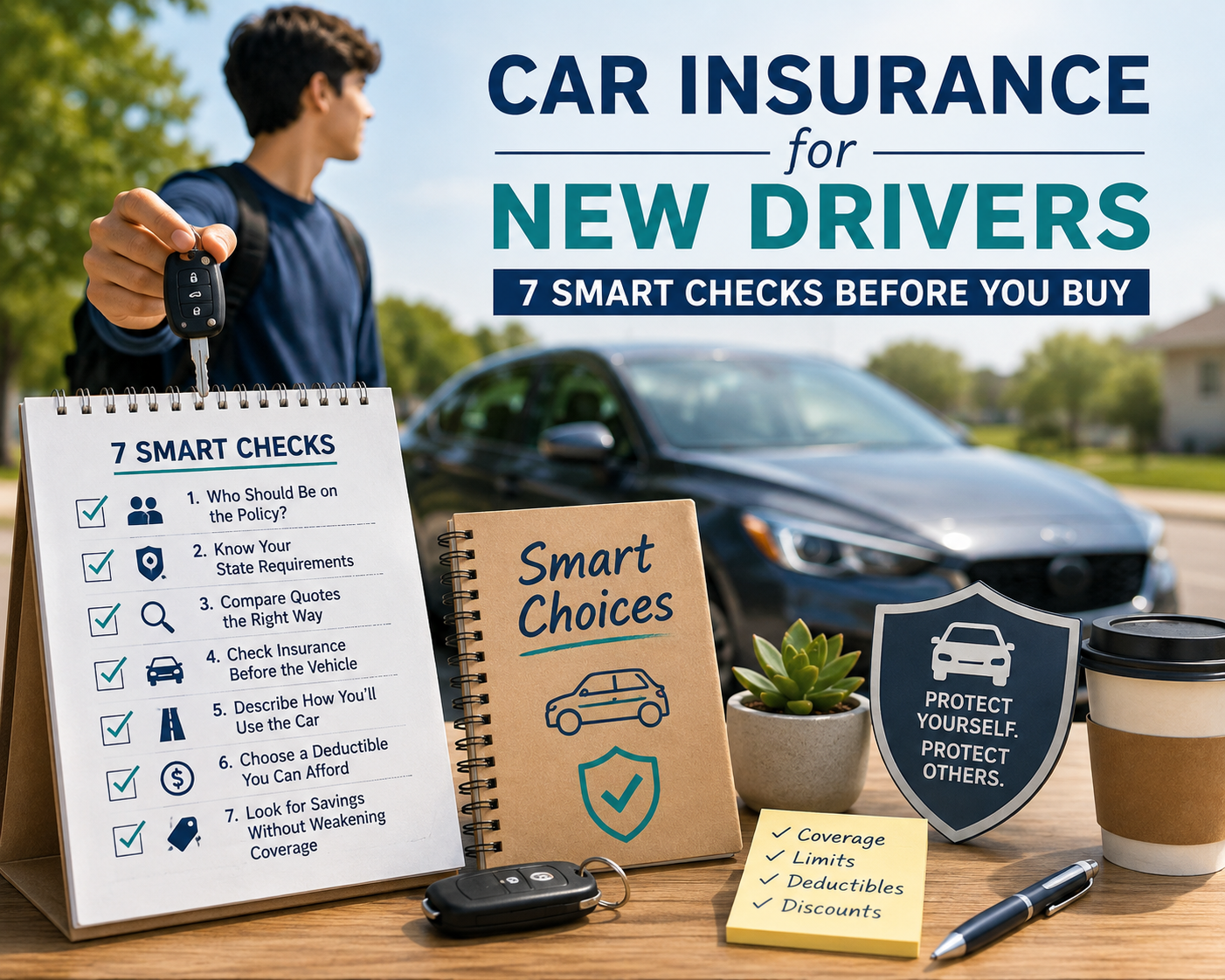
Car Insurance for New Drivers is ordinary personal auto insurance being purchased or arranged for someone with limited driving or insurance history. There is no single special policy that every new driver needs, and being a new driver does not automatically mean being a teenager.
A new driver might be a 17-year-old joining a family policy, a 25-year-old buying a first car, a newly licensed adult, or someone beginning to drive regularly after years without their own vehicle.
The important question is not simply, “How do I get insured?”
A better question is:
What coverage am I buying, what financial risk am I keeping, and are all the information and quote details accurate?
Car Insurance for New Drivers should be compared carefully because two policies with similar-looking premiums can contain different liability limits, deductibles, optional coverages, exclusions, household-driver arrangements, or vehicle protection.
This guide walks through seven practical checks before selecting a first auto insurance policy.
Educational note: PolicyQuotesUS.com provides general U.S. personal auto insurance education only. We are not an insurer, insurance agency, broker, quote marketplace, claims service, financial adviser, or coverage approval service. Auto insurance requirements, premiums, deductibles, limits, discounts, eligibility rules, underwriting practices, exclusions, and coverage options vary by state, insurer, vehicle, driver, household, and policy. Review the declarations page, policy forms, endorsements, exclusions, and applicable state requirements before purchasing or changing coverage.
Decision Snapshot: The New-Driver Policy Fit Test
A first policy should be judged on more than whether the premium looks affordable. The New-Driver Policy Fit Test focuses the decision on five questions that can materially change both cost and protection.
| Fit question | What to verify |
|---|---|
| Where should the driver be insured? | Whether the new driver belongs on a household policy, needs a separate policy, or requires another arrangement under the insurer’s rules. |
| Does the vehicle fit the budget? | Insurance cost before purchase, especially for financed, leased, high-value or expensive-to-repair vehicles. |
| Is the protection adequate? | Liability limits and relevant physical-damage, injury and uninsured-driver protections rather than automatically choosing only the minimum. |
| Can the deductible actually be paid? | The amount the driver or household could realistically produce after a covered loss. |
| Are savings sustainable? | The final premium after legitimate discounts, payment choices and any telematics conditions—not a temporary or assumed discount. |
Decision rule: the strongest first policy is the one that fits the driver, vehicle and household without creating a deductible or coverage problem that only becomes visible after a loss.
What Car Insurance for New Drivers Means
Car Insurance for New Drivers generally contains the same types of personal auto coverage available to more experienced motorists.
Depending on the policy and state, those can include:
- Bodily injury liability
- Property damage liability
- Collision coverage
- Comprehensive coverage
- Uninsured motorist coverage
- Underinsured motorist coverage
- Personal injury protection
- Medical payments coverage
- Rental reimbursement
- Roadside assistance
- Other optional endorsements
The difference is the driver.
Someone with limited driving history may give an insurer less past information to evaluate than a long-established driver.
Age can matter, but age and driving experience are not the same thing.
A newly licensed 40-year-old is a new driver but not a young driver. A 20-year-old who has driven for several years may be young but no longer completely new to driving.
That distinction is important when researching Car Insurance for New Drivers.
For a broader explanation of the protection available in a personal auto policy, see what coverage do I need for auto insurance.
Why Car Insurance for New Drivers Needs Careful Comparison
A first insurance policy introduces several terms at once:
- Premium
- Deductible
- Liability limit
- Exclusion
- Endorsement
- Declarations page
- Collision
- Comprehensive
- UM/UIM
- PIP
- Policy period
It is easy to focus only on the premium.
That can be a mistake.
A lower quote might use lower liability limits, higher physical-damage deductibles, fewer optional coverages, different driver information, or different assumptions about vehicle use.
A proper comparison keeps the important inputs as similar as possible. Our guide to comparing car insurance quotes online explains how to request like-for-like prices while checking limits, deductibles and when coverage starts.
Car Insurance for New Drivers should therefore be compared as a complete policy rather than as one monthly price.
1. Decide Who Should Be on the Policy
The first question is who owns the vehicle, who regularly drives it, and where the vehicle normally lives.
A new driver might:
- Join a parent’s or household policy
- Insure a personally owned vehicle
- Regularly drive a family vehicle
- Drive a financed vehicle
- Drive a leased vehicle
- Share access to several household vehicles
The correct arrangement depends on the actual situation and the insurer’s rules.
Car Insurance for New Drivers should accurately identify relevant information requested by the insurer, including vehicle ownership, household members, regular drivers, garaging, and normal vehicle use.
Do not assume that leaving a licensed household member off an application is a harmless way to make a quote cheaper.
Insurers may ask about licensed household residents and people who regularly operate the insured vehicles.
Providing incomplete or inaccurate information can create problems with:
- Underwriting
- Policy issuance
- Premium calculation
- Renewal
- Cancellation
- Claim handling
Answer application questions accurately.
Teen Driver Joining a Household Policy
A newly licensed teenager may regularly use a parent’s vehicle rather than own a car.
The household should ask the insurer how that driver must be listed and whether particular vehicles are assigned to individual drivers.
Adult Buying a First Policy
An adult who owns and garages a vehicle independently may need a separate policy.
The driver’s age does not remove the need to provide accurate ownership, residence, mileage, and use information.
The key is not age alone.
It is the actual insurance arrangement.
2. Check the State Requirements First
Personal auto insurance is regulated largely at the state level.
That means the legal starting point for Car Insurance for New Drivers depends on where the vehicle is insured.
States can differ in areas such as:
- Required coverage types
- Minimum liability limits
- Injury-related coverage
- Uninsured motorist rules
- Proof-of-insurance requirements
- Registration procedures
- Consumer protections
The auto insurance by state hub explains why changing location can change the insurance question.
Drivers should then confirm the actual legal requirements through the appropriate state insurance department, motor vehicle agency, or another official government source.
Our minimum car insurance requirements guide explains why the legal minimum is only a starting point.
Meeting a state’s minimum requirement does not mean every possible loss is covered.
It also does not automatically mean the liability limits are appropriate for a particular household.
Car Insurance for New Drivers should be considered in terms of both:
legal compliance + realistic financial protection
3. Compare Quotes Using Matching Coverage
This is one of the most important rules in the entire guide.
Compare like with like.
Suppose one insurer quotes $500 collision deductibles while another quote uses $1,000 deductibles.
Those are not identical policies.
The higher deductible transfers more of a covered physical-damage loss to the policyholder.
The same problem occurs when liability limits differ.
When comparing Car Insurance for New Drivers, try to keep these inputs consistent:
- Drivers
- Vehicle
- Garaging address
- Mileage estimate
- Vehicle use
- Liability limits
- Collision deductible
- Comprehensive deductible
- Optional coverage
- Policy period
Then compare the total premium and policy details.
Do not compare only the first installment or advertised monthly figure.
Check:
- Total premium
- Payment schedule
- Installment fees
- Initial payment
- Deductibles
- Liability limits
- Optional coverages
- Discount requirements
A quote that looks cheaper can simply contain less protection.
4. Check Insurance Before Buying the Vehicle
A first-time car buyer can fall in love with a vehicle and only later discover what it costs to insure.
Reverse the order where practical.
Check the likely insurance cost before committing to the vehicle.
Car Insurance for New Drivers can vary between vehicles because insurers may consider factors associated with the car itself, such as:
- Repair cost
- Vehicle value
- Safety equipment
- Theft exposure
- Performance characteristics
- Vehicle age
- Body style
- Ownership
- How the vehicle will be used
Two drivers with broadly similar personal details can therefore receive different quotes for different vehicles.
This matters when establishing the total cost of owning a first car.
The real household cost can include:
vehicle payment + insurance + fuel + maintenance + registration + repairs
A car that barely fits the purchase budget may become uncomfortable once insurance and other ongoing costs are added.
Financed and Leased Vehicles
Financing can also change the coverage decision.
A lender or lessor may require protection for the vehicle itself, commonly including collision and comprehensive coverage.
The comprehensive vs collision insurance guide explains the different types of physical-damage protection.
A financed new driver’s vehicle can therefore have less flexibility than a low-value paid-off vehicle.
Check the finance or lease agreement before removing or changing required coverage.
5. Describe How the Vehicle Will Actually Be Used
Insurance applications commonly ask how a vehicle is used.
That information matters.
The vehicle might be used for:
- Personal driving
- Commuting
- School
- Regular long-distance travel
- Business-related driving
- Delivery work
- Rideshare activity
Car Insurance for New Drivers should reflect the real use of the vehicle.
Do not intentionally reduce the mileage estimate or describe a commuting vehicle as pleasure-only simply to try to lower the quote.
Similarly, delivery and rideshare activity can raise separate coverage questions.
A standard personal auto policy may not treat every type of commercial or platform-based driving the same way.
If the new driver expects to perform delivery, rideshare, or other business activity, disclose the intended use and ask how the policy responds.
Garaging Also Matters
The principal garaging location should also be accurate.
A vehicle normally kept at one address should not intentionally be represented as living somewhere else to obtain a different rate.
Car Insurance for New Drivers works best when the application accurately describes the actual risk being insured.
6. Choose a Deductible the Driver Could Really Pay
A higher deductible can look attractive because it may lower the premium for the coverage where the deductible applies.
But a deductible must also work after a claim.
Imagine a new driver chooses a $1,000 collision deductible because the quote is cheaper.
A few months later, the car is damaged in a covered collision.
Could that driver comfortably handle the $1,000 deductible?
If not, the deductible may have been too aggressive for the household budget.
The recently completed best deductible for auto insurance guide explains the decision in detail.
For Car Insurance for New Drivers, a simple test is:
Could the deductible be paid this week without missing essential bills or relying on expensive emergency debt?
If not, compare a lower deductible and see what happens to the premium.
Compare the Premium Difference
Do not assume a higher deductible always creates enough savings to justify the extra risk.
Ask for otherwise similar quotes with several deductible choices.
Then compare:
- The premium difference
- The additional claim-day responsibility
- Available savings
- Vehicle value
- Any lender restrictions
The cheapest premium is not automatically the strongest financial choice.
7. Look for Savings Without Weakening the Policy
New drivers often want to reduce cost.
That is understandable.
When looking for cheap insurance for new drivers, compare the same limits, deductibles, and optional coverages so a lower premium does not simply mean less protection.
The trick is to reduce unnecessary cost without accidentally removing important protection.
Possible discount categories can include, depending on insurer and state:
- Driver education
- Good-student eligibility
- Low mileage
- Telematics or usage-based programs
- Multiple vehicles
- Eligible combined policies
- Safety equipment
- Anti-theft equipment
- Certain payment arrangements
- Other insurer-specific programs
No discount should be assumed.
Ask which discounts are actually available and what requirements apply.
For younger motorists specifically, cheap car insurance for young drivers focuses on cost-control strategies for that narrower group.
Car Insurance for New Drivers is broader.
A new driver can be any age.
The goal is not to win the largest advertised discount.
It is to compare the final premium and protection after all legitimate discounts have been applied.
Liability Protection Matters for New Drivers
Liability coverage addresses a different risk from repairing the insured vehicle.
If a covered driver causes an accident, bodily injury and property damage liability may respond to eligible losses suffered by other people, subject to the policy’s limits and terms.
State minimums create a legal baseline, not a guarantee that the limits are appropriate for every accident.
A serious collision can involve:
- Multiple vehicles
- Significant property damage
- Medical treatment
- Lost income
- Legal claims
Car Insurance for New Drivers should therefore not be judged solely by the cost of collision or comprehensive protection.
Review liability limits deliberately.
Uninsured and Underinsured Motorist Protection
Another coverage question is what happens when the other driver has no usable insurance or does not carry enough liability insurance for a covered loss.
Rules and availability differ by state.
Our uninsured motorist coverage guide explains protection involving drivers who have no usable liability insurance.
Underinsured motorist protection deals with the related problem of an at-fault driver whose available liability limits are insufficient for an eligible loss.
Car Insurance for New Drivers should be reviewed as a package rather than assuming another driver’s insurance will always solve the problem.
PIP and Injury-Related Coverage
Depending on the state and policy, a new driver may also encounter personal injury protection or medical payments coverage.
These are not the same as liability coverage.
The personal injury protection insurance guide explains how PIP may operate where it is available or required.
State rules matter heavily here.
Do not assume an injury-related coverage found in one state works the same way in another.
Two Common Car Insurance for New Drivers Scenarios
Scenario 1: Teen Added to a Family Policy
A teenager receives a driver’s license and will regularly use a family vehicle.
The household should contact its insurer and accurately describe:
- The new driver
- Available vehicles
- Normal vehicle use
- Garaging
- School or commuting mileage
- Driver assignment
- Relevant discounts
The family can then review liability limits, collision and comprehensive deductibles, and optional protection.
If competing quotes are requested, keep the drivers, vehicles, limits, and deductibles consistent.
Scenario 2: Adult Buying a First Car
A newly licensed adult purchases a used car.
The driver should determine:
- State insurance requirements
- Vehicle ownership
- Finance requirements
- Garaging address
- Expected mileage
- Vehicle use
- Liability limits
- Physical-damage needs
- Deductible affordability
Car Insurance for New Drivers should not be reduced to “young driver insurance.”
This adult has a different household and ownership situation from the teenager even though both are inexperienced drivers.
Common Car Insurance for New Drivers Mistakes
Buying the Car Before Checking Insurance
A vehicle can fit the purchase budget but produce a difficult overall ownership cost.
Get an insurance estimate first where practical.
Shopping Only by Premium
Compare limits, deductibles, coverage, and exclusions as well as price.
Comparing Unequal Quotes
A $500 deductible should not be treated as identical to a $1,000 deductible.
Likewise, different liability limits mean different protection.
Choosing Only the State Minimum Automatically
Legal compliance and adequate household protection are different questions.
Giving an Incorrect Garaging Address
Use the location where the vehicle is actually principally garaged.
Understating Mileage
Provide a realistic estimate.
Omitting Regular Drivers
Answer household and driver questions accurately.
Failing to Disclose Delivery or Rideshare Use
Ask how the policy treats the actual activity.
Picking a Deductible That Cannot Be Paid
A lower premium is little comfort if a covered claim creates an unaffordable immediate expense.
Canceling Existing Coverage Too Soon
When replacing a policy, confirm the effective date of the new coverage before ending existing protection.
Avoid creating an accidental gap.
What to Prepare Before Requesting Quotes
A little preparation makes quote comparison much easier.
Gather:
- Driver’s license information
- Vehicle identification number
- Vehicle year, make, and model
- Ownership information
- Finance or lease details
- Garaging address
- Estimated annual mileage
- Normal vehicle use
- Relevant household-driver information
- Prior insurance information where applicable
- Driving-history information requested by the insurer
- Preferred liability limits
- Collision and comprehensive deductible choices
- Optional coverage selections
- Discount documentation where required
Then use the same information for each insurer.
Car Insurance for New Drivers becomes much easier to compare when each quote begins with the same facts.
A Simple First-Policy Comparison
Instead of keeping several confusing quote screens open, make a basic comparison.
| Item | Quote A | Quote B | Quote C |
|---|---|---|---|
| Liability limits | Compare | Compare | Compare |
| Collision | Compare | Compare | Compare |
| Comprehensive | Compare | Compare | Compare |
| Collision deductible | Compare | Compare | Compare |
| Comprehensive deductible | Compare | Compare | Compare |
| UM/UIM | Compare | Compare | Compare |
| PIP/MedPay | Compare | Compare | Compare |
| Total premium | Compare | Compare | Compare |
| Fees/payment terms | Compare | Compare | Compare |
| Discounts applied | Confirm | Confirm | Confirm |
Do not automatically select the lowest number in the premium row.
Look across the entire table.
That is a much safer way to compare Car Insurance for New Drivers.
Questions to Ask Before Buying the First Policy
Before accepting a policy, ask:
- Which drivers need to be listed?
- Which vehicle is each driver assigned to?
- Are the garaging address and mileage accurate?
- What liability limits are included?
- What are the collision and comprehensive deductibles?
- Which optional coverages are included?
- Are UM/UIM, PIP, or MedPay available or required?
- Does the vehicle’s financing require particular coverage?
- Which discounts have actually been applied?
- Are there installment or payment fees?
- How is delivery, rideshare, or business use treated?
- When does coverage begin?
- What exclusions should the driver understand?
- What happens if another household driver regularly uses the car?
- Which documents control the final coverage?
The answers matter more than an advertising slogan.
Final Takeaway
Car Insurance for New Drivers should be built around the driver’s real situation, not around finding the smallest number on a quote screen.
Start with accurate information.
Confirm who owns and drives the vehicle.
Check the applicable state requirements.
Compare policies using matching limits and deductibles.
Check insurance before committing to a vehicle.
Describe garaging, mileage, commuting, delivery, rideshare, and other vehicle use accurately.
Choose a deductible that could realistically be paid after a covered loss.
Then look for legitimate discounts without hollowing out the policy.
A new driver does not need the fanciest policy or the biggest advertised discount.
The goal is much simpler:
accurate application + appropriate coverage + affordable premium + manageable deductible
That creates a much stronger foundation for a first auto insurance policy.
Questions and Answers About Car Insurance for New Drivers
Is Car Insurance for New Drivers Always More Expensive?
Not necessarily in every case. The final premium can depend on driving experience, age, location, vehicle, household, driving history, coverage selections, deductibles, mileage, use, discounts, and insurer pricing.
Can a New Driver Stay on a Parent’s Auto Insurance Policy?
Sometimes. The correct arrangement can depend on residence, vehicle ownership, regular vehicle access, household circumstances, and insurer rules. Give the insurer accurate information and ask how the driver must be listed.
Does a New Driver Need Full Coverage?
“Full coverage” is an informal expression rather than one standardized policy. A financed or leased vehicle may require collision and comprehensive protection. Other drivers should consider vehicle value, financial exposure, state requirements, and available coverage before deciding.
Should a New Driver Buy Only Minimum Insurance?
Not automatically. State minimum coverage can satisfy a legal requirement but may leave significant financial exposure. Compare available limits and protection against the premium and household risk.
What Deductible Should a New Driver Choose?
Choose a deductible that balances premium cost with the amount that could realistically be paid after an eligible claim. A deductible that requires expensive emergency borrowing may be too high.
Does Driver Education Guarantee Cheaper Car Insurance?
No. Some insurers may offer qualifying discounts, but eligibility, documentation, availability, and savings vary.
Is Car Insurance for New Drivers Only for Teenagers?
No. An adult who has recently obtained a driver’s license or is arranging a first personal auto policy can also be a new driver.
Can Car Insurance for New Drivers Cover Delivery or Rideshare Work?
Do not assume ordinary personal coverage automatically handles delivery or rideshare activity. Tell the insurer how the vehicle will be used and confirm what coverage or endorsement is required.
Helpful Official Resources
- National Association of Insurance Commissioners — Auto Insurance Consumer Information
- NAIC — State Insurance Departments
- NHTSA — Teen Driving
- Consumer Financial Protection Bureau — Auto Insurance When Financing a Vehicle
Author Bio
PolicyQuotesUS.com Editorial Team
The PolicyQuotesUS.com Editorial Team creates clear, neutral personal auto insurance education for drivers and households throughout the United States.
Copyright Notice
© 2026 – PolicyQuotesUS.com. All rights reserved.
This article about Car Insurance for New Drivers is protected by copyright and may not be copied, scraped, spun, republished, reproduced, distributed, or used commercially without prior written permission from PolicyQuotesUS.com. Brief quotations may be used with clear attribution and a link to the original article.
PolicyQuotesUS.com publishes original educational information about personal auto insurance, car insurance quotes, new drivers, liability coverage, collision coverage, comprehensive coverage, uninsured and underinsured motorist protection, personal injury protection, deductibles, premiums, policy limits, claims, discounts, and related U.S. auto insurance topics.
Unauthorized reuse, including AI rewriting, automated extraction, content spinning, bulk scraping, database collection, or republication on another website, is prohibited.
Disclaimer
This Car Insurance for New Drivers article provides general educational information intended for people living in the United States.
It is not personalized insurance, financial, legal, tax, claims, underwriting, or lending advice. It does not recommend a particular insurer, policy, deductible, coverage limit, vehicle, or financial decision.
Insurance requirements, premiums, eligibility, discounts, deductibles, coverage options, limits, exclusions, endorsements, household-driver rules, underwriting practices, and claims procedures vary by state, insurer, vehicle, driver, household, policy, and the facts of a loss.
PolicyQuotesUS.com does not sell insurance, issue policies, provide or guarantee quotes, determine eligibility, approve claims, make coverage decisions, or promise savings.
Review the declarations page, complete policy wording, endorsements, exclusions, coverage limits, finance or lease requirements, and applicable state rules before purchasing or changing coverage.
When necessary, confirm policy-specific questions directly with the insurer, a licensed insurance professional, or the appropriate state insurance regulator.