
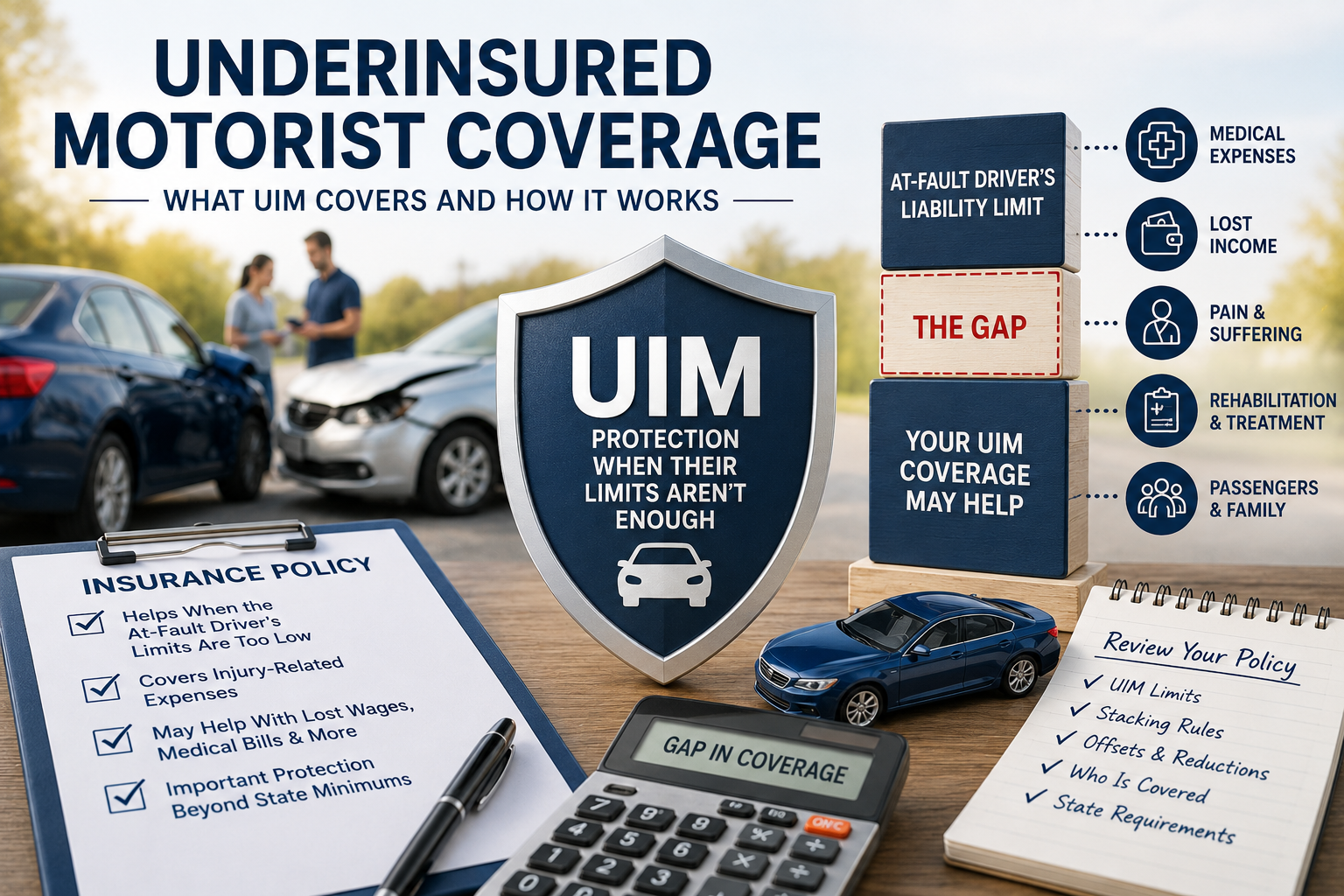
Underinsured Motorist Coverage, often called UIM, is auto insurance protection that may help when another driver causes a covered crash but does not carry enough liability insurance to fully address the eligible loss. The at-fault driver has insurance, but the available liability limit may be too low.
That is the central UIM problem: not zero insurance, but not enough insurance.
For U.S. drivers, Underinsured Motorist Coverage can be an important part of understanding how an auto policy responds after a serious accident. The actual protection depends on state law, the policy form, selected limits, definitions, exclusions, offsets, stacking rules, claim facts, and other available insurance.
This guide explains the coverage in plain English, including how UIM differs from uninsured motorist coverage, what losses it may address, how limits work, why state rules matter, and what to compare before changing a policy.
Educational note: PolicyQuotesUS.com provides general U.S. personal auto insurance education only. We are not an insurer, insurance agency, broker, quote marketplace, claims service, legal service, or coverage approval service. Coverage requirements, limits, exclusions, claim procedures, settlement methods, stacking rules, and availability vary by state, insurer, vehicle, driver, policy, and accident circumstances. Review official state information and the controlling policy documents before purchasing, changing, rejecting, or relying on coverage.
Decision Snapshot: The UIM Shortfall Test
Underinsured Motorist coverage matters when the at-fault driver’s available liability insurance may be too small for a covered loss. Use the UIM Shortfall Test to understand the role of the coverage without assuming it automatically pays every remaining dollar.
- Establish responsibility: determine whether the other driver is legally responsible under the facts and applicable rules.
- Identify available liability insurance: confirm what liability limit is actually available from the at-fault driver.
- Identify the covered loss: determine which damages are recognized under the applicable UIM coverage.
- Apply the UIM limit: check the declarations page and any state or policy rules affecting limits, offsets or reductions.
- Check procedural requirements: settlement consent, notice, evidence and other claim conditions may affect the process.
Decision rule: think of UIM as protection against an insured-but-insufficient driver, not as an unlimited top-up fund.
What Underinsured Motorist Coverage Means
Underinsured Motorist Coverage is designed for a specific problem: an at-fault driver has liability insurance, but the available liability limit is insufficient for the covered loss.
Suppose another driver causes a serious accident. Their insurer accepts a covered liability claim, but the driver’s bodily injury limit is lower than the eligible damages arising from the crash. UIM may then become relevant under the injured person’s own applicable policy.
UIM does not automatically pay every amount left over. Coverage still depends on:
- Who qualifies as an insured person
- The applicable UIM limit
- The other driver’s available liability insurance
- State law
- Policy definitions
- Exclusions
- Claim documentation
- Fault and damage determinations
- Offset or reduction provisions
- Stacking rules where relevant
- Other available insurance
Drivers unfamiliar with terms such as policy limit, endorsement, exclusion, declarations page, or stacking can use the auto insurance glossary before reading the policy.
Underinsured vs Uninsured Motorist Coverage
The difference is simple and important.
Uninsured motorist coverage: the responsible driver has no usable liability insurance, or another qualifying uninsured-driver situation applies.
Underinsured Motorist Coverage: the responsible driver has liability insurance, but the available amount is too low for the covered loss.
The dedicated uninsured motorist coverage pillar owns the no-usable-insurance topic.
This page owns the not-enough-insurance topic.
That separation matters because the two coverages may be combined on a policy, but they solve different insurance gaps.
A simple memory rule is:
UM = no usable insurance.
UIM = not enough insurance.
Why UIM Can Matter After a Serious Crash
A driver can legally satisfy a state’s liability requirement and still carry a limit that is insufficient for a severe accident.
Medical treatment, rehabilitation, lost earnings, and other legally recognized damages can become substantial after a serious injury.
If the at-fault driver’s available liability coverage is exhausted, Underinsured Motorist Coverage may provide another source of eligible protection, subject to the injured person’s own policy and applicable law.
This is why minimum insurance and adequate protection are separate questions.
The minimum car insurance requirements pillar explains the legal floor. A state minimum establishes what may be required by law; it does not guarantee that the available amount will cover every serious loss.
For the broader policy-planning question, see what coverage do I need for auto insurance.
What Underinsured Motorist Coverage May Cover
UIM is commonly associated with bodily injury losses.
Depending on the state and policy, eligible damages may potentially involve:
- Medical expenses
- Rehabilitation expenses
- Lost income
- Future income loss where recognized
- Pain and suffering where legally recoverable
- Other covered bodily injury damages
- Passenger injury claims
- Certain pedestrian injuries
The exact categories are not universal.
Underinsured Motorist Coverage does not turn every accident-related cost into a covered claim. The insurer may evaluate whether the person qualifies as an insured, whether the other driver is legally responsible, whether the other vehicle meets the policy definition of underinsured, whether the damages are covered, and whether all procedural requirements have been satisfied.
Does UIM Pay for Vehicle Damage?
Not always.
Many UIM discussions focus on bodily injury. Property-damage protection can be structured differently depending on the state and policy.
Some policies or jurisdictions may provide an underinsured motorist property-damage form or related protection. In other situations, vehicle damage may instead be addressed through collision coverage or another applicable policy provision.
Drivers should not assume the letters “UIM” automatically protect the car.
The comprehensive vs collision insurance guide explains the separate physical-damage role of those coverages.
If vehicle damage matters to the decision, verify whether the policy shows:
- UIM bodily injury
- UIM property damage
- Combined UM/UIM protection
- Collision coverage
- A deductible
- Separate limits or conditions
Read the declarations page and coverage forms rather than relying on a short quote label.
How a UIM Claim May Develop
The exact claim process varies, but the general sequence can be easier to understand as a series of questions.
1. Was the Other Driver Responsible?
The accident facts and applicable law are reviewed.
2. Does the Other Driver Have Liability Insurance?
If there is no usable liability policy, uninsured motorist protection may be the more relevant coverage.
3. Is the Available Liability Limit Insufficient?
If the responsible driver has coverage but the available limit is not enough for the eligible loss, Underinsured Motorist Coverage may become relevant.
4. Does the Injured Person Qualify Under the UIM Policy?
The policy definition of an insured person matters.
5. What UIM Limit Applies?
The declarations page identifies the selected coverage, while the policy explains how the limit operates.
6. Do Offsets, Reductions, or Other Rules Apply?
The policy and state law may affect how amounts paid by another insurer interact with the UIM benefit.
This is why the simple phrase “it covers the difference” can be incomplete. Actual payment calculations can be more complicated.
UIM Limits and the Declarations Page
Always review Underinsured Motorist Coverage together with its limit. The declarations page can show whether UIM is included and the selected amount.
Depending on the policy structure, bodily injury limits may be displayed using separate per-person and per-accident figures. Other structures can also exist.
Ask:
- What UIM limit did I select?
- Is the limit per person, per accident, or structured another way?
- Is UIM combined with uninsured motorist coverage?
- Is property-damage protection separate?
- Are passengers included?
- Are resident family members included?
- Does coverage apply when an insured is a pedestrian?
- Does the policy contain offset or reduction language?
- Can coverage from multiple vehicles or policies be combined?
- Are there consent or notice requirements before settlement?
The limit is the financial boundary. The policy wording explains how that boundary works.
What Offsets and Reductions Can Mean
Underinsured motorist claims can involve rules that reduce the amount available under the insured person’s policy.
For example, another driver’s liability insurer may pay its available limit first. The UIM policy may then apply a particular calculation under state law and the policy wording.
That does not necessarily mean the UIM insurer simply writes a check for the mathematical difference between the total loss and the first insurer’s payment.
Different policy forms and state rules can produce different results.
The selected UIM limit is not the same thing as a guaranteed additional payment. If a claim is substantial or disputed, professional insurance or legal guidance may be appropriate.
What Stacking Means
“Stacking” generally refers to whether UIM or UM limits from more than one insured vehicle or policy can be combined in a qualifying claim.
This can be highly state- and policy-specific.
Depending on the applicable rules, stacking may be:
- Permitted
- Restricted
- Prohibited
- Available only in particular circumstances
- Affected by policy language or selections
Do not assume that insuring several vehicles automatically multiplies the available UIM benefit.
Likewise, do not assume stacking is prohibited everywhere.
Check the declarations page, endorsements, policy forms, and official state guidance.
Who May Be Protected?
Underinsured Motorist Coverage may protect more than the person named first on the policy, but the exact definition matters.
Depending on the policy, eligible people may potentially include:
- The named insured
- A spouse
- Resident relatives
- Passengers
- Other qualifying occupants
- An insured person struck as a pedestrian
Coverage can also depend on household residency, other insurance, excluded-driver provisions, and the circumstances of the accident. Never assume every occupant has identical rights under every policy.
State Rules Are Critical
Underinsured Motorist Coverage is not regulated identically across the country.
Depending on the state, UIM may be required, required to be offered, optional, combined with uninsured motorist coverage, separately selected, or subject to a rejection or selection process.
State law can also affect:
- Available limits
- Definitions
- Stacking
- Claim procedures
- Settlement requirements
- Property-damage protection
- Arbitration or dispute processes
- How other insurance affects payment
The auto insurance by state hub explains why insurance requirements and policy structures can differ by jurisdiction.
When the legal rule matters, verify it through the appropriate state insurance department rather than relying on a rule from another state.
UIM and Bodily Injury Liability Are Different
Underinsured Motorist Coverage and bodily injury liability can appear on the same policy but protect against opposite sides of the liability problem.
Bodily injury liability generally addresses covered injuries an insured driver causes to other people.
UIM generally addresses certain covered injury losses suffered by an insured person when another at-fault driver’s liability protection is insufficient.
The what does liability car insurance cover guide explains liability coverage in more detail.
A driver selecting a strong liability limit should not automatically assume that the same amount of UIM is included.
Compare both lines on the declarations page.
Does a Lender Require UIM?
A lender or lessor is generally focused on protecting the financed or leased vehicle, which is why finance agreements commonly emphasize collision and comprehensive coverage.
Underinsured Motorist Coverage addresses a different risk. Meeting lender requirements therefore does not automatically answer the UIM question. Review legal requirements, lender requirements, and personal protection separately.
How UIM Can Affect an Auto Insurance Quote
Adding UIM, increasing its limit, or selecting different available options can affect the premium.
The price difference varies by insurer, state, driver profile, selected limits, and policy structure. Keep the UIM settings consistent when comparing quotes.
Otherwise, one quote may look cheaper because it contains:
- A lower UIM limit
- No UIM where rejection is permitted
- Different UM/UIM structure
- Different property-damage protection
- Different stacking treatment
- Different liability limits
Before using instant auto insurance quotes, gather the current declarations page and decide which limits and coverage selections should remain the same across each request.
A fair comparison requires like-for-like protection.
A Simple Underinsured Driver Scenario
Imagine another driver causes a covered crash.
The injured driver requires substantial medical treatment and misses work. The at-fault driver has liability insurance, but the available bodily injury limit is insufficient for the eligible damages.
The injured person’s Underinsured Motorist Coverage may then be reviewed.
The insurer may examine:
- Fault
- The other driver’s available liability coverage
- Medical documentation
- Wage-loss evidence
- Whether the injured person qualifies under the policy
- The selected UIM limit
- Applicable offsets or reductions
- State rules
- Other available insurance
Now change one fact.
If the at-fault driver had no usable liability insurance at all, uninsured motorist coverage could become the more relevant protection.
Change another fact.
If the claim is only for vehicle repairs, collision coverage or another property-damage provision may be more relevant than bodily injury UIM.
The correct coverage depends on the actual loss.
Common UIM Mistakes to Avoid
Assuming “Full Coverage” Automatically Includes UIM
“Full coverage” is not a standardized policy term.
Do not assume UIM is included merely because a policy has liability, comprehensive, and collision coverage.
Confusing Underinsured With Uninsured
The distinction is fundamental.
Uninsured means no usable at-fault liability coverage. Underinsured means coverage exists but is insufficient.
Looking Only at the Premium
A cheaper quote may simply contain weaker limits or fewer protections.
Ignoring the UIM Limit
The coverage name without the limit tells only part of the story.
Assuming Every Leftover Dollar Is Paid
Offsets, limits, exclusions, state law, policy definitions, and damages calculations can affect the amount payable.
Assuming UIM Always Repairs the Car
Bodily injury and property-damage protection should be checked separately.
Assuming Multiple Vehicles Automatically Multiply Coverage
Stacking rules vary.
Settling Without Checking Policy Requirements
Some policies or state rules can impose notice, consent, documentation, or other procedural requirements that matter before or during settlement.
Read the policy and seek qualified guidance when the stakes are significant.
Questions to Ask Before Choosing UIM
Before adding, rejecting, increasing, or changing Underinsured Motorist Coverage, ask:
- Is UIM required, offered, optional, or rejectable in my state?
- Is it combined with uninsured motorist coverage?
- What bodily injury limit applies?
- Is property-damage protection included or separate?
- Who qualifies as an insured person?
- Are passengers protected?
- Can pedestrian injuries qualify?
- Does a deductible apply to any part of the coverage?
- How does the policy define an underinsured vehicle?
- Do offsets or reductions apply?
- Can limits be stacked?
- Does insuring multiple vehicles change the available protection?
- Are there notice or consent requirements before settling with another insurer?
- How does UIM interact with other applicable insurance?
- Which policy form or endorsement controls the answer?
These questions turn a vague coverage label into a real policy review.
Final Takeaway
Underinsured Motorist Coverage addresses a simple but important insurance gap: another driver causes a covered loss, has liability insurance, but does not have enough available coverage for the eligible damages.
That differs from an uninsured-driver situation.
Confirm the state rules, selected limit, insured-person definition, bodily injury and property-damage treatment, and any provisions involving offsets, reductions, stacking, notice, or settlement. Keep UIM selections consistent across quotes.
Remember the basic distinction:
Uninsured = no usable insurance.
Underinsured = not enough insurance.
Questions and Answers About Underinsured Motorist Coverage
What Is Underinsured Motorist Coverage?
Underinsured Motorist Coverage is auto insurance protection that may help with certain covered losses when an at-fault driver has liability insurance but the available liability limit is insufficient, subject to the insured person’s policy and state law.
Is UIM the Same as Uninsured Motorist Coverage?
No. Uninsured motorist coverage generally addresses qualifying losses involving a driver with no usable liability insurance. UIM addresses the problem of insufficient liability insurance.
Is Underinsured Motorist Coverage Required?
It depends on the state. UIM can be mandatory, required to be offered, optional, combined with UM, or subject to a rejection or selection process.
Does UIM Automatically Pay Everything Above the Other Driver’s Limit?
No. The applicable UIM limit, policy wording, state law, covered damages, offsets, other insurance, exclusions, and claim facts can affect payment.
Does Underinsured Motorist Coverage Pay for Car Repairs?
Not necessarily. Many UIM provisions focus on bodily injury. Property damage may be handled through separate UIM property-damage coverage, collision coverage, or another applicable policy provision.
Can Passengers Be Covered by UIM?
They may be, depending on the policy definition of an insured person, other available insurance, state law, and the facts of the accident.
What Is UIM Stacking?
Stacking generally concerns whether limits from multiple insured vehicles or policies can be combined for a qualifying claim. The rules vary substantially by state and policy.
Should My UIM Limit Match My Liability Limit?
That is a coverage-selection question rather than a universal rule. Available choices and legal requirements vary. Compare the protection, premium, household exposure, and applicable state rules before making a decision.
Can I Add UIM After an Accident?
A policy change generally applies according to its effective date and cannot simply be added after a loss to create retroactive protection for an earlier accident. Confirm the effective date and policy terms with the insurer.
Helpful Official Resources
- NAIC Auto Insurance Consumer Information
- NAIC State Insurance Department Directory
- Insurance Information Institute Auto Insurance Basics
Author Bio
PolicyQuotesUS.com Editorial Team
The PolicyQuotesUS.com Editorial Team creates clear, neutral auto insurance education for drivers and households in the United States.
Copyright Notice
© 2026 – PolicyQuotesUS.com. All rights reserved.
This article about Underinsured Motorist Coverage is protected by copyright and may not be copied, scraped, spun, translated, republished, reproduced, distributed, or used for commercial purposes without prior written permission from PolicyQuotesUS.com. Brief quotations may be used with clear attribution and a link to the original article.
PolicyQuotesUS.com publishes original educational information about uninsured and underinsured motorist protection, liability limits, collision and comprehensive coverage, personal auto policies, claim considerations, state insurance requirements, and related U.S. auto insurance topics.
Unauthorized reuse of this content, including AI rewriting, content spinning, automated extraction, bulk scraping, database collection, or republication on another website, is prohibited.
Disclaimer
This Underinsured Motorist Coverage article provides general educational information for people living in the United States.
It is not personalized insurance, financial, legal, tax, medical, claims, or underwriting advice. It does not guarantee coverage, eligibility, savings, claim approval, settlement amount, renewal, or policy availability.
Underinsured Motorist Coverage requirements, definitions, limits, exclusions, deductibles, offsets, stacking rules, claim procedures, settlement methods, insurer practices, and availability can vary by state, insurer, vehicle, driver, household, policy form, and the facts of a loss.
Review the declarations page, coverage forms, endorsements, exclusions, definitions, conditions, and applicable state rules before relying on coverage.
This article does not replace the controlling policy documents, guidance from a licensed insurance professional, advice from a qualified attorney where legal issues arise, or information from an official state insurance regulator.