
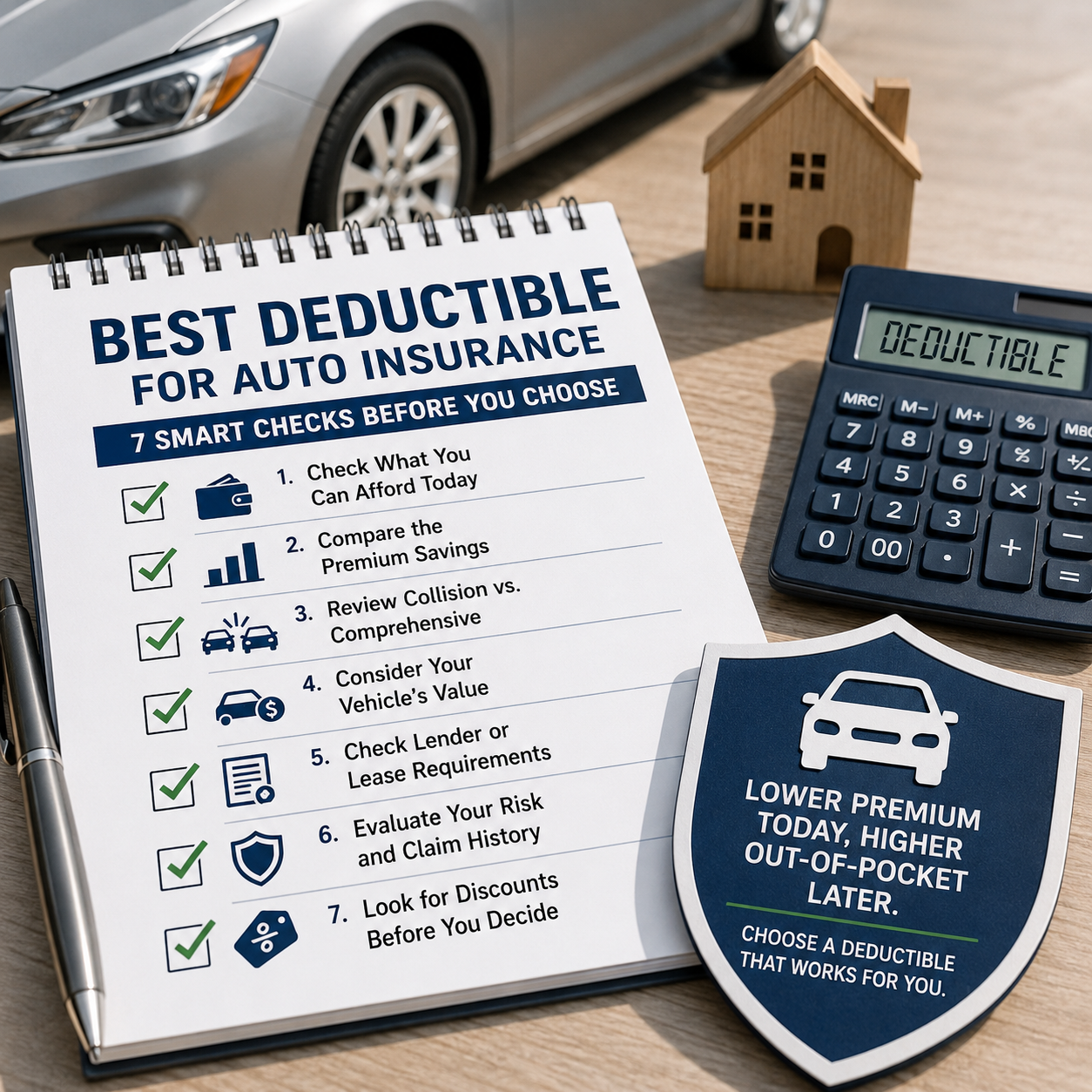
The Best Deductible for Auto Insurance is not one universal dollar amount. It is the deductible that fits your vehicle, policy, available savings, lender requirements, and ability to handle an unexpected covered loss without creating a financial emergency.
A deductible is the amount you generally absorb when a covered loss is subject to one. In personal auto insurance, deductibles are most commonly associated with collision and comprehensive coverage. A higher deductible may reduce the premium, while a lower deductible generally reduces the amount you must absorb when an eligible claim occurs.
That tradeoff sounds simple, but the right choice depends on more than the quote screen.
This guide explains how to compare deductible options, how collision and comprehensive deductibles work, how vehicle value and financing matter, how to test whether a deductible is actually affordable, and how to compare policies without accidentally choosing a cheaper quote that creates a bigger claim-day problem.
Educational note: PolicyQuotesUS.com provides general U.S. personal auto insurance education only. We are not an insurer, insurance agency, broker, quote marketplace, claims service, financial adviser, or coverage approval service. Deductibles, premiums, limits, exclusions, lender requirements, claim procedures, and available coverage options vary by insurer, state, vehicle, driver, household, policy, and claim. Review the declarations page, policy forms, endorsements, exclusions, and finance or lease requirements before selecting or changing a deductible.
Decision Snapshot: The Deductible Recovery Test
A higher deductible can lower a premium, but the useful question is whether the savings justify the extra amount you would have to absorb after a covered claim. The Deductible Recovery Test turns that trade-off into a simple comparison.
Formula: additional deductible exposure ÷ annual premium savings = approximate years of savings needed to offset that extra claim-day exposure.
Hypothetical example: suppose increasing a collision deductible from $500 to $1,000 lowers the annual premium by $120. The additional claim-day exposure is $500. Dividing $500 by $120 gives about 4.2 years. That does not predict whether a claim will happen. It simply shows how long the premium savings would take to equal the extra deductible if everything else stayed the same.
| Question | Why it matters |
|---|---|
| Could you pay the higher deductible tomorrow? | A deductible that looks efficient on paper can still be unaffordable at claim time. |
| How much premium does the higher deductible actually save? | Small savings may not justify a large increase in retained risk. |
| Does the lender or lease allow the deductible? | Contract limits can remove an otherwise available option. |
| Are collision and comprehensive priced separately? | The best deductible choice may differ by coverage. |
| Does the vehicle’s value change the decision? | A deductible should be considered in the context of the amount of vehicle value being protected. |
Decision rule: choose the highest deductible that remains comfortably payable and produces a premium saving large enough to matter—not simply the highest number an insurer offers.
What Best Deductible for Auto Insurance Means
The Best Deductible for Auto Insurance is the deductible that creates a workable balance between premium cost and the amount you could realistically pay after a covered loss.
The key word is realistically.
A deductible should not look affordable only because the monthly premium is lower. It should still make sense if a collision, theft, hail loss, animal strike, vandalism event, or another covered physical-damage loss happens unexpectedly.
A practical deductible should pass two tests:
- Can I comfortably afford the premium?
- Could I comfortably absorb the deductible if a covered claim happened soon?
If the answer to the second question is no, the deductible may be too aggressive even if the quote looks attractive.
For the broader policy question, what coverage do I need for auto insurance explains how deductibles fit alongside liability, collision, comprehensive, uninsured motorist protection, and other coverage choices.
How an Auto Insurance Deductible Works
A deductible is not a loan, fee, credit line, or repayment plan. It is part of the insurance contract.
Suppose a covered collision causes $3,200 of eligible vehicle damage and the applicable collision deductible is $500. The deductible is the policyholder’s share of that covered loss, subject to the policy and claim calculation.
If the deductible were higher, the policyholder would generally retain more of the claim cost.
The exact claim payment can still depend on:
- Repair estimates
- Actual cash value if the vehicle is totaled
- Policy limits
- Exclusions
- Betterment or depreciation provisions where applicable
- Covered versus uncovered damage
- Other insurance
- Claim facts
The Best Deductible for Auto Insurance should therefore be chosen before a claim occurs, not after the repair shop has already produced the estimate.
Which Auto Coverages Usually Have Deductibles?
Deductibles are most commonly associated with physical-damage coverage.
Collision Coverage
Collision coverage generally addresses covered damage to the insured vehicle caused by a collision with another vehicle or object, or another covered collision event.
A collision deductible normally applies when the policyholder uses collision coverage for an eligible claim.
Comprehensive Coverage
Comprehensive coverage generally addresses certain covered non-collision losses, such as theft, vandalism, fire, weather damage, falling objects, animal contact, or other listed causes.
A comprehensive deductible may be different from the collision deductible if the insurer allows separate selections.
The comprehensive vs collision insurance guide explains why the two coverages solve different vehicle-damage problems.
The Best Deductible for Auto Insurance does not necessarily mean choosing the same amount for every coverage.
Deductibles and Liability Coverage Are Different
Liability coverage generally works differently from collision and comprehensive.
Bodily injury liability and property damage liability are designed to address covered losses the insured driver causes to other people, subject to policy limits and terms.
A standard collision or comprehensive deductible should not be confused with liability limits.
This distinction matters because a driver can accidentally focus so heavily on lowering a physical-damage deductible that they ignore the much larger question of liability protection.
The liability vs full coverage auto insurance guide explains the difference between liability-focused protection and broader coverage that may include protection for the insured vehicle.
1. Start With the Claim-Day Affordability Test
The first Best Deductible for Auto Insurance test is simple:
Could you pay the deductible this week without missing an essential bill or relying on expensive debt?
If the answer is no, the deductible may be too high.
A deductible is not useful merely because it produces the lowest premium. Its purpose is to divide risk between the policyholder and insurer.
Consider the money that could be accessed quickly from:
- Emergency savings
- Ordinary savings
- Available household cash
- Other liquid funds that would not create serious hardship
Do not assume a credit-card limit is the same thing as deductible affordability.
Borrowing to fund a claim can add interest and turn a one-time insurance cost into a longer financial problem.
2. Compare the Premium Difference, Not Just the Deductible
The second step is to ask what you actually save by taking a higher deductible.
For example, request otherwise identical quotes using several available deductible options.
Keep the same:
- Drivers
- Vehicle
- Garaging location
- Mileage
- Vehicle use
- Liability limits
- Collision coverage
- Comprehensive coverage
- Optional endorsements
Then compare the total premium difference.
If increasing the deductible substantially raises your claim-day responsibility but changes the premium only slightly, the tradeoff may not be attractive.
If the premium difference is meaningful and the higher deductible is comfortably affordable, the higher option may deserve consideration.
There is no universal answer because insurer pricing differs.
3. Review Collision and Comprehensive Separately
The Best Deductible for Auto Insurance may differ between collision and comprehensive coverage.
Collision risk and comprehensive risk are not identical.
A driver who commutes in heavy traffic may think differently about collision exposure than a driver whose vehicle spends most of its time parked.
A vehicle routinely parked outdoors may face theft, hail, storm, tree, animal, or vandalism exposure that affects how the owner thinks about comprehensive coverage.
Ask the insurer whether separate deductibles are available.
Then compare each choice rather than assuming one deductible must control everything.
4. Consider the Vehicle’s Value
Vehicle value matters.
Imagine two drivers:
- Driver A owns a newer vehicle with significant market value.
- Driver B owns an older paid-off vehicle worth much less.
The same deductible can represent a very different percentage of the vehicle’s value.
For an older vehicle, the owner may want to compare the cost of collision and comprehensive coverage, the deductible, and the vehicle’s approximate current value.
For a newer vehicle, losing or seriously damaging the car may create a much larger financial problem.
The Best Deductible for Auto Insurance should make sense relative to the asset being protected.
Do not choose physical-damage coverage or a deductible using the vehicle’s original purchase price alone. Current value, repair cost, coverage cost, and financial ability all matter.
5. Check Lender or Lease Requirements
A financed or leased vehicle adds another layer.
A lender or lessor may require collision and comprehensive coverage while its financial interest remains in the vehicle. A contract may also limit the deductible options the borrower or lessee can select.
That means a deductible can be acceptable to the insurer but still conflict with the finance or lease agreement.
Before changing the Best Deductible for Auto Insurance on a financed or leased vehicle:
- Check the finance or lease documents
- Confirm required physical-damage coverage
- Check any deductible restrictions
- Verify lienholder information
- Confirm the new policy remains compliant
The leased car insurance guide explains why lease requirements can go beyond the legal minimum.
State law and lender requirements should also be kept separate. Minimum car insurance requirements explains the legal baseline, while a lender or lessor may require additional protection under the contract.
6. Think About Claim Frequency and Risk Exposure
No one can predict exactly when a claim will happen, but drivers can still think about their exposure.
Relevant factors can include:
- Annual mileage
- Commuting frequency
- Parking environment
- Weather exposure
- Theft exposure
- Driver experience
- Household drivers
- Vehicle repair cost
- Recent claim history
- Typical roads and traffic
These factors do not produce a guaranteed “correct” deductible.
They help put the deductible into context.
A driver with strong savings and limited vehicle use may be comfortable carrying more of a future loss.
A driver with little accessible cash may value a lower deductible even if the premium is higher.
The Best Deductible for Auto Insurance is therefore partly a risk-retention decision.
7. Compare Discounts Before Raising the Deductible Too Far
A higher deductible is only one possible way to reduce a premium.
Before taking substantially more claim-day risk, check whether legitimate discounts could improve the price without changing the deductible as much.
The best auto insurance discounts guide explains common categories and why eligibility differs by insurer and state.
Possible premium changes may come from:
- Multi-policy arrangements
- Multi-vehicle eligibility
- Driving-related discounts
- Vehicle safety features
- Anti-theft equipment
- Low-mileage programs
- Payment choices
- Other insurer-specific programs
Do not assume a discount will apply.
Ask the insurer what is available and compare the final policy rather than an advertised maximum saving.
Does a Higher Deductible Always Mean a Lower Premium?
Often, a higher deductible can reduce the premium for the coverage where that deductible applies.
But the amount of the reduction is not fixed.
It can depend on:
- Insurer
- State
- Vehicle
- Coverage
- Driver profile
- Deductible options
- Rating structure
The Best Deductible for Auto Insurance should therefore be based on the actual quote difference.
Do not raise a deductible because an article says it “usually saves money” without checking what it saves on your specific quote.
How State Rules Can Affect Deductibles
Auto insurance is regulated at the state level, so deductible structures and specific coverage rules can vary.
The auto insurance by state hub explains why state requirements, injury coverage, proof rules, policy structures, and consumer protections are not identical nationwide.
State differences may affect:
- Available coverage forms
- Glass coverage
- UM/UIM property-damage deductibles
- Required coverages
- Policy wording
- Claim procedures
The declarations page and policy documents remain the best source for the deductible actually attached to a specific policy.
A Simple Deductible Comparison Example
Suppose an insurer offers Driver A two otherwise similar collision options:
Option 1: lower deductible, higher premium
Option 2: higher deductible, lower premium
The useful comparison is not simply which premium is lower.
Driver A should ask:
- How much premium is actually saved over the policy term?
- How much additional money would be owed after a covered collision under the higher deductible?
- Is that additional amount already available in savings?
- Does the lender or lease permit the higher deductible?
- Would the higher deductible make a smaller covered repair impractical to claim?
The Best Deductible for Auto Insurance becomes clearer when those questions are answered together.
Common Deductible Mistakes
Choosing the Highest Deductible Only for the Cheapest Quote
A low premium is not useful if the deductible would be difficult to pay.
Assuming a Deductible Applies Once Per Year
Auto insurance deductibles commonly apply to individual covered claims rather than functioning as one annual health-insurance-style deductible.
Ignoring the Vehicle’s Value
A deductible and physical-damage premium should be considered in relation to the vehicle’s current value.
Forgetting Lender or Lease Rules
Financed and leased vehicles may have contractual insurance requirements.
Assuming Collision and Comprehensive Must Use the Same Deductible
Available selections vary by insurer.
Comparing Different Policies
Keep limits and coverage consistent when comparing deductible options.
Raising the Deductible Before Checking Discounts
A legitimate discount may reduce premium without shifting as much additional claim risk to the driver.
Using Inaccurate Information to Lower the Quote
Do not misstate mileage, garaging, household drivers, vehicle use, or other material information.
How to Compare Deductibles When Requesting Quotes
Drivers preparing to shop can use instant auto insurance quotes as a quote-preparation guide.
For deductible comparison, request otherwise similar quotes using two or three deductible levels.
Create a simple comparison:
| Item | Option A | Option B | Option C |
|---|---|---|---|
| Collision deductible | Lower | Middle | Higher |
| Comprehensive deductible | Lower | Middle | Higher |
| Total premium | Compare | Compare | Compare |
| Extra claim-day responsibility | Compare | Compare | Compare |
| Lender compliant? | Confirm | Confirm | Confirm |
| Comfortable from savings? | Yes/No | Yes/No | Yes/No |
This makes the tradeoff visible.
The Best Deductible for Auto Insurance is easier to choose when the numbers are compared side by side instead of relying on instinct.
Questions to Ask Before Changing a Deductible
Before making a change, ask:
- Which coverages have a deductible?
- What deductible is currently shown on the declarations page?
- What alternative deductible options are available?
- How much does each option change the total premium?
- Could I pay the higher deductible immediately if necessary?
- Does collision use a different deductible from comprehensive?
- Are glass claims treated differently?
- Does a lender or lease restrict the deductible?
- Does changing the deductible affect any endorsement?
- When would the new deductible become effective?
- Does the quote keep all other coverage and limits identical?
- Are there discounts worth checking first?
Those questions keep the decision focused on the actual policy.
Final Takeaway
The Best Deductible for Auto Insurance is not automatically the lowest deductible, the highest deductible, or the option that produces the cheapest quote.
It is the deductible that balances:
premium affordability + claim-day affordability + vehicle value + coverage needs + lender requirements
A higher deductible may reduce the premium but transfers more of a covered loss to the policyholder.
A lower deductible may reduce claim-day cost but can make the policy more expensive.
Compare actual quote differences. Keep coverage and limits consistent. Check collision and comprehensive separately. Review the vehicle’s current value. Confirm finance or lease requirements.
Most importantly, choose a deductible that could be paid from available funds without turning an ordinary covered vehicle loss into a larger household financial problem.
Questions and Answers About Best Deductible for Auto Insurance
What Is the Best Deductible for Auto Insurance?
The Best Deductible for Auto Insurance is the deductible that keeps the premium manageable while remaining realistically affordable if an eligible claim occurs. There is no universal deductible that suits every driver.
Is a Higher Auto Insurance Deductible Better?
Not automatically. A higher deductible may reduce the premium but increases the amount the policyholder generally absorbs after a covered loss.
Is a Lower Deductible Safer?
A lower deductible can reduce claim-day financial pressure, but it may increase the premium. The tradeoff should be compared using actual quotes.
Can Collision and Comprehensive Have Different Deductibles?
They may. Available deductible options depend on the insurer and policy. Check the declarations page and quote details.
Does Liability Insurance Have a Deductible?
Standard personal auto liability coverage generally works differently from collision and comprehensive deductibles. Review the specific policy because coverage structures can vary.
Can a Lender Limit My Deductible?
A finance or lease agreement may require physical-damage coverage and may place restrictions on deductible amounts. Check the contract before changing the policy.
Should I Raise My Deductible to Save Money?
Only after comparing the actual premium difference and confirming that the higher deductible could be paid comfortably after a claim.
Does the Deductible Apply to Every Claim?
It depends on the coverage and claim. Collision and comprehensive deductibles generally apply when those respective coverages respond, subject to the policy.
How Do I Know if My Auto Insurance Deductible Is Too High?
Your deductible may be too high if paying it after a covered claim would force you to miss essential bills, delay repairs, or rely on expensive debt. The Best Deductible for Auto Insurance should be an amount you can realistically afford from available funds while still keeping the premium manageable.
Helpful Official Resources
- NAIC Auto Insurance Consumer Information
- NAIC What Does Auto Insurance Cover?
- Insurance Information Institute — Understanding Your Insurance Deductibles
- Consumer Financial Protection Bureau — Auto Insurance When Financing a Car
Author Bio
PolicyQuotesUS.com Editorial Team
The PolicyQuotesUS.com Editorial Team creates clear, neutral auto insurance education for drivers and households throughout the United States.
Copyright Notice
© 2026 – PolicyQuotesUS.com. All rights reserved.
This article about the Best Deductible for Auto Insurance is protected by copyright and may not be copied, scraped, spun, republished, reproduced, distributed, or used commercially without prior written permission from PolicyQuotesUS.com. Brief quotations may be used with clear attribution and a link to the original article.
PolicyQuotesUS.com publishes original educational information about auto insurance deductibles, premiums, collision and comprehensive coverage, liability coverage, policy limits, claims, vehicle protection, insurance quotes, and related U.S. personal auto insurance topics.
Unauthorized reuse including AI rewriting, content spinning, automated extraction, bulk scraping, database collection, or republication on another website is prohibited.
Disclaimer
This Best Deductible for Auto Insurance article provides general educational information for people living in the United States.
It is not personalized insurance, financial, legal, tax, claims, lending, or underwriting advice. It does not recommend a particular deductible, insurer, policy, coverage limit, or financial decision.
Deductible options, premiums, limits, exclusions, lender requirements, claim procedures, discounts, policy terms, and available coverages can vary by state, insurer, vehicle, driver, household, policy, and the facts of a loss.
A higher deductible may reduce premium cost but increases the policyholder’s potential share of an eligible loss. A lower deductible may reduce that immediate share but may increase the premium. Neither outcome is guaranteed.
Review the declarations page, policy forms, endorsements, exclusions, coverage limits, finance or lease requirements, and applicable state rules before purchasing or changing coverage.
PolicyQuotesUS.com does not issue insurance policies, calculate or guarantee quotes, determine eligibility, approve claims, make coverage decisions, or provide personalized deductible recommendations.