
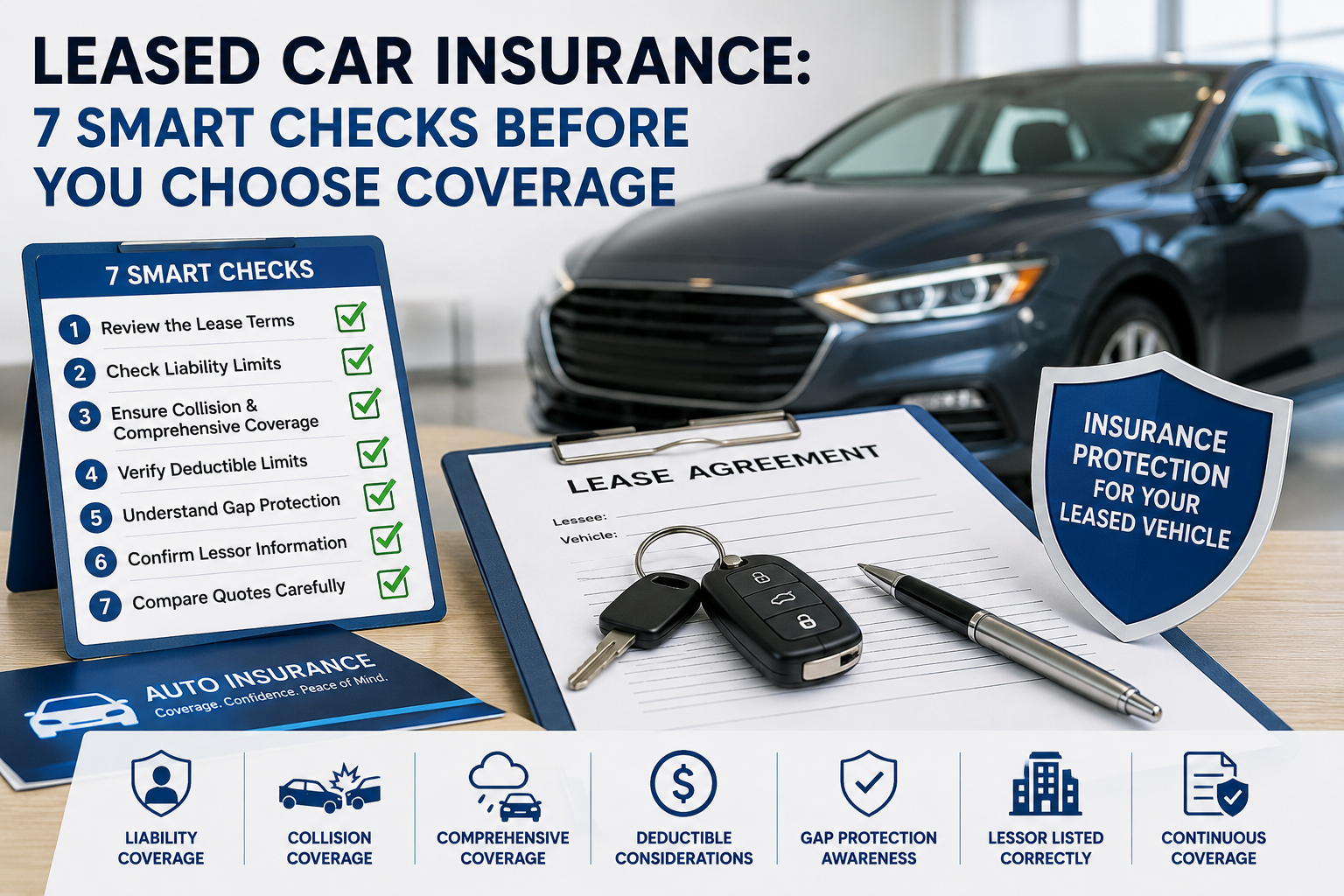
Leased car insurance protects a vehicle that you drive but do not legally own.
The leasing company remains the owner of the vehicle during the lease, so your insurance normally has to satisfy two separate sets of requirements:
- State auto insurance law
- The insurance conditions written into the lease agreement
That difference matters.
A policy might satisfy the minimum insurance required to drive legally in your state but still fail to satisfy the leasing company’s requirements.
Leased car insurance commonly involves:
- Liability insurance
- Collision coverage
- Comprehensive coverage
- Deductible restrictions
- Correct lessor information
- Possible gap-related protection
- Continuous insurance throughout the lease
The smartest approach is simple:
check the lease → check state requirements → match the policy → confirm the documents
This guide explains seven important checks drivers should make when arranging leased car insurance.
Educational note: PolicyQuotesUS.com provides general U.S. personal auto insurance education only. We are not an insurer, insurance agency, broker, quote marketplace, claims service, leasing company, financial adviser, or coverage approval service. We do not sell, issue, bind, approve, underwrite, recommend, or adjust insurance policies. Lease requirements, insurance limits, deductibles, coverage requirements, premiums, eligibility, exclusions, gap protection, and policy terms vary by state, insurer, leasing company, vehicle, driver, household, and contract. Always review the lease agreement, declarations page, policy forms, endorsements, exclusions, and applicable state requirements before relying on coverage.
Decision Snapshot: The Lease Compliance Stack
Leased car insurance has four overlapping rule sets. Check them in the right order so a policy is not merely legal, but also compliant with the lease and suitable for the vehicle.
| Layer | What to verify |
|---|---|
| State rules | Use the auto insurance by state framework to identify the legal baseline and the correct official agencies. |
| Lease contract | Check liability limits, collision/comprehensive requirements, maximum deductibles and how the leasing company must be listed. |
| Coverage fit | Review the wider question of what coverage you may need for auto insurance rather than assuming the lease contract answers every personal protection decision. |
| Quote comparison | When using car insurance quotes online, hold lease-required limits and deductibles constant so price differences are meaningful. |
Decision rule: a leased-car policy must satisfy the strictest applicable obligation among state law, the lease contract and the selected insurer’s policy terms. A cheaper quote that fails one of those layers is not a usable alternative.
What Leased Car Insurance Really Means
Leased car insurance is generally not a special standalone type of auto insurance.
It is usually a personal auto insurance policy covering a leased vehicle while also meeting the requirements imposed by the company that owns the vehicle.
The leasing company has a financial interest in protecting the car.
That is why leased car insurance often includes broader protection than a driver might choose for an older vehicle owned outright.
A lease may specify requirements involving:
- Bodily injury liability
- Property damage liability
- Collision coverage
- Comprehensive coverage
- Maximum deductibles
- Proof of insurance
- How the leasing company is listed
- Continuous coverage
The exact requirements are found in the lease agreement.
Do not assume every lease uses identical standards.
State Requirements and Lease Requirements Are Different
Understanding leased car insurance starts with separating two questions.
What Does the State Require?
State law establishes the legal insurance baseline.
This can include required liability insurance and, depending on the jurisdiction, other types of coverage.
What Does the Leasing Company Require?
The lease contract can impose additional insurance requirements because the leasing company owns the vehicle.
For example, a lease may require collision and comprehensive coverage even though those coverages are not generally required by state law.
It may also impose:
- Higher liability limits
- Maximum deductible amounts
- Specific lessor-listing requirements
The driver normally has to satisfy both.
1. Compare the Lease Agreement With State Requirements
The first leased car insurance check should happen before comparing premiums.
Read the insurance section of the lease.
Look for requirements involving:
- Liability coverage
- Required limits
- Collision
- Comprehensive
- Deductibles
- Gap protection
- Proof of insurance
- Continuous coverage
- Lessor information
Then compare those requirements with the applicable state insurance rules.
The minimum car insurance requirements guide explains the legal baseline.
But the state minimum is only the beginning for a leased vehicle.
Example
Suppose a state allows a driver to satisfy the law with a relatively basic liability policy.
The lease contract separately requires:
- Higher liability limits
- Collision coverage
- Comprehensive coverage
- Deductibles below a specified maximum
The driver cannot simply choose the state minimum and assume the lease has been satisfied.
The lease agreement adds another layer.
Do Not Reduce Coverage Without Checking
A common leased car insurance mistake is reducing coverage later because the driver sees a cheaper option.
Before changing:
- Liability limits
- Collision
- Comprehensive
- Deductibles
check the lease again.
A policy can remain legal under state law while violating the lease agreement.
2. Check Liability Coverage and Limits
Liability insurance is a central part of leased car insurance.
It generally addresses covered injuries or property damage that an insured driver becomes legally responsible for causing to other people.
The two main components are:
- Bodily injury liability
- Property damage liability
The what does liability car insurance cover guide explains this protection in more detail.
Lease Liability Requirements Can Be Higher
A leasing company may require liability limits above the state minimum.
That means a driver comparing leased car insurance quotes should not simply accept whatever default limit appears first.
Check the lease.
Then request the required limits from every insurer.
Compare Identical Limits
Suppose:
Quote A: lower liability limits and lower premium
Quote B: higher liability limits and higher premium
That is not a proper price comparison.
The policies provide different protection.
For leased car insurance, compare:
same liability limits → then compare premiums
That gives you a much clearer picture.
3. Expect Collision and Comprehensive Coverage
Leased car insurance commonly requires both collision and comprehensive coverage.
Why?
Because the leasing company owns the vehicle and wants its financial interest protected if the car is damaged or lost.
Collision Coverage
Collision coverage may address covered damage to the leased vehicle caused by incidents such as:
- Collision with another vehicle
- Collision with an object
- Certain rollover events
Coverage remains subject to the policy terms and deductible.
Comprehensive Coverage
Comprehensive coverage may address certain covered non-collision losses, including:
- Theft
- Vandalism
- Fire
- Hail
- Storm damage
- Flood
- Falling objects
- Animal contact
The comprehensive vs collision insurance guide explains the distinction.
Why This Matters More With a Lease
A driver who owns an older vehicle outright might choose not to carry physical-damage coverage.
A leased vehicle is different.
The driver does not have complete freedom to remove coverage if the lease contract requires it.
That makes collision and comprehensive two of the most important leased car insurance checks.
4. Check the Maximum Deductible Allowed by the Lease
A deductible is the amount the policyholder generally pays toward a covered collision or comprehensive claim before the insurer contributes.
For example, a policy may use:
- $500 deductible
- $1,000 deductible
depending on the options available.
Higher deductibles can sometimes reduce the premium.
But leased car insurance has another complication:
the leasing company may restrict how high the deductible can be.
Why the Lease Can Restrict Deductibles
The leasing company owns the vehicle.
A very high deductible increases the amount the driver must pay before insurance contributes to repairing the lessor’s asset.
For that reason, the contract may specify a maximum permitted deductible.
Three Things to Check
When selecting a leased car insurance deductible, compare:
1. The lease requirement
Does the deductible satisfy the contract?
2. Your financial ability
Could you pay the deductible comfortably after an unexpected loss?
3. The premium difference
How much are you actually saving by choosing a higher deductible?
The best deductible for auto insurance guide explains this tradeoff in greater detail.
Do not choose the highest deductible purely because Rank Math—or a quote screen—shows a cheaper premium.
5. Understand Gap Protection
Leased car insurance and gap protection are related, but they are not the same thing.
Suppose a leased vehicle is declared a total loss.
The auto insurer’s covered settlement may be based on the insured vehicle’s value according to the policy.
The amount owed under the lease can be different.
That difference creates possible gap exposure.
Some Leases Already Address the Gap
Some lease agreements may include:
- Gap waiver provisions
- Gap protection
- Similar contractual arrangements
Other leases may handle the issue differently.
That means drivers should not automatically buy separate gap insurance without first checking the lease.
The gap insurance guide explains the broader concept.
Ask These Questions
Before adding gap-related protection to leased car insurance, determine:
- Does the lease already include gap protection?
- Is it a waiver or insurance product?
- What events qualify?
- What exclusions apply?
- Are deductibles included?
- Are overdue payments covered?
- Are excess mileage or wear charges excluded?
- Can separate gap insurance be added to the auto policy?
The answers depend on the specific contract.
Gap Does Not Replace Collision or Comprehensive
This is important.
Gap-related protection generally addresses a financial difference after a qualifying total loss.
Collision and comprehensive protect against covered physical damage to the vehicle.
They solve different problems.
6. Make Sure the Leasing Company Is Listed Correctly
Leased car insurance usually needs to show the leasing company’s financial interest in the vehicle.
The exact terminology can vary by insurer and contract.
You may see descriptions such as:
- Lessor
- Additional interest
- Loss payee
- Other insurer-specific terminology
Follow the instructions in the lease.
Use the Exact Information
Do not guess the leasing company’s details.
Use the exact:
- Legal name
- Address
- Account information if requested
shown in the lease or supplied by the leasing company.
Incorrect information can create unnecessary problems with proof of insurance.
Review the Declarations Page
After the leased car insurance policy is issued, check:
- Vehicle year
- Make
- Model
- VIN
- Garaging address
- Named insured
- Listed drivers
- Liability limits
- Collision coverage
- Comprehensive coverage
- Deductibles
- Leasing-company information
- Effective date
Do this before assuming everything was entered correctly.
7. Compare Leased Car Insurance Quotes on Equal Terms
Leased car insurance premiums can vary substantially between insurers.
But the lowest number is meaningful only when the policies are genuinely comparable.
Use identical information for every quote.
Keep the same:
- Drivers
- Vehicle
- VIN
- Garaging address
- Annual mileage
- Vehicle use
- Liability limits
- Collision coverage
- Comprehensive coverage
- Collision deductible
- Comprehensive deductible
- Optional endorsements
- Payment frequency
Compare Total Cost
Do not focus only on:
first payment
or
monthly payment
Review:
- Total policy premium
- Installment fees where applicable
- Deductibles
- Limits
- Exclusions
- Endorsements
- Payment schedule
A lower monthly payment does not necessarily mean the leased car insurance policy costs less overall.
Why Leased Cars Usually Need More Coverage Than State Minimums
A state insurance law primarily addresses legal driving requirements.
The leasing company has another concern:
protecting the vehicle it owns.
That is why leased car insurance commonly includes collision and comprehensive coverage even when state law does not require them.
The difference can be summarized simply:
State requirement → protects legal compliance
Lease requirement → also protects the lessor’s financial interest
Drivers need to satisfy both.
Leased Car Insurance vs Financed Car Insurance
Leased and financed vehicles have similarities.
Both commonly involve a third party with a financial interest in the vehicle.
Both may require:
- Collision
- Comprehensive
- Certain deductible levels
- Correct lender or lessor information
But ownership differs.
Financed Vehicle
The buyer is generally purchasing the vehicle and gradually paying off the loan.
Leased Vehicle
The leasing company continues to own the vehicle while the customer pays for the right to use it under the lease terms.
That difference matters when reviewing contracts, total-loss procedures, mileage limits, wear charges, and end-of-lease obligations.
What Happens if Leased Car Insurance Lapses?
Allowing required insurance to lapse can create serious problems.
Depending on the lease agreement and circumstances, possible consequences can involve:
- Lease notices
- Contract problems
- Added costs
- Force-placed or lender-placed insurance
- Registration consequences
- Exposure to uninsured losses
The exact consequences depend on the contract and applicable law.
Do Not Cancel Before Replacement Coverage Starts
If changing insurers:
- Buy the replacement policy.
- Confirm the effective date and time.
- Confirm the required coverages.
- Confirm the deductibles.
- Confirm the lessor information.
- Obtain proof.
- Then terminate the old policy appropriately.
Do not create an accidental insurance gap while switching.
Can You Change Insurers During a Lease?
Generally, the important issue is not loyalty to one insurer.
It is maintaining insurance that satisfies the lease.
If changing companies, confirm that the new leased car insurance policy maintains:
- Required liability limits
- Collision
- Comprehensive
- Acceptable deductibles
- Correct lessor listing
- Continuous coverage
Also confirm how proof needs to be sent to the leasing company.
A cheaper insurer is useful only if the replacement policy still meets the contract.
What Happens if a Leased Car Is Damaged?
If the vehicle suffers covered damage, report the loss according to the insurer’s procedures.
The insurer may review:
- Accident circumstances
- Vehicle damage
- Coverage
- Deductible
- Exclusions
- Repair estimates
- Policy conditions
- Leasing company’s financial interest
Repairable Damage
If the vehicle can be repaired, the lease may contain requirements involving:
- Repair standards
- Approved repair procedures
- Vehicle condition
- Documentation
Review both the insurance policy and lease.
Do Not Ignore End-of-Lease Standards
A vehicle may later be inspected when returned.
Leases can contain requirements relating to:
- Excess wear
- Damage
- Missing equipment
- Mileage
Insurance does not automatically eliminate every end-of-lease charge.
What Happens if a Leased Car Is Totaled?
A total loss requires extra attention because the driver does not own the vehicle.
The insurer and leasing company may both become involved.
The insurance settlement and remaining lease obligation are separate figures.
That is where gap-related protection may become relevant.
Do Not Assume the Lease Ends Automatically
Continue following instructions from the leasing company until it confirms what happens next.
A total loss does not automatically mean every contractual obligation disappears immediately.
Check:
- Insurance settlement
- Lease balance
- Gap provision
- Deductible
- Outstanding payments
- Contract exclusions
- Remaining charges
Use the actual contract rather than assumptions.
What About Theft of a Leased Vehicle?
Theft is generally associated with comprehensive coverage rather than collision.
If a leased vehicle is stolen:
- Report the theft appropriately
- Notify the insurer
- Notify the leasing company when required
- Follow policy requirements
- Keep relevant documents
- Continue following lease instructions
If the vehicle is not recovered and becomes a total-loss claim, gap-related questions may also arise.
Again, the policy and lease documents control.
Household Drivers and Leased Cars
Leased car insurance applications need accurate driver information.
Do not assume only the person whose name appears on the lease matters.
The insurer may ask about:
- Spouse
- Partner
- Licensed household members
- Regular vehicle users
- Young drivers
- Other people with regular access
Answer accurately.
Leaving out a regular driver simply to reduce the premium can create significant insurance problems.
Vehicle Use Must Be Accurate
The insurer may also ask how the leased vehicle is used.
Possible categories include:
- Personal use
- Commuting
- Business use
- Delivery
- Rideshare
Describe the actual use.
A leased vehicle used for rideshare or delivery can raise additional insurance and lease questions.
Do not assume either the personal policy or lease automatically permits compensated driving.
Check both.
Common Leased Car Insurance Mistakes
Mistake 1: Buying Only the State Minimum
The lease may require more.
Mistake 2: Removing Collision
Leased vehicles commonly require collision coverage.
Mistake 3: Removing Comprehensive
The lease may also require comprehensive coverage.
Mistake 4: Choosing Too High a Deductible
Check the maximum allowed under the lease.
Mistake 5: Assuming Gap Is Automatically Included
Read the contract.
Mistake 6: Buying Duplicate Gap Protection
Check whether the lease already contains a gap waiver or similar protection.
Mistake 7: Listing the Leasing Company Incorrectly
Use the exact details provided.
Mistake 8: Comparing Quotes With Different Limits
Match the coverage first.
Mistake 9: Ignoring Household Drivers
Disclose regular drivers accurately.
Mistake 10: Failing to Disclose Vehicle Use
Commuting, rideshare, delivery, and business use can matter.
Mistake 11: Allowing Coverage to Lapse
Maintain continuous insurance throughout the lease.
Leased Car Insurance Checklist
Before accepting a policy, check:
| Leased Car Insurance Item | Confirmed? |
|---|---|
| State requirements checked | Yes / No |
| Lease insurance section reviewed | Yes / No |
| Liability limits meet lease | Yes / No |
| Collision included | Yes / No |
| Comprehensive included | Yes / No |
| Collision deductible allowed | Yes / No |
| Comprehensive deductible allowed | Yes / No |
| Gap arrangement checked | Yes / No |
| Leasing company listed correctly | Yes / No |
| VIN correct | Yes / No |
| Garaging address correct | Yes / No |
| Household drivers disclosed | Yes / No |
| Vehicle use accurate | Yes / No |
| Total premium reviewed | Yes / No |
| Effective date confirmed | Yes / No |
| Proof of insurance available | Yes / No |
This simple checklist can prevent most avoidable leased car insurance mistakes.
Questions to Ask Before Buying Leased Car Insurance
Ask:
- What liability limits does my lease require?
- Does the policy meet those limits?
- Is collision included?
- Is comprehensive included?
- What collision deductible is allowed?
- What comprehensive deductible is allowed?
- Does my lease already include gap protection?
- Is separate gap insurance necessary or available?
- How should the leasing company be listed?
- Are all household drivers correctly shown?
- Is my actual vehicle use covered?
- Are rideshare or delivery activities restricted?
- What happens after a total loss?
- What happens if the vehicle is stolen?
- How does the leasing company receive proof of insurance?
- Can I change insurers during the lease?
- What happens if coverage lapses?
Those questions expose the important details before they become problems.
Final Takeaway
Leased car insurance needs to satisfy more than the minimum insurance required to drive legally.
Because the leasing company owns the vehicle, the lease may require:
- Higher liability limits
- Collision coverage
- Comprehensive coverage
- Maximum deductibles
- Correct lessor information
- Continuous insurance
- Gap-related protection or documentation
The smartest approach is:
read the lease → verify state requirements → match the required coverage → compare equivalent quotes → confirm the issued policy
Do not choose leased car insurance purely on the lowest premium.
A cheap policy that fails the lease requirements is not genuinely cheaper if it creates contractual problems later.
Check:
- Liability
- Collision
- Comprehensive
- Deductibles
- Gap exposure
- Lessor listing
- Drivers
- Vehicle use
- Effective dates
Then make sure the declarations page matches what the lease requires.
That gives you a much stronger leased car insurance setup than relying on the words “full coverage” or assuming state-minimum insurance is enough.
Questions and Answers About Leased Car Insurance
What Is Leased Car Insurance?
Leased car insurance is generally a standard personal auto policy arranged to cover a leased vehicle while satisfying applicable state requirements and the insurance standards imposed by the leasing company.
Does a Leased Car Need Full Coverage?
Leased vehicles commonly require both collision and comprehensive coverage in addition to liability insurance. Check the lease for the exact requirements rather than relying on the informal term “full coverage.”
Can I Carry Only State-Minimum Insurance on a Leased Car?
The state minimum may satisfy legal requirements but still fail to satisfy the lease agreement. The lessor may require higher liability limits, collision, comprehensive, and specific deductibles.
Do Leased Cars Need Collision Insurance?
Leasing companies commonly require collision coverage because they own the vehicle and want protection against covered crash damage.
Do Leased Cars Need Comprehensive Insurance?
Comprehensive coverage is also commonly required to protect the leased vehicle against certain covered non-collision losses such as theft, weather, vandalism, or fire.
Does a Lease Limit My Deductible?
It can. Some leases specify maximum collision or comprehensive deductibles. Check the contract before choosing a deductible.
Do I Need Gap Insurance on a Leased Car?
Not always. Some leases already include gap-related protection or a gap waiver. Review the lease before buying separate protection.
Can I Change Insurance Companies During a Lease?
Usually the key requirement is maintaining uninterrupted insurance that continues to satisfy the lease. Confirm the new policy before canceling the existing one.
What Happens if My Leased Car Is Totaled?
The insurer will evaluate the covered loss according to the policy. The leasing company may receive or participate in the settlement because it owns the vehicle. Any remaining lease obligation and gap protection should then be reviewed separately.
What Happens if Leased Car Insurance Lapses?
The consequences depend on the lease, insurer, and state. A lapse can create contractual, registration, financial, and insurance problems, so continuous coverage is important.
Helpful Official Resources
- Federal Trade Commission — Financing or Leasing a Car
- National Association of Insurance Commissioners — Consumer Auto Insurance
- National Association of Insurance Commissioners — State Insurance Departments
Author Bio
PolicyQuotesUS.com Editorial Team
The PolicyQuotesUS.com Editorial Team creates clear, neutral educational content for U.S. consumers researching leased car insurance, liability coverage, collision coverage, comprehensive coverage, deductibles, gap protection, insurance quotes, and related auto insurance decisions.
Copyright Notice
© 2026 – PolicyQuotesUS.com. All rights reserved.
This article about leased car insurance is protected by copyright and may not be copied, scraped, spun, republished, reproduced, distributed, or used commercially without prior written permission from PolicyQuotesUS.com. Brief quotations may be used with clear attribution and a link to the original article.
PolicyQuotesUS.com publishes original educational information about U.S. personal auto insurance, leased car insurance, liability coverage, collision coverage, comprehensive coverage, uninsured motorist coverage, underinsured motorist coverage, personal injury protection, medical payments coverage, deductibles, policy limits, premiums, claims, gap protection, and related consumer insurance topics.
Unauthorized reuse, including AI rewriting, automated extraction, content spinning, bulk scraping, database collection, or republication on another website, is prohibited.
Disclaimer
This leased car insurance article provides general educational information intended for people living in the United States.
It is not personalized insurance, financial, legal, tax, leasing, claims, underwriting, or accounting advice.
Lease requirements, insurance limits, deductible requirements, gap arrangements, policy terms, premiums, eligibility rules, endorsements, exclusions, and insurer practices vary by state, insurer, leasing company, vehicle, driver, household, and circumstances.
PolicyQuotesUS.com does not sell insurance, issue policies, bind coverage, determine eligibility, guarantee insurance prices, approve claims, interpret individual lease contracts, or determine whether a particular loss is covered.
Review the lease agreement, insurance application, declarations page, policy forms, endorsements, exclusions, coverage limits, deductibles, and applicable state requirements before relying on coverage.
When necessary, confirm situation-specific questions with the leasing company, insurer, licensed insurance professional, state insurance regulator, or another appropriately qualified professional.