
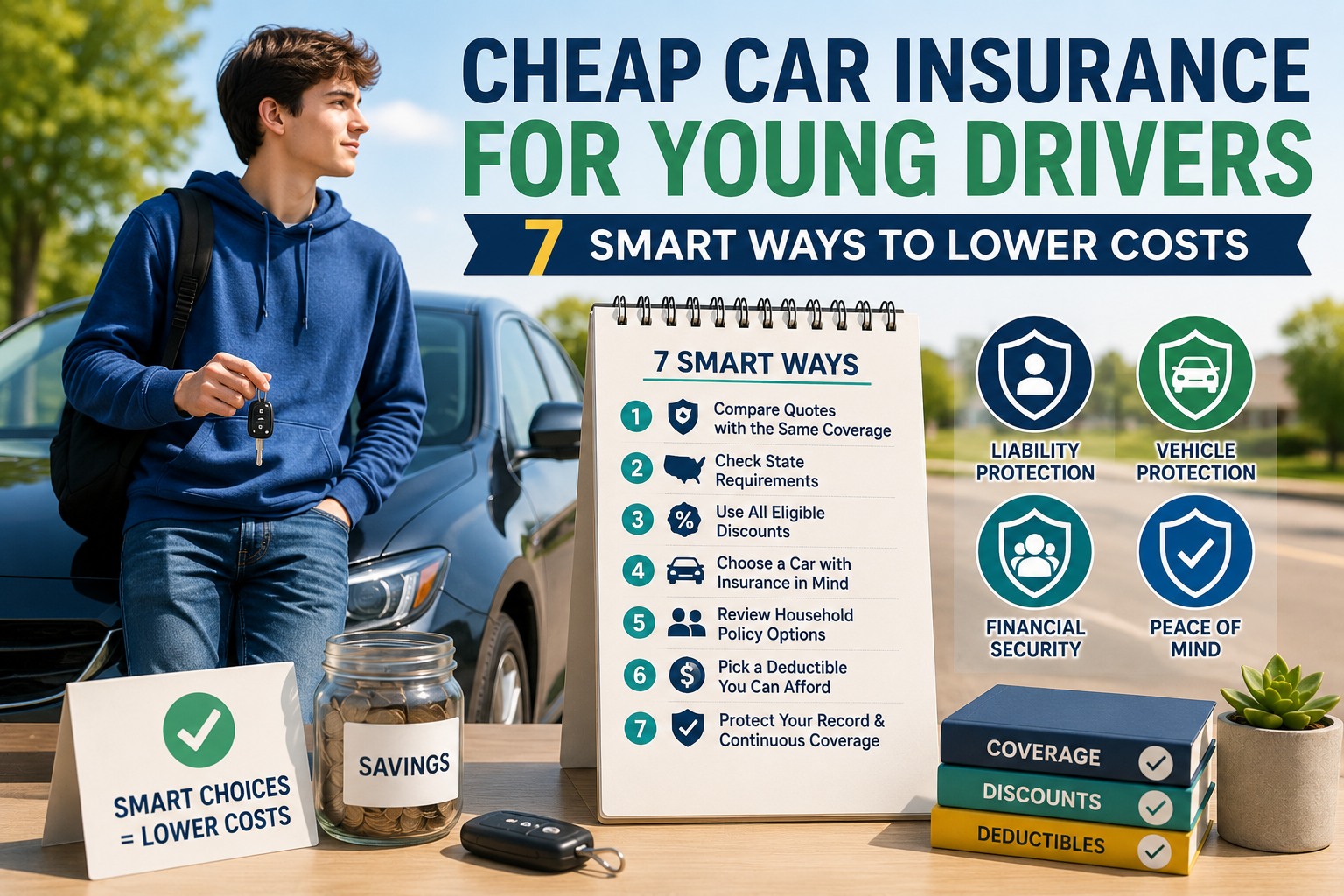
Cheap car insurance for young drivers is not simply the policy with the smallest advertised premium. A genuinely good result combines an affordable price with coverage that still protects the driver, vehicle, and household against meaningful financial risks.
Young drivers can face higher insurance costs because age, limited driving experience, driving history, vehicle choice, location, mileage, household arrangements, coverage selections, and other rating factors may affect premiums.
But expensive insurance should not automatically be accepted without comparison.
Young motorists and their families can often make smarter decisions by comparing insurers using identical coverage, checking available discounts, choosing vehicles with insurance costs in mind, reviewing household-policy options, selecting sensible deductibles, and keeping policy information accurate.
This guide explains seven practical ways to look for cheap car insurance for young drivers without accidentally stripping away important protection simply to produce a lower quote.
Educational note: PolicyQuotesUS.com provides general U.S. personal auto insurance education only. We are not an insurer, insurance agency, broker, quote marketplace, claims service, financial adviser, or coverage approval service. Premiums, discounts, deductibles, limits, eligibility, underwriting rules, state requirements, exclusions, policy terms, and available coverage vary by insurer, state, vehicle, driver, household, and policy. Always review the declarations page, complete policy wording, endorsements, exclusions, and applicable state requirements before purchasing or changing auto insurance.
Decision Snapshot: The Young-Driver Savings Stack
Young-driver premiums can be difficult to manage, but the safest cost strategy is to stack several legitimate savings levers rather than forcing the entire reduction through weaker coverage. Use the Young-Driver Savings Stack in this order.
- Compare insurer pricing: hold the driver facts and coverage design constant so you can see genuine pricing differences.
- Test household structure: compare an appropriate household-policy arrangement with a separate policy where both are legitimately available.
- Choose the vehicle carefully: check insurance before buying, because vehicle value, repair characteristics and other rating factors can materially affect cost.
- Apply legitimate discounts: ask about good-student, driver-education, telematics, multi-policy, payment and other discounts for which the driver may actually qualify.
- Adjust deductibles only after the first four steps: a higher deductible may reduce premium, but only use one the driver or household could realistically pay after a claim.
Decision rule: pursue savings that preserve the intended protection first. Coverage reductions should be conscious risk decisions, not the hidden side effect of chasing the lowest displayed premium.
What Cheap Car Insurance for Young Drivers Really Means
Cheap car insurance for young drivers should mean good-value insurance, not simply minimum-price insurance.
Those are different things.
Imagine two policies.
Policy A has the lower premium but also has:
- Lower liability limits
- A substantially higher collision deductible
- No optional rental reimbursement
- Different uninsured motorist protection
- Fewer applicable benefits
Policy B costs somewhat more but provides stronger limits and a deductible the driver could realistically afford after a covered accident.
Calling Policy A “cheaper” without comparing the protection can be misleading.
A better comparison asks:
What am I paying, what protection am I receiving, and what financial risk am I keeping?
That is the foundation for comparing cheap car insurance for young drivers properly.
Young motorists who are also arranging insurance for the first time should see car insurance for new drivers for the broader first-policy process.
Why Auto Insurance Can Cost More for Young Drivers
Auto insurers use multiple factors when developing premiums, subject to state rules and their own rating methods.
Those can include:
- Age
- Driving experience
- Driving record
- Claims history
- Vehicle
- Location
- Annual mileage
- Vehicle use
- Household drivers
- Prior insurance history
- Requested coverage
- Deductible choices
Younger motorists often have less driving history for an insurer to evaluate.
That does not mean every young driver receives the same price.
Two people of the same age can receive very different quotes because their circumstances are different.
For example, one young driver might:
- Drive an older sedan
- Live with parents
- Drive relatively few miles
- Have a clean record
Another might:
- Drive a newer performance vehicle
- Commute long distances
- Live in a different rating territory
- Have a recent violation
Cheap car insurance for young drivers therefore requires comparison based on the individual driver rather than assumptions based solely on age.
1. Compare Every Quote Using the Same Coverage
This is the most important rule.
Compare like with like.
If one insurer quotes $100,000 of liability protection and another uses only a much lower limit, you are not comparing equivalent policies.
The same applies to deductibles.
A quote using a $1,000 collision deductible should not be compared directly with another using $500 without recognizing the difference.
When comparing cheap car insurance for young drivers, keep these details as consistent as possible:
- Liability limits
- Collision coverage
- Comprehensive coverage
- Collision deductible
- Comprehensive deductible
- Uninsured motorist protection
- Underinsured motorist protection
- PIP or MedPay where applicable
- Rental reimbursement
- Roadside assistance
- Driver information
- Vehicle information
- Mileage
- Garaging address
- Vehicle use
Then compare the premium.
This prevents a stripped-down policy from appearing artificially attractive.
Compare the Total Cost
Do not look only at the first monthly payment.
Review:
- Total policy premium
- Initial payment
- Installment fees
- Payment schedule
- Discounts applied
- Deductibles
- Coverage limits
Cheap car insurance for young drivers should still be affordable over the full policy period.
2. Check State Requirements Before Cutting Coverage
Auto insurance requirements differ across the United States.
A young driver should know what the state requires before trying to reduce coverage.
Our auto insurance by state hub explains why state location can change the insurance question.
The minimum car insurance requirements guide explains the legal baseline in more detail.
But remember:
Minimum legal coverage and adequate financial protection are not necessarily the same thing.
State minimums are designed to satisfy legal requirements.
They do not guarantee that every loss from a serious accident will be fully covered.
Reducing liability limits simply to obtain cheap car insurance for young drivers can expose the driver or household to more financial risk if a serious at-fault accident occurs.
Review:
- State-required coverage
- Liability limits
- Injury-related requirements
- UM/UIM rules
- Proof requirements
- Lender or lease requirements
Then decide what protection makes sense.
3. Ask About Every Legitimate Discount
Discounts are one of the cleanest ways to look for cheap car insurance for young drivers because they may reduce premium without necessarily reducing coverage.
Available discounts differ by insurer and state.
Possible examples include:
- Good-student discounts
- Driver-education discounts
- Safe-driving programs
- Telematics programs
- Low-mileage discounts
- Multiple vehicles
- Multi-policy arrangements
- Vehicle safety equipment
- Anti-theft features
- Continuous-coverage discounts
- Certain payment arrangements
The best auto insurance discounts guide explains common discount categories in more detail.
Good-Student Discounts
Some insurers may offer discounts to qualifying students who meet specified academic requirements.
Do not assume eligibility.
Ask:
- What grades are required?
- What age limits apply?
- What documentation is needed?
- How often must eligibility be confirmed?
Driver-Education Discounts
Some insurers may recognize qualifying driver-training or education programs.
Again, this is not universal.
A course can still have safety value even where it does not produce an insurance discount.
Telematics Programs
Usage-based or telematics programs can monitor certain driving behaviors or usage information.
Before enrolling, understand:
- What information is collected
- How the program affects pricing
- Whether participation is optional
- What happens at renewal
- Whether poor driving results could affect the premium
Cheap car insurance for young drivers should not require agreeing to a program without understanding how it works.
4. Check Insurance Costs Before Choosing the Vehicle
Vehicle choice can have a major effect on insurance.
Do not buy the car first and investigate insurance later if you can avoid it.
Before purchasing a vehicle, request insurance estimates for the exact or closely matching vehicle.
Insurers may consider characteristics such as:
- Repair costs
- Vehicle value
- Theft exposure
- Safety equipment
- Performance
- Parts availability
- Claim experience associated with the vehicle
- Vehicle use
A modest vehicle does not guarantee cheap car insurance for young drivers, but vehicle choice can materially change the cost.
Compare Several Vehicles
Suppose a young driver is choosing between three cars.
Before buying, request comparable insurance quotes for all three.
The vehicle that costs slightly more to purchase could potentially cost less to insure, or vice versa.
The useful number is not simply:
purchase price
It is closer to:
purchase cost + insurance + fuel + registration + maintenance + likely repairs
Insurance should be part of the vehicle-shopping decision.
Be Careful With Performance Vehicles
A high-performance or expensive vehicle may increase the financial consequences of damage and may cost more to insure.
That does not mean every sporty vehicle is automatically unaffordable.
It means the young driver should obtain the insurance price before signing the purchase contract.
5. Compare Household Policy and Separate Policy Options
A young driver living with parents or relatives may sometimes be eligible to join an existing household auto policy.
In other situations, a separate policy may be appropriate.
The answer can depend on:
- Vehicle ownership
- Residence
- Regular vehicle access
- Household drivers
- Insurer rules
- State requirements
Cheap car insurance for young drivers can sometimes come from a family or multi-vehicle arrangement, but it should never be assumed.
Get actual quotes.
Keep Household Information Accurate
Insurers may ask about licensed residents and regular vehicle users.
Do not intentionally omit a driver simply to lower the quote.
The same applies to:
- Garaging address
- Mileage
- Vehicle ownership
- Commuting
- School use
- Delivery activity
- Rideshare activity
- Business use
A cheap quote based on incorrect information is not a reliable comparison.
The policy should reflect the actual household and actual use of the vehicle.
6. Choose the Deductible Carefully
Raising a collision or comprehensive deductible may reduce premium.
That can help create cheap car insurance for young drivers.
But the higher deductible also means the policyholder retains more financial responsibility when that deductible applies.
For example, consider two available collision deductibles:
$500 deductible
versus
$1,000 deductible
The higher deductible may produce a lower premium.
But the driver should ask:
Could I comfortably handle the higher amount after a covered collision?
If the answer is no, the premium reduction may not justify the additional risk.
Our best deductible for auto insurance guide explains this tradeoff in detail.
Compare Collision and Comprehensive Separately
Collision and comprehensive cover different types of vehicle damage.
The comprehensive vs collision insurance guide explains those differences.
Some insurers may allow different deductible selections for each.
Do not automatically choose the largest deductible simply because it lowers the premium.
Compare:
premium saving versus additional claim-day cost
Cheap car insurance for young drivers should remain usable if a covered loss actually happens.
7. Protect Your Driving Record and Continuous Coverage
This is the long game.
A young driver’s insurance situation can change as more driving and insurance history develops.
Avoiding:
- Speeding violations
- Distracted driving
- At-fault crashes
- Impaired driving
- Other unsafe behavior
is valuable first and foremost because it protects people.
It can also help avoid adding negative driving-history factors that may affect future insurance.
Young drivers should also avoid accidental gaps in insurance coverage.
When changing insurers:
- Confirm the replacement policy.
- Confirm its effective date.
- Make sure there is no gap.
- Only then end the previous policy.
Some insurers may consider prior coverage history in pricing or eligibility.
Cheap car insurance for young drivers should therefore be sustainable, not a short-term policy that becomes impossible to maintain.
Do Not Reduce Liability Protection Without Understanding the Risk
One way to make a quote look cheaper is to reduce liability limits.
That deserves careful thought.
Liability insurance is designed to address covered injuries or property damage caused to others, subject to policy terms and limits.
A serious collision can involve:
- Several vehicles
- Expensive vehicle damage
- Medical treatment
- Lost income
- Legal claims
A lower liability limit transfers more potential financial exposure back to the policyholder.
That is why cheap car insurance for young drivers should not simply mean choosing the smallest limits permitted by law.
Compare the savings against the additional exposure.
Uninsured and Underinsured Motorist Coverage
Young drivers should also understand what happens when another driver causes a loss but has no usable insurance or insufficient insurance.
Uninsured motorist coverage deals with the first problem.
Underinsured motorist coverage addresses the related problem of insufficient liability protection, subject to state law and policy terms.
Availability and requirements vary by state.
When comparing cheap car insurance for young drivers, do not remove these coverages without understanding what protection is being lost.
Is Liability-Only Insurance Cheaper for Young Drivers?
It can be cheaper because collision and comprehensive coverage for the insured vehicle are not included.
But that does not automatically make liability-only insurance appropriate.
Consider:
- Vehicle value
- Finance or lease requirements
- Ability to replace the vehicle
- Ability to pay for repairs
- Premium difference
- Household finances
If a vehicle is financed or leased, the lender or lessor may require physical-damage coverage.
A driver with a paid-off older vehicle may have more flexibility.
The important question is not whether liability-only insurance costs less.
It is whether the driver can financially handle losing the vehicle without collision or comprehensive protection.
Is the Cheapest Insurer Always the Best Choice?
No.
Insurance companies price risk differently.
One insurer may be particularly competitive for one young driver and much less competitive for another.
That is why shopping around matters.
Cheap car insurance for young drivers should be evaluated using:
- Comparable limits
- Comparable deductibles
- Comparable optional coverage
- Accurate driver information
- Accurate vehicle information
- Total premium
- Applicable discounts
- Policy exclusions
- Payment terms
The best-value policy may not be the lowest-priced policy.
A Simple Young Driver Quote Comparison
Suppose a 20-year-old receives three quotes.
Quote A
- Lowest premium
- Lower liability limits
- $1,000 collision deductible
- Limited optional protection
Quote B
- Highest premium
- Higher liability limits
- $500 collision deductible
- Several optional coverages
Quote C
- Middle premium
- Higher liability limits
- $500 deductible
- Only the optional protection the driver actually wants
Which is best?
There is not enough information to answer from price alone.
That is the lesson.
Cheap car insurance for young drivers should be compared by examining the whole policy.
A middle-priced option might provide better value than the cheapest one.
Common Mistakes Young Drivers Should Avoid
Comparing Different Coverage Limits
This makes the premium comparison unreliable.
Choosing the Highest Deductible Automatically
Make sure the deductible can actually be paid.
Buying a Vehicle Before Getting an Insurance Estimate
Check insurance while comparing vehicles.
Assuming Every Discount Applies
Eligibility varies.
Using an Incorrect Garaging Address
Provide the actual principal garaging information requested.
Understating Mileage
Use a realistic estimate.
Omitting Household Drivers
Answer insurer questions accurately.
Hiding Delivery or Rideshare Use
Tell the insurer how the vehicle is genuinely used.
Dropping Coverage Before Replacement Starts
Avoid accidental gaps.
Buying Only the State Minimum Without Comparing Risk
Legal minimums are a starting point, not an automatic recommendation.
Looking Only at Monthly Payment
Compare the total premium and fees.
Information to Prepare Before Requesting Quotes
Gathering the same information for every quote makes comparison easier.
Prepare:
- Driver’s license information
- Driving history
- Vehicle identification number
- Vehicle ownership details
- Finance or lease information
- Garaging address
- Estimated annual mileage
- Commuting or school use
- Household-driver information
- Current policy declarations page if applicable
- Desired liability limits
- Collision deductible
- Comprehensive deductible
- Optional coverage selections
- Relevant discount documentation
Use the same information with every insurer.
That way, premium differences are more likely to reflect insurer pricing rather than mismatched application details.
Questions to Ask Before Buying
Before choosing cheap car insurance for young drivers, ask:
- Are the liability limits identical across the quotes?
- Are collision and comprehensive included?
- What deductibles apply?
- Are UM/UIM options included?
- Are PIP or MedPay required or available?
- Which discounts have actually been applied?
- Are there requirements for maintaining those discounts?
- Are all household drivers correctly listed?
- Is the vehicle’s use accurate?
- Is the garaging address accurate?
- Are there payment or installment fees?
- What exclusions deserve attention?
- Does a lender require particular coverage?
- When does the policy become effective?
- What is the total premium?
Those questions make cheap car insurance for young drivers much easier to evaluate intelligently.
A Simple Cost-Saving Checklist
Before reducing coverage, work through this order:
First: Compare several insurers.
Second: Keep the coverage identical.
Third: Check legitimate discounts.
Fourth: Compare insurance costs before choosing the vehicle.
Fifth: Compare household and separate-policy arrangements where applicable.
Sixth: Test different deductible levels.
Seventh: Only then consider whether changing coverage itself makes financial sense.
That order helps prevent the driver from weakening the policy before exploring less disruptive savings opportunities.
Final Takeaway
Cheap car insurance for young drivers is achievable for some drivers, but the goal should be good-value insurance, not simply the smallest quote.
Young motorists should compare several insurers using the same:
- Driver information
- Vehicle
- Coverage
- Liability limits
- Deductibles
- Mileage
- Vehicle use
Then look for legitimate discounts and compare how vehicle choice affects the premium.
Where appropriate, compare joining a household policy with purchasing separate coverage.
Choose a deductible that remains affordable after a covered loss.
Keep application details accurate and avoid unnecessary insurance gaps.
Most importantly, understand what is being removed whenever a quote becomes cheaper.
The strongest approach is:
accurate information + matching quotes + legitimate discounts + sensible deductibles + appropriate coverage
That is a much better definition of cheap car insurance for young drivers than simply chasing the smallest advertised number.
Questions and Answers About Cheap Car Insurance for Young Drivers
Why Is Car Insurance Often More Expensive for Young Drivers?
Younger drivers may have less driving history and experience for insurers to evaluate. Premiums can also depend on vehicle, location, mileage, driving record, household arrangements, requested coverage, deductibles, and insurer pricing.
What Is the Best Way to Find Cheap Car Insurance for Young Drivers?
Compare several insurers using identical driver information, vehicles, liability limits, deductibles, and optional coverages. Then compare eligible discounts and the total policy cost.
Is It Cheaper for a Young Driver to Stay on a Parent’s Policy?
It can be in some situations, but not always. Vehicle ownership, residence, household structure, insurer rules, and state requirements matter. Compare both arrangements when they are genuinely available.
Can Good Grades Lower Car Insurance Costs?
Some insurers offer qualifying good-student discounts. Requirements, age limits, documentation, and savings vary by company and state.
Does Driver Education Lower Car Insurance?
Some insurers offer discounts for qualifying driver-education programs, but a discount is not guaranteed.
Should a Young Driver Choose a $1,000 Deductible?
Only if that deductible is permitted and could realistically be paid after an eligible claim. Compare the premium saving against the additional out-of-pocket responsibility.
Should a Young Driver Buy Only Minimum Coverage?
Not automatically. State minimum insurance may satisfy legal requirements but can leave substantial financial exposure. Compare the premium difference with the additional protection available.
Can the Vehicle Affect Cheap Car Insurance for Young Drivers?
Yes. Vehicle value, repair costs, safety equipment, theft exposure, performance characteristics, and other vehicle-related factors can affect insurance pricing.
Does Continuous Insurance Matter?
It can. Some insurers consider prior insurance history in pricing or eligibility. When replacing a policy, make sure new coverage begins before ending the existing policy.
Is the Cheapest Auto Insurance Quote Always Best?
No. A cheaper quote may contain lower limits, higher deductibles, or fewer coverages. Compare the complete policy rather than price alone.
Helpful Official Resources
- National Association of Insurance Commissioners — Auto Insurance Consumer Information
- NAIC — State Insurance Departments
- National Highway Traffic Safety Administration — Teen Driving
- Consumer Financial Protection Bureau — Auto Insurance When Financing a Vehicle
Author Bio
PolicyQuotesUS.com Editorial Team
The PolicyQuotesUS.com Editorial Team creates clear, neutral personal auto insurance education to help U.S. drivers understand coverage, policy choices, insurance costs, deductibles, and common comparison questions.
Copyright Notice
© 2026 – PolicyQuotesUS.com. All rights reserved.
This article about cheap car insurance for young drivers is protected by copyright and may not be copied, scraped, spun, republished, reproduced, distributed, or used commercially without prior written permission from PolicyQuotesUS.com. Brief quotations may be used with clear attribution and a link to the original article.
PolicyQuotesUS.com publishes original educational information about U.S. personal auto insurance, young drivers, car insurance quotes, liability coverage, collision coverage, comprehensive coverage, uninsured motorist coverage, underinsured motorist coverage, deductibles, premiums, claims, discounts, policy limits, and related consumer insurance topics.
Unauthorized reuse, including AI rewriting, content spinning, automated extraction, bulk scraping, database collection, or republication on another website, is prohibited.
Disclaimer
This cheap car insurance for young drivers article provides general educational information intended for people living in the United States.
It is not personalized insurance, financial, legal, tax, claims, underwriting, or lending advice. It does not recommend a particular insurer, policy, vehicle, deductible, limit, discount program, or financial decision.
Insurance requirements, premiums, eligibility, discounts, deductibles, limits, exclusions, endorsements, household-driver rules, underwriting practices, and claims procedures vary by state, insurer, vehicle, driver, household, policy, and the circumstances of a loss.
PolicyQuotesUS.com does not sell insurance, issue policies, provide or guarantee insurance quotes, determine eligibility, approve claims, make coverage decisions, or guarantee savings.
Review the declarations page, complete policy wording, endorsements, exclusions, coverage limits, finance or lease requirements, and applicable state requirements before purchasing or changing coverage.
When necessary, confirm policy-specific questions directly with the insurer, a licensed insurance professional, or the appropriate state insurance regulator.