
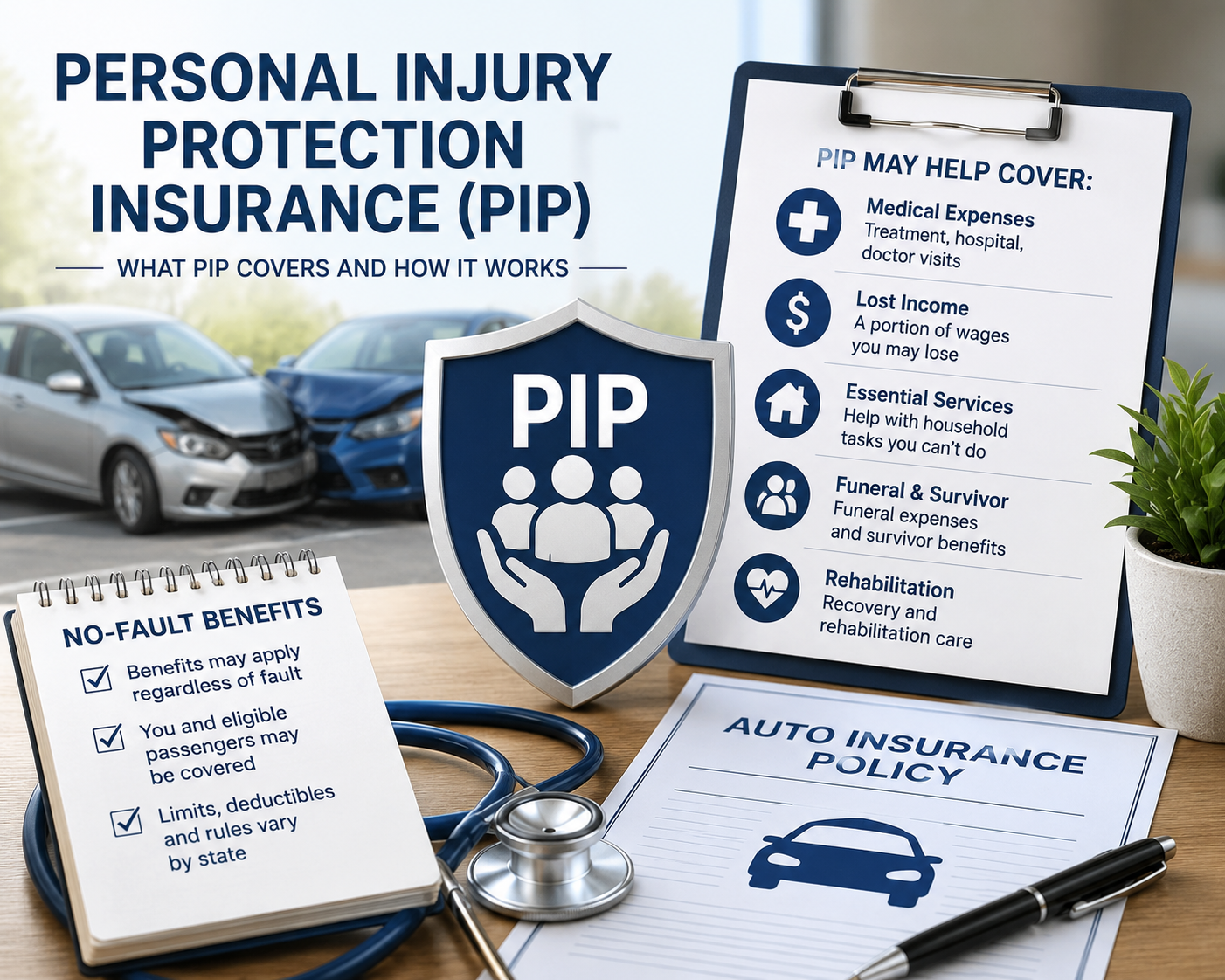
Personal injury protection insurance, often called PIP, is auto coverage that may help pay certain injury-related expenses after a covered car accident, regardless of who caused the crash. Depending on the state and policy, benefits can include medical treatment, portions of lost income, rehabilitation, essential services, funeral expenses, or other specified first-party benefits.
PIP is closely associated with no-fault auto insurance systems, but its exact role is not identical across the United States. State law can affect whether the coverage is required, optional, available, rejectable, or structured in another way.
The most important rule is simple: do not judge PIP by the name alone. The declarations page, coverage form, endorsements, exclusions, benefit limits, deductible, coordination rules, and applicable state law determine what protection actually applies.
Educational note: PolicyQuotesUS.com provides general U.S. personal auto insurance education only. We are not an insurer, insurance agency, broker, quote marketplace, claims service, or coverage approval service. Premiums, deductibles, limits, eligibility rules, exclusions, benefits, and policy terms vary by insurer, state, vehicle, driver, household, and policy. Always review the controlling policy documents and official state information before purchasing or changing coverage.
Decision Snapshot: The PIP Protection Map
Personal Injury Protection should be evaluated by what benefits the policy actually provides in the state where the vehicle is insured. Use this PIP Protection Map before comparing limits or premiums.
| Question | Why it changes the decision |
|---|---|
| Is PIP required, optional or subject to a waiver? | State rules can determine whether the choice exists and what documentation is required. |
| Which medical expenses qualify? | Covered services, limits, exclusions and coordination rules vary. |
| Are lost income or essential services included? | PIP can differ materially from a medical-expense-only benefit. |
| Who qualifies as an insured person? | Household members, passengers or pedestrians may be treated differently under the policy and state law. |
| Does a deductible or other cost sharing apply? | The nominal limit is not the only number that affects practical value. |
| How does PIP interact with health insurance or MedPay? | Overlap does not automatically mean duplication; coordination rules matter. |
Decision rule: compare PIP by benefits, eligible people, limits and coordination rules—not by the label alone.
What Personal Injury Protection Insurance Means
PIP is generally a first-party auto insurance benefit. That means it can provide eligible benefits to people protected under the insured policy rather than functioning only as coverage for injuries caused to someone else.
Depending on the policy, protected people may include the named insured, household members, passengers, or certain pedestrians.
Because benefits can apply without waiting for a final decision about fault, PIP can help address eligible injury expenses while the wider accident investigation continues.
That does not mean fault becomes irrelevant.
Fault may still matter for:
- Damage to vehicles
- Property damage claims
- Bodily injury liability claims
- Lawsuits
- Uninsured or underinsured motorist claims
- Coverage outside the PIP section
Drivers who want help with terms such as first-party coverage, policy limit, deductible, exclusion, endorsement, and declarations page can use the auto insurance glossary.
What PIP May Help Cover
PIP can include several categories of injury-related benefits. The exact list depends on state law and policy wording.
Potential benefits can include:
- Reasonable and necessary medical treatment
- Ambulance and emergency care
- Hospital and physician services
- Rehabilitation
- A portion of covered lost income
- Certain replacement or essential household services
- Funeral expenses
- Survivor benefits where included
- Other specifically defined injury-related expenses
A listed benefit is not an automatic promise of payment.
An insurer may review whether an expense:
- Resulted from a covered accident
- Involves an eligible person
- Is medically necessary
- Is properly documented
- Falls within a covered benefit category
- Meets notice or treatment requirements
- Is within the available limit
- Is not excluded by the policy
This is why the policy wording matters more than a short coverage summary.
Why PIP Is Associated With No-Fault Insurance
Personal injury protection insurance is commonly connected with no-fault auto insurance systems because eligible first-party injury benefits may be available without first proving another driver caused the accident.
The basic idea is to allow certain injury-related expenses to be handled through the injured person’s own applicable coverage.
However, “no-fault” does not mean nobody can ever be held responsible for an accident.
State rules can still affect when an injured person may pursue another driver and whether an injury must meet a particular legal threshold before certain claims or lawsuits can proceed.
The broader auto insurance by state guide explains why the claims framework, required coverages, and consumer rules can differ depending on where a vehicle is registered and principally garaged.
Drivers should use official state information when they need to know whether PIP is mandatory, optional, rejectable, or unavailable in the same form.
Is Personal Injury Protection Insurance Required?
There is no single nationwide answer.
The legal status of personal injury protection insurance depends heavily on state law.
Depending on the jurisdiction, PIP may be:
- Required
- Optional
- Required to be offered
- Rejectable through a prescribed process
- Replaced or supplemented by another injury-benefit structure
- Unavailable in the same form used elsewhere
That is why a driver moving to another state should not assume an existing policy structure will remain appropriate.
The PolicyQuotesUS guide to minimum car insurance requirements owns the broader legal-minimum topic.
This page owns the PIP coverage topic.
Before changing PIP, confirm the applicable state rule and read the actual policy forms.
PIP Limits Matter
Every PIP selection should be reviewed together with its benefit limits.
A policy may set a maximum amount available for certain eligible expenses. Once the applicable limit is exhausted, additional expenses may no longer be payable under that PIP benefit.
Limits can also be structured differently by state or policy.
Ask:
- What is the total PIP limit?
- Are separate limits used for particular benefit categories?
- Does a limit apply per person or in another way?
- Are wage-loss benefits capped separately?
- Are funeral or survivor benefits separately limited?
- Can another source of insurance affect the available amount?
The declarations page is a useful starting point, but the coverage form and endorsements provide the details needed to understand how those limits operate.
How PIP Deductibles Can Work
Some PIP arrangements may include a deductible.
A deductible is an amount the insured may have to absorb before an eligible benefit responds, depending on the policy structure.
A higher deductible can sometimes reduce the premium, but it can also increase the amount the policyholder must absorb after a covered injury.
Do not choose a deductible from the premium alone.
Review:
- Who the deductible applies to
- Whether it applies once or separately
- Which benefits are subject to it
- Whether state law restricts the available choices
- How it interacts with health insurance or other benefits
The cheapest option is not automatically the most useful, and the lowest deductible is not automatically appropriate for every household.
Personal Injury Protection Insurance vs Medical Payments Coverage
Personal injury protection insurance and Medical Payments Coverage can both address certain accident-related medical expenses, but they are not the same coverage.
MedPay is generally narrower. It commonly focuses on eligible medical and funeral expenses up to the selected limit.
PIP may include a broader package of first-party injury benefits, depending on state law and policy wording. Those benefits can extend beyond medical treatment to categories such as limited lost income or replacement services.
The dedicated Medical Payments Coverage pillar owns the MedPay topic.
This page owns PIP and its broader first-party injury benefits.
The MedPay page owns the narrower medical-payments benefit.
Drivers should compare actual benefit categories rather than assuming PIP is always superior or MedPay is always sufficient.
PIP Is Not Bodily Injury Liability
Another common mistake is confusing PIP with bodily injury liability.
Personal injury protection insurance is generally first-party injury coverage for eligible people protected under the policy.
Bodily injury liability generally addresses covered injuries caused to other people when an insured driver is legally responsible.
These protections can exist in the same policy while serving different purposes.
The guide what does liability car insurance cover explains the liability side in more detail.
A driver should therefore avoid thinking of PIP as a replacement for liability coverage.
PIP Does Not Repair the Vehicle
PIP is injury protection.
It generally does not repair the policyholder’s vehicle merely because the same accident caused injuries.
Vehicle damage may instead involve:
- Collision coverage
- Comprehensive coverage
- Another driver’s property damage liability
- Another applicable physical-damage provision
A single crash can therefore trigger several different coverage questions.
Personal injury protection insurance may address eligible injury expenses while another policy section addresses the damaged car.
Who May Be Protected by PIP?
The definition of an insured person matters.
Depending on state law and the policy, PIP may potentially protect:
- The named insured
- A spouse
- Resident relatives
- Passengers
- Pedestrians
- Other people specifically included by the policy
Coverage should never be assumed merely because a person was present at the accident scene.
Questions can arise about:
- Household residency
- Ownership of another vehicle
- Other available insurance
- Passenger status
- Pedestrian status
- Excluded drivers
- Commercial or rideshare activity
- Vehicle occupancy
Read the definitions section carefully.
The phrase “who is insured” can be just as important as the benefit limit.
Lost Income and Essential Services
One feature that can separate PIP from narrower medical coverage is the possibility of non-medical benefits.
Depending on the applicable state and policy, PIP may provide a portion of covered lost income when an eligible injury prevents a person from working.
Some policies or state systems may also recognize certain replacement or essential services when an injured person cannot perform normal household tasks.
These benefits can have:
- Separate limits
- Waiting periods
- Documentation requirements
- Percentage restrictions
- Time limits
- Eligibility conditions
Do not assume a policy replaces every dollar of lost earnings or every household cost.
Look for the specific benefit language.
How PIP Can Coordinate With Health Insurance
Personal injury protection insurance and health insurance are separate contracts.
Both may potentially relate to medical expenses arising from the same accident, but the order of payment and reimbursement rules can vary.
Drivers should review:
- Health-plan deductibles
- Copayments
- Coinsurance
- Network requirements
- Accident-related provisions
- Coordination-of-benefits language
- Reimbursement rights
- PIP benefit limits
- PIP deductibles
The existence of health insurance does not by itself answer whether PIP is useful, required, optional, or unnecessary.
Likewise, having PIP does not mean health insurance has no role.
The interaction must be determined from the applicable policies and state rules.
How PIP Relates to Uninsured and Underinsured Motorist Coverage
PIP and uninsured or underinsured motorist coverage also serve different purposes.
PIP can provide specified first-party injury benefits without depending on whether another driver has sufficient liability insurance.
Uninsured motorist coverage may address certain covered losses caused by a driver who has no usable insurance.
Underinsured motorist coverage may help with certain covered losses when an at-fault driver’s available liability insurance is insufficient.
The underinsured motorist coverage pillar explains that separate risk.
One policy may contain several injury-related protections, each with its own limits, exclusions, definitions, and conditions.
How PIP Can Affect an Auto Insurance Quote
Adding, removing, or changing personal injury protection insurance can affect the total premium.
The amount can vary based on:
- State
- Insurer
- Available PIP options
- Selected limit
- Deductible
- Driver profile
- Household information
- Other policy selections
A quote comparison becomes unreliable if the PIP settings are different.
When comparing policies, try to keep the following consistent:
- Drivers
- Vehicles
- Garaging address
- Mileage
- Vehicle use
- Liability limits
- PIP limit
- PIP deductible
- Collision and comprehensive selections
- Uninsured and underinsured motorist selections
- Other optional coverages
The instant auto insurance quotes guide can help organize the information used for a fair comparison.
A Simple PIP Scenario
Imagine a driver and passenger are injured in a covered intersection crash.
The driver needs medical treatment and cannot work for several days. The passenger also requires treatment.
If both qualify under the applicable policy, PIP may potentially address eligible medical expenses and other covered benefits without waiting for a final fault determination.
Now change one fact.
Suppose the driver was using the vehicle for an undisclosed delivery activity. A business-use or delivery exclusion could become relevant.
Change another fact.
Suppose the passenger has another auto policy or another source of first-party benefits. Coordination rules may affect which coverage responds.
The lesson is straightforward: personal injury protection insurance cannot be evaluated from its name alone.
The people, accident facts, state rules, limits, deductible, exclusions, documentation, and other available coverage all matter.
Common PIP Mistakes to Avoid
Assuming PIP Pays Every Injury Expense
Personal injury protection insurance still operates under limits, exclusions, definitions, conditions, and documentation requirements.
Confusing PIP With Health Insurance
PIP is part of an auto insurance policy. Health insurance is a separate contract with different rules and purposes.
Confusing PIP With Liability
PIP and bodily injury liability generally protect different interests.
Ignoring MedPay
Where both types of first-party medical protection are relevant, compare the actual benefits rather than assuming the labels are interchangeable.
Comparing Quotes With Different PIP Settings
A cheaper quote may simply contain a lower limit, larger deductible, or different benefit structure.
Ignoring State Rules
The legal treatment of PIP is not identical across the United States.
Misstating Vehicle Use
Do not hide rideshare, delivery, commuting, business use, household drivers, or garaging information to influence a quote.
Assuming a Higher Limit Is Always Better
More potential protection can cost more. The appropriate selection depends on the available options, other insurance, household exposure, state rules, and budget.
How to Review PIP Before Buying or Renewing
A good review starts with the declarations page.
Confirm:
- PIP is listed correctly
- The selected limit is correct
- The deductible is correct
- Required drivers and vehicles are accurate
- The garaging address is correct
Then read:
- PIP coverage form
- Definitions
- Exclusions
- Endorsements
- Conditions
- Notice requirements
- Proof requirements
- Coordination provisions
For the broader policy decision, use what coverage do I need for auto insurance to place PIP alongside liability, physical-damage coverage, uninsured motorist protection, and other options.
Do not rely only on a quote summary.
The policy documents control the contract.
Questions to Ask Before Choosing PIP
Before selecting or changing personal injury protection insurance, ask:
- Is PIP required, optional, or rejectable in my state?
- Who qualifies as an insured person?
- Are passengers protected?
- Can pedestrian injuries qualify?
- Which medical expenses are eligible?
- Are lost-income benefits included?
- Are replacement or essential services included?
- Are funeral or survivor benefits available?
- What limit applies?
- Does a deductible apply?
- Are separate benefit limits used?
- How does PIP interact with health insurance?
- How does it compare with MedPay?
- How do other auto policies affect payment?
- Are rideshare, delivery, or business-use restrictions relevant?
- What deadlines apply to notice, treatment, or documentation?
- Which policy form or endorsement controls the answer?
These questions make the coverage easier to understand before a claim occurs.
Final Takeaway
Personal injury protection insurance can provide an important layer of first-party injury protection after a covered vehicle accident.
Its biggest distinguishing feature is that eligible benefits may be available without first waiting for a final fault determination. Depending on state law and policy wording, PIP can include medical treatment, portions of lost income, rehabilitation, essential services, funeral benefits, or other specified expenses.
But the coverage is not identical nationwide.
The strongest approach is to verify the applicable state rule, identify who qualifies, review the benefit categories, check the limit and deductible, understand coordination with health insurance and other auto coverage, and compare quotes using the same PIP settings.
Personal injury protection insurance should be judged by the actual policy language, not by the coverage label alone.
Questions and Answers About Personal Injury Protection Insurance
What Is Personal Injury Protection Insurance?
Personal injury protection insurance is first-party auto coverage that may help with certain eligible injury-related expenses after a covered accident, subject to state law, policy limits, deductibles, exclusions, and other terms.
Does PIP Pay if I Caused the Accident?
It may. PIP is designed to provide eligible first-party injury benefits without requiring the covered person to first prove another driver was responsible. Policy terms and state rules still control.
Is Personal Injury Protection Insurance the Same as Health Insurance?
No. PIP is auto insurance coverage. Health insurance is a separate contract. They can sometimes interact, but coordination rules vary.
Is PIP the Same as Medical Payments Coverage?
No. Both may address accident-related medical expenses, but PIP may include broader benefits such as limited lost income or essential services, depending on the applicable policy and state rules.
Does PIP Cover Passengers?
It may. Passenger protection depends on the definition of an insured person, state law, other available insurance, exclusions, and the facts of the accident.
Does PIP Cover Lost Wages?
Some PIP structures may provide a portion of eligible lost income. Benefit limits, percentages, waiting periods, proof requirements, and other restrictions can apply.
Does Personal Injury Protection Insurance Repair My Car?
Generally no. PIP focuses on eligible injury-related benefits. Vehicle repairs normally involve another applicable coverage such as collision or property damage liability.
Can I Reject PIP?
That depends on state law and the policy options available. PIP can be required, optional, or subject to a specific rejection procedure.
Is a Higher PIP Limit Always Better?
Not automatically. A higher limit can provide more potential protection but may also increase the premium. Compare the available benefits, other insurance, household circumstances, state rules, and cost.
Helpful Official Resources
- NAIC Consumer Auto Insurance Information
- NAIC State Insurance Department Directory
- Insurance Information Institute No-Fault Auto Insurance Background
Author Bio
PolicyQuotesUS.com Editorial Team
The PolicyQuotesUS.com Editorial Team creates clear, neutral auto insurance education for drivers and households in the United States.
Copyright Notice
© 2026 – PolicyQuotesUS.com. All rights reserved.
This article about personal injury protection insurance is protected by copyright and may not be copied, scraped, spun, republished, or used for commercial purposes without prior written permission from PolicyQuotesUS.com. Brief quotations may be used with clear attribution and a link to the original article.
PolicyQuotesUS.com provides U.S. personal auto insurance, car insurance quotes, liability coverage, collision coverage, comprehensive coverage, uninsured motorist coverage, underinsured motorist coverage, personal injury protection, medical payments coverage, deductibles, policy limits, premiums, claims, discounts, and related coverage education for informational purposes only.
Unauthorized reuse of this content, including AI rewriting, content spinning, bulk scraping, or republication on another website, is prohibited.
Disclaimer
This personal injury protection insurance article provides general educational information for people living in the United States.
It is not personalized insurance, financial, legal, tax, medical, claims, or underwriting advice. It does not guarantee coverage, eligibility, savings, discounts, renewal, policy availability, or claim approval.
Personal injury protection insurance requirements, benefits, limits, deductibles, exclusions, endorsements, coordination provisions, insurer practices, and claim outcomes can vary by state, insurer, vehicle, driver, household, policy, and the facts of a loss.
Review the declarations page, coverage forms, endorsements, exclusions, definitions, conditions, and applicable state rules before relying on coverage.
This article does not replace the policy documents, guidance from a licensed insurance professional, medical advice from a qualified healthcare professional, or information from an official state insurance regulator.