
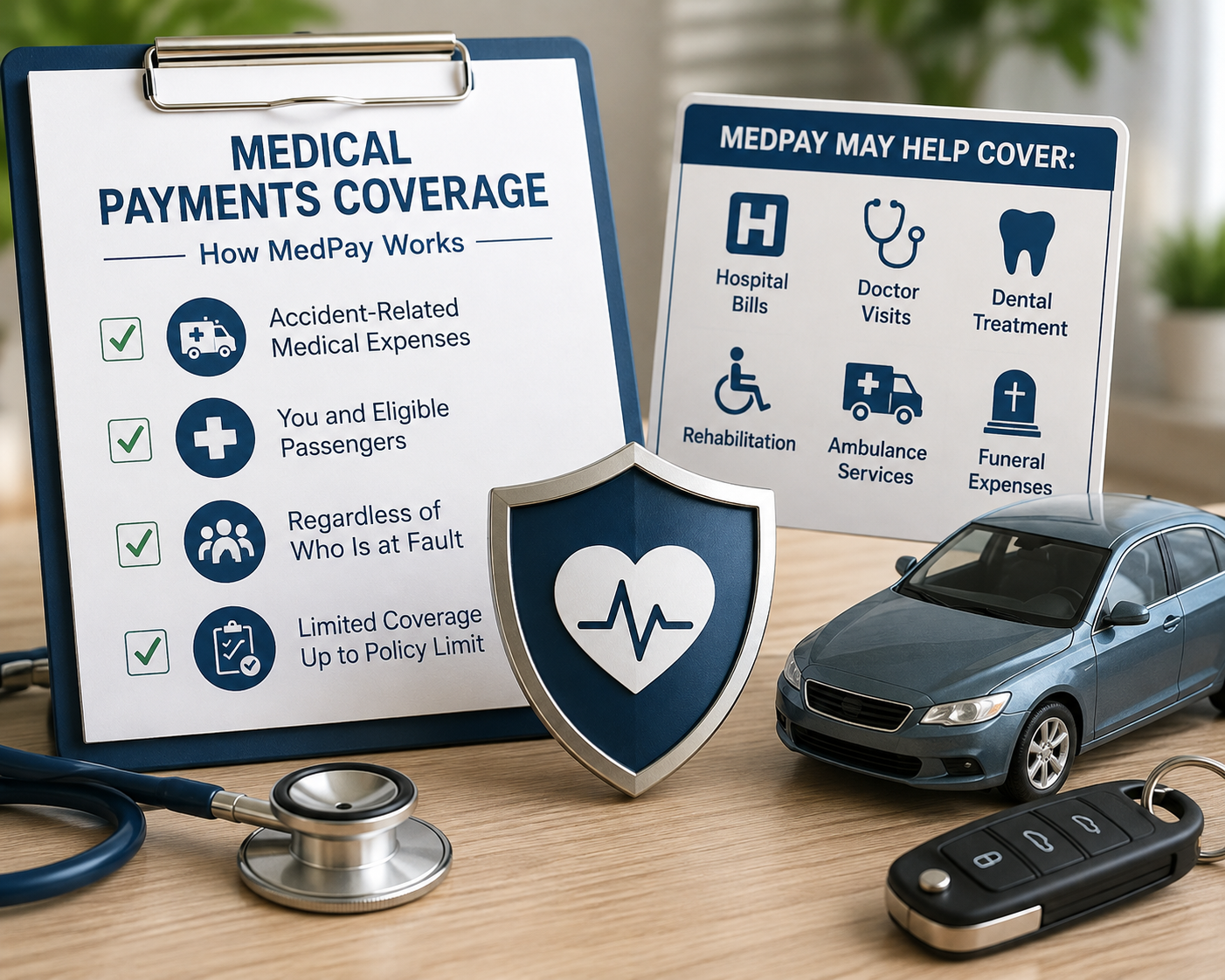
Medical Payments Coverage, often called MedPay, is an auto insurance benefit that may help pay certain accident-related medical or funeral expenses for you and other eligible people, regardless of who caused the crash. It is generally a limited first-party benefit rather than a replacement for health insurance, liability coverage, or broader injury protection.
For U.S. drivers, the value of Medical Payments Coverage depends on more than the coverage name. The selected limit, who qualifies as an insured person, state rules, health insurance, other auto coverage, exclusions, and the facts of a loss can all affect how the benefit works.
This guide explains what MedPay may cover, what it generally does not replace, how it differs from personal injury protection, how limits and coordination rules matter, and what to compare before adding, removing, or changing the coverage.
Educational note: PolicyQuotesUS.com provides general U.S. personal auto insurance education only. We are not an insurer, insurance agency, broker, quote marketplace, claims service, or coverage approval service. Auto insurance premiums, deductibles, limits, eligibility rules, exclusions, endorsements, and coverage options vary by insurer, state, vehicle, driver, household, and policy. Review the actual policy documents and official state information before purchasing or changing coverage.
Decision Snapshot: The MedPay Fit Test
Medical Payments coverage is most useful when evaluated as part of the household’s wider injury-protection picture. Use the MedPay Fit Test before choosing a limit or removing the coverage.
- State and policy availability: confirm whether MedPay is optional, required, unavailable, or affected by other state-specific injury protections.
- Who may be covered: check the policy definition of insured persons, occupants and any pedestrian-related protection.
- Health-plan interaction: understand deductibles, copayments, exclusions and coordination rules rather than assuming health insurance makes MedPay unnecessary.
- PIP overlap: determine whether Personal Injury Protection is present and how the two coverages differ.
- Limit usefulness: compare the chosen MedPay limit with the types of expenses it may address and the premium charged.
Decision rule: judge MedPay by the protection gap it fills, not by whether the premium is small or the coverage name sounds reassuring.
What Medical Payments Coverage Means
Medical Payments Coverage is designed to address certain covered medical expenses arising from an auto accident. Depending on the policy, it may apply to the named insured, resident family members, passengers in a covered vehicle, or other people who qualify under the policy definition.
Some policies may also extend protection when an insured person is injured while occupying another vehicle or is struck by a vehicle as a pedestrian. The exact wording matters.
Potential covered expenses may include:
- Ambulance transportation
- Emergency room treatment
- Hospital care
- Physician services
- Diagnostic imaging
- Surgery
- Accident-related dental treatment
- Rehabilitation
- Certain medically necessary follow-up care
- Funeral expenses when included by the policy
The important phrase is subject to the policy.
MedPay does not create unlimited medical protection. The declarations page, coverage form, definitions, exclusions, endorsements, conditions, and selected limit control how the benefit applies.
Drivers who want a broader overview of policy terminology can use the auto insurance glossary before comparing quotes or reading coverage forms.
Why Drivers Consider Medical Payments Coverage
An auto accident can create medical expenses before fault is fully determined or another insurer accepts responsibility.
Medical Payments Coverage may provide a limited source of first-party benefits under the insured driver’s own policy, subject to the policy terms. That can be useful when accident-related expenses arise quickly.
Drivers may review MedPay when they:
- Regularly carry passengers
- Have meaningful health-plan deductibles or copayments
- Want another layer of accident-related medical protection
- Are concerned about smaller medical costs after a crash
- Want protection that may apply without waiting for a fault determination
None of these situations automatically makes the coverage necessary for every driver.
The value depends on the premium, available limits, health insurance, other injury protection, state rules, household circumstances, and the way different policies coordinate.
Because state rules vary, the auto insurance by state guide is a useful starting point for understanding why Medical Payments Coverage can be treated differently across the country.
What MedPay Does Not Replace
MedPay has a narrow job. Understanding what it does not replace is just as important as understanding what it may pay.
It Does Not Replace Bodily Injury Liability
Bodily injury liability generally addresses covered claims involving injuries caused to other people when an insured driver is legally responsible.
MedPay focuses on eligible people protected by that policy provision. It is not a substitute for required or selected liability limits.
The guide to what does liability car insurance cover explains the different role liability plays.
It Does Not Pay for Damage to Your Vehicle
MedPay is injury-related coverage.
It does not normally repair the insured vehicle merely because someone was injured in the crash.
Collision coverage may apply to certain covered crash damage to the policyholder’s vehicle. Comprehensive coverage may apply to certain covered non-collision losses. Another driver’s property damage liability may also be relevant depending on responsibility and the claim.
It Does Not Replace Health Insurance
Health insurance and MedPay are different contracts.
They can sometimes overlap, but one should not be assumed to replace the other. Coordination rules, deductibles, reimbursement rights, exclusions, networks, and other policy terms can determine which coverage pays and in what order.
It Usually Does Not Replace Lost Income
Standard MedPay is generally focused on covered medical and funeral expenses.
It usually does not provide the wider lost-income, replacement-service, or related benefits that may be available under personal injury protection.
That distinction is one of the main reasons drivers should compare MedPay and PIP carefully rather than treating them as interchangeable.
Medical Payments Coverage vs Personal Injury Protection
MedPay and personal injury protection can both address certain accident-related injury expenses without requiring the insured person to prove fault first, but they are not the same coverage.
MedPay generally focuses on covered medical and funeral expenses up to the selected limit.
Personal injury protection may provide a broader set of benefits depending on state law and policy terms. Those benefits can include medical expenses and, in some situations, portions of lost income, replacement services, or other injury-related costs.
The personal injury protection insurance pillar owns the detailed PIP topic.
This page owns the MedPay topic.
That separation matters because a driver should not assume:
- PIP is always available
- MedPay is always optional
- One automatically includes the other
- One is always broader in every state
- Both pay the same expenses
- Both use the same limits or deductibles
State law and policy wording control the actual result.
When deciding how injury-related protection fits into the larger policy, the broader guide what coverage do I need for auto insurance can help place MedPay alongside liability, physical-damage coverage, uninsured motorist protection, and other options.
Who May Be Covered by MedPay?
A common mistake is focusing only on the dollar limit and ignoring who qualifies.
MedPay can define insured people in different ways.
Depending on the policy, protection may extend to:
- The named insured
- A spouse or resident family member
- Passengers occupying the insured vehicle
- An insured person occupying another vehicle
- An insured person injured as a pedestrian
Do not assume every passenger, household member, or person near the vehicle automatically qualifies.
Read the policy definition of “insured,” “covered person,” or similar wording.
Also review how the policy treats:
- Household members
- Excluded drivers
- Unlisted drivers
- Passengers
- Occupants of borrowed vehicles
- Pedestrian injuries
- Business or delivery use
- Rideshare activity
The person injured can be just as important as the type of medical bill.
Medical Payments Coverage Limits
Every MedPay selection should be reviewed together with its limit.
The limit establishes the maximum benefit available under the applicable policy terms. It is not a promise that every bill will be paid or that the full stated amount will always be available after an accident.
Ask:
- Does the limit apply per person?
- Does it apply per accident?
- Are separate limits shown for different insured people?
- Does another applicable policy affect payment?
- Can benefits from multiple vehicles or policies be combined?
- Are stacking restrictions relevant?
- Is there a treatment or submission deadline?
- Which bills qualify as reasonable and necessary?
These details can vary by insurer and state.
The number printed on the declarations page is only the beginning of the review.
How MedPay May Work With Health Insurance
MedPay and health insurance can interact in several ways.
One plan may pay before the other. One may reimburse another. A health insurer may have rights related to accident recoveries. The auto policy may contain coordination or reimbursement language.
Drivers should not assume that having both policies means receiving duplicate payment for the same expense.
When comparing coverage, review relevant health-plan details such as:
- Deductible
- Copayments
- Coinsurance
- Network restrictions
- Accident-related provisions
- Reimbursement rights
- Coordination-of-benefits language
Then compare those provisions with the MedPay limit and policy terms.
A driver with strong health coverage may evaluate MedPay differently from a driver with substantial out-of-pocket medical exposure. That is a comparison question, not a universal recommendation.
How MedPay Relates to Uninsured and Underinsured Motorist Coverage
MedPay and uninsured or underinsured motorist protection solve different problems.
MedPay generally focuses on certain medical expenses for eligible people under the insured policy.
Uninsured motorist coverage may apply to certain covered losses involving a driver who has no usable insurance.
Underinsured motorist coverage may help with certain covered losses when the at-fault driver has insurance but the applicable limit is insufficient.
The underinsured motorist coverage guide explains that separate protection in more detail.
A policy may contain more than one injury-related coverage, but each section can have its own:
- Insured-person definition
- Limit
- Exclusions
- Conditions
- Proof requirements
- Coordination rules
- Claim process
Do not assume that one injury coverage automatically makes every other one unnecessary.
Is Medical Payments Coverage Required?
Whether Medical Payments Coverage is required, optional, offered, or structured differently depends on the state and policy.
That is why a national article should not pretend one rule applies everywhere.
The minimum car insurance requirements pillar owns the legal-minimum question.
Before changing MedPay, verify:
- The applicable state rule
- Whether another injury coverage is required
- Whether MedPay must be offered
- Whether a rejection or selection form applies
- Whether the policy already contains a similar benefit
Official state insurance information should be used when legal verification is necessary.
How Medical Payments Coverage Can Affect a Quote
Adding MedPay can increase the total premium. Changing the selected limit may also change the quote.
The amount depends on the insurer, state, driver profile, vehicle, limit, other coverage selections, and policy design.
Removing the coverage may reduce the premium but also removes that particular layer of protection.
For a fair comparison, use the same MedPay selection across competing quotes.
Otherwise, one policy may appear cheaper simply because it provides a lower limit or excludes the coverage entirely.
Before using instant auto insurance quotes, keep these inputs consistent:
- Drivers
- Vehicles
- Garaging address
- Mileage
- Vehicle use
- Liability limits
- Collision and comprehensive selections
- Uninsured and underinsured motorist selections
- PIP or MedPay selections
- Deductibles
- Important endorsements
The goal is to compare like with like.
A Simple MedPay Example
Imagine a driver and a passenger are injured in a covered crash.
The driver has health insurance with a deductible. The passenger also has health insurance but faces significant out-of-pocket costs.
MedPay may be reviewed for eligible accident-related expenses for both people, subject to the insured-person definition, policy limit, exclusions, proof requirements, and coordination rules.
Now change the facts.
Suppose the vehicle was being used for undisclosed delivery work. A business-use or delivery exclusion could become relevant.
Or suppose another policy provides personal injury protection. The order in which different benefits respond may depend on state law and policy language.
This example shows why MedPay cannot be evaluated from its name alone.
The accident facts, covered people, policy wording, state rules, and other available insurance all matter.
Common MedPay Mistakes to Avoid
Assuming Every Medical Bill Is Covered
MedPay still has limits, exclusions, definitions, conditions, and proof requirements.
An accident-related bill is not automatically payable merely because the coverage exists.
Treating MedPay as Liability Coverage
MedPay and liability protect different interests.
Liability generally addresses covered injuries caused to others when the insured driver is legally responsible. MedPay focuses on eligible people under its own coverage provision.
Ignoring PIP
Where personal injury protection is available or required, compare the two protections rather than assuming they perform identical jobs.
Ignoring Health Insurance
Health-plan deductibles, coordination provisions, reimbursement rights, and other terms may materially affect the value of MedPay.
Comparing Quotes With Different MedPay Limits
Two quotes cannot be compared fairly when one contains substantially different injury protection.
Assuming Passengers Are Always Covered
Passenger protection depends on the policy definition and circumstances.
Ignoring Vehicle Use
Delivery, rideshare, commercial activity, or excluded vehicle use can affect coverage.
Choosing a Limit From the Premium Alone
The cheapest selection is not automatically the most suitable, and the highest available limit is not automatically necessary.
Compare the premium with the protection being added or removed.
Documents to Review Before Choosing MedPay
Start with the declarations page.
Confirm whether MedPay appears and which limit is shown.
Then review:
- Coverage form
- Definitions
- Exclusions
- Endorsements
- Conditions
- Insured-person definitions
- Claim-notice provisions
- Treatment or proof requirements
- Coordination language
- Reimbursement provisions
Health insurance documents may also matter.
Do not rely only on an advertisement, quote screen, or brief verbal explanation.
The policy documents control the insurance contract.
Questions to Ask Before Adding or Changing MedPay
Before selecting MedPay, ask:
- Is MedPay available or required in my state?
- Who qualifies as an insured person?
- Are passengers covered?
- Can coverage apply when I am injured in another vehicle?
- Can it apply if I am struck as a pedestrian?
- Which medical expenses qualify?
- Are funeral expenses included?
- What limit applies?
- Does a deductible apply?
- How does the coverage coordinate with health insurance?
- How does it interact with PIP?
- Are workers’ compensation or other auto policies relevant?
- Are delivery, rideshare, or business-use exclusions important?
- Are there deadlines for treatment, notice, or proof?
- Which policy document controls if there is a disagreement?
Written policy terms are more reliable than assumptions.
Final Takeaway
Medical Payments Coverage can provide a useful but limited layer of accident-related medical protection for eligible people under an auto policy.
Its value cannot be judged by the label alone.
Check who qualifies, which expenses are covered, what limit applies, whether a deductible exists, how health insurance coordinates with the benefit, and whether personal injury protection or uninsured motorist coverage changes the picture.
MedPay should also be compared consistently across quotes. A lower premium may simply reflect a lower limit or the absence of the coverage.
The best review is simple: understand the state rules, read the declarations page and coverage form, compare equivalent policy selections, and know which medical costs would still remain your responsibility after an accident.
Questions and Answers About Medical Payments Coverage
What Is Medical Payments Coverage?
Medical Payments Coverage is an auto insurance benefit that may help pay certain covered medical or funeral expenses for eligible people after a vehicle accident, subject to the policy limit, definitions, exclusions, and conditions.
Is Medical Payments Coverage the Same as PIP?
No. MedPay generally focuses on covered medical and funeral expenses. Personal injury protection can provide a broader range of benefits depending on the state and policy.
Does Medical Payments Coverage Pay Regardless of Fault?
MedPay is generally designed as first-party coverage that can apply without waiting for a final fault decision, subject to the policy terms and facts of the loss.
Does Medical Payments Coverage Cover Passengers?
It may. Passenger coverage depends on the policy definition of an insured or covered person, the circumstances of the accident, exclusions, and the selected limit.
Does Medical Payments Coverage Have a Deductible?
Some MedPay provisions may be written without a deductible, but policy forms vary. Check the declarations page and coverage form rather than assuming one rule applies everywhere.
Can MedPay Help With Health Insurance Deductibles or Copayments?
It may help with eligible accident-related medical expenses that are not fully paid elsewhere, subject to the MedPay limit, coordination rules, reimbursement provisions, and policy terms.
Does MedPay Cover Lost Wages?
Standard MedPay is generally focused on medical and funeral expenses rather than lost income. PIP may provide broader benefits in some states and policies.
Does Medical Payments Coverage Cover Injuries Outside My Own Car?
Some policies may extend protection when an insured person occupies another vehicle or is struck as a pedestrian. Definitions and exclusions determine whether a particular event qualifies.
Is a Higher MedPay Limit Always Better?
No. A higher limit can provide more potential protection but may cost more. Compare the premium, other insurance, passenger exposure, household circumstances, state rules, and policy terms.
Helpful Official Resources
- NAIC auto insurance consumer information
- NAIC directory of state insurance departments
- USA.gov health insurance information
Author Bio
PolicyQuotesUS.com Editorial Team
The PolicyQuotesUS.com Editorial Team creates clear, neutral auto insurance education for drivers and households in the United States.
Copyright Notice
© 2026 – PolicyQuotesUS.com. All rights reserved.
This article about Medical Payments Coverage is protected by copyright and may not be copied, scraped, spun, republished, or used for commercial purposes without prior written permission from PolicyQuotesUS.com. Brief quotations may be used with clear attribution and a link to the original article.
PolicyQuotesUS.com provides U.S. personal auto insurance, car insurance quotes, liability coverage, collision coverage, comprehensive coverage, uninsured motorist coverage, underinsured motorist coverage, personal injury protection, MedPay, deductibles, policy limits, premiums, claims, discounts, and related coverage education for informational purposes only.
Unauthorized reuse of this content, including AI rewriting, content spinning, bulk scraping, or republication on another website, is prohibited.
Disclaimer
This Medical Payments Coverage article provides general educational information for people living in the United States.
It is not personalized insurance, financial, legal, tax, claims, medical, or underwriting advice. It does not guarantee coverage, eligibility, savings, discounts, renewal, policy availability, or claim approval.
Medical Payments Coverage requirements, premiums, limits, deductibles, eligibility rules, exclusions, endorsements, coordination provisions, insurer practices, and claim outcomes can vary by state, insurer, vehicle, driver, household, policy, and the facts of a loss.
Review the declarations page, coverage forms, endorsements, exclusions, definitions, conditions, and applicable state rules before relying on coverage.
This article does not replace the policy documents, guidance from a licensed insurance professional, medical advice from a qualified healthcare professional, or information from an official state insurance regulator.