
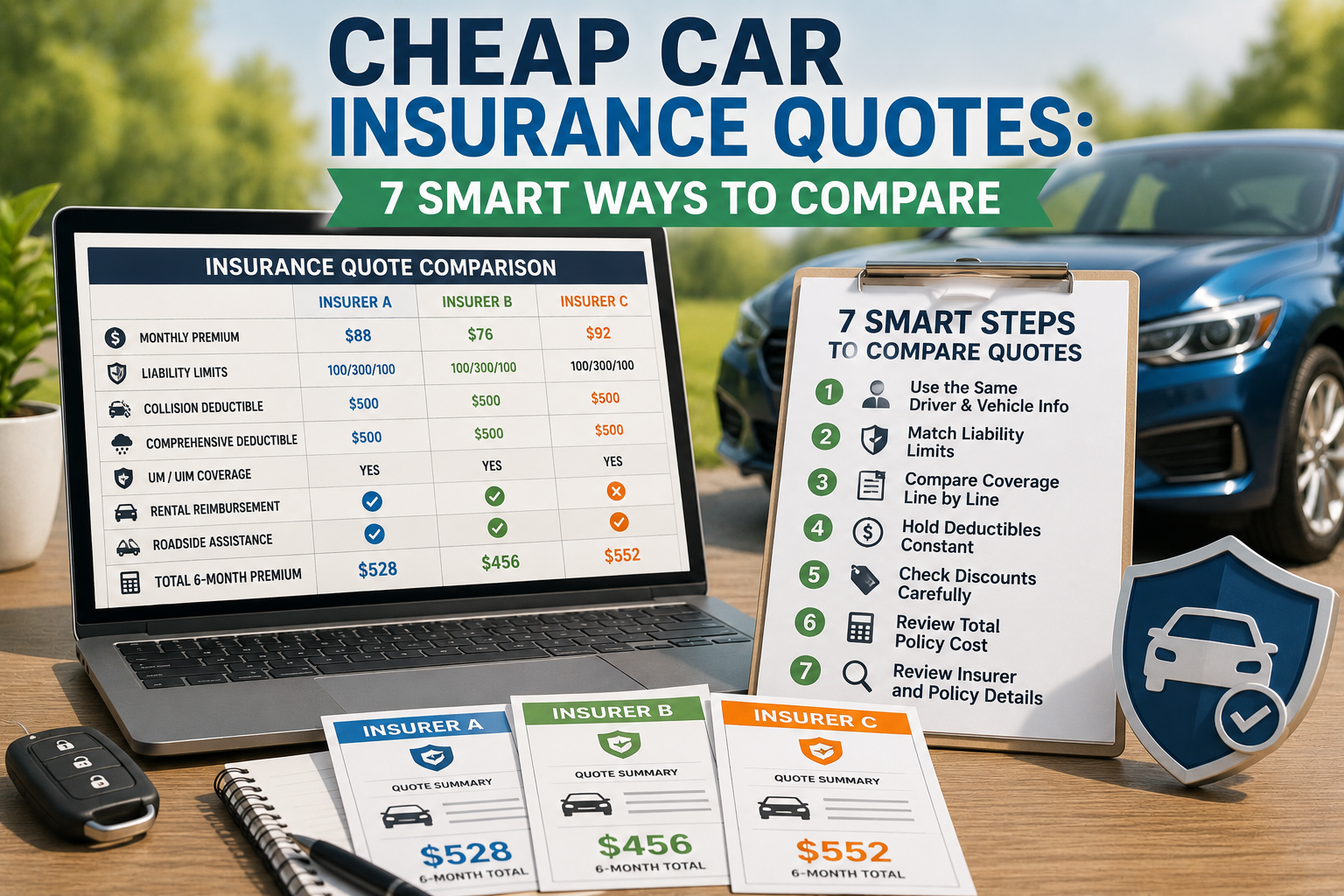
Cheap Car Insurance Quotes can help U.S. drivers find a more affordable personal auto insurance policy, but the smallest number on the screen is not automatically the best deal.
A quote can look cheaper because it uses:
- Lower liability limits
- Higher collision or comprehensive deductibles
- Fewer optional coverages
- Different mileage
- Different vehicle use
- Different household-driver information
- Different discounts
- Different payment arrangements
That is why a useful comparison asks more than:
“Which quote is cheapest?”
A better question is:
“Which quote gives me the best combination of price, protection and manageable financial risk?”
Cheap Car Insurance Quotes become much more useful when every insurer receives the same information and is asked to quote reasonably matching coverage. For a practical step-by-step method, see how to compare car insurance quotes online without confusing a lower price with weaker protection.
This guide explains seven practical ways to compare quotes properly, identify genuine savings, avoid misleading price differences and understand what you are actually buying.
Educational note: PolicyQuotesUS.com provides general U.S. personal auto insurance education only. We are not an insurer, insurance agency, broker, quote marketplace, claims service, financial adviser or coverage approval service. Premiums, quotes, deductibles, limits, discounts, eligibility, underwriting practices, coverage options and policy terms vary by state, insurer, vehicle, driver and household. A preliminary quote may change after information is verified. Always review the declarations page, policy forms, endorsements, exclusions and applicable state requirements before purchasing or changing coverage.
Decision Snapshot: The Cheap Quote Reality Check
A low premium becomes a useful option only after you understand why it is low. Use the Cheap Quote Reality Check before treating the cheapest result as the best value.
| Reality check | Question to answer |
|---|---|
| Savings source | Is the price lower because of genuine insurer pricing, a discount, a different payment method, lower limits, removed coverage or a higher deductible? |
| Protection retained | Does the quote still include the coverage and limits you intended to compare? |
| Claim-day cash exposure | Could you comfortably handle the deductible and other uncovered costs after a loss? |
| Total policy cost | What will the complete policy term cost after fees, installments and confirmed discounts? |
| Conditions | Are any savings dependent on telematics, bundling, paperless billing, automatic payments, continued eligibility or another requirement? |
Decision rule: a cheap quote is strongest when the savings come from better pricing for the same requested protection—not from quietly weakening the policy or moving more financial risk back to you. If two quotes are not equivalent, separate them into different comparison groups before deciding.
What Cheap Car Insurance Quotes Really Mean
Cheap Car Insurance Quotes are preliminary estimates of what an auto insurance policy may cost based on the information supplied and the insurer’s rating process.
The word cheap should not mean inadequate.
A genuinely useful cheap quote should still reflect the protection the driver actually intends to purchase.
Imagine two quotes.
Quote A
- Lower premium
- Lower liability limits
- $1,000 collision deductible
- No rental reimbursement
- Different uninsured motorist selection
Quote B
- Slightly higher premium
- Higher liability limits
- $500 collision deductible
- Additional optional protection
Quote A is cheaper.
But that does not prove it offers better value.
The policies are different.
Cheap Car Insurance Quotes should therefore be compared using both:
PRICE + PROTECTION
That simple rule prevents many bad comparisons.
Why Auto Insurance Quotes Can Differ So Much
Different insurers can produce different premiums for the same driver.
Insurers may evaluate factors such as:
- Driver information
- Driving history
- Claims history
- Vehicle
- Garaging location
- Annual mileage
- Vehicle use
- Household drivers
- Prior insurance history
- Coverage selections
- Deductibles
- Available discounts
Insurers can also use different rating methods, subject to state law.
That means receiving different Cheap Car Insurance Quotes does not automatically indicate that one company made a mistake.
The important question is whether the quotes are based on comparable information.
1. Give Every Insurer the Same Information
The first rule is simple:
Same driver + same car + same circumstances.
If you change the information between quote requests, you are no longer running a clean comparison.
Try to keep these details consistent:
- Named drivers
- Household drivers
- Vehicle identification
- Garaging address
- Expected annual mileage
- Commuting
- School use
- Personal use
- Delivery or rideshare activity
- Prior insurance
- Requested start date
- Driving-history information
Cheap Car Insurance Quotes are only as useful as the information behind them.
Do Not Change Facts to Lower the Quote
Never intentionally use a different garaging address, artificially low mileage or incomplete driver information simply to obtain a smaller displayed premium.
The policy eventually needs to reflect the real vehicle and real drivers.
Incorrect information can lead to:
- Recalculated premiums
- Underwriting questions
- Policy changes
- Cancellation or non-renewal issues
- Claim complications
Accurate information gives you a quote you can actually use.
2. Compare the Same Liability Limits
Liability coverage is one of the biggest areas where quote comparisons can become misleading.
Suppose:
Quote A: lower liability limits
Quote B: substantially higher liability limits
Quote A may cost less simply because it provides less protection.
Before requesting Cheap Car Insurance Quotes, decide which liability limits you want compared.
Then use those same limits with every insurer.
The minimum car insurance requirements guide explains the legal starting point.
But remember:
State minimum ≠ automatic recommendation
Minimum coverage may satisfy a legal requirement while still leaving the driver exposed to financial losses above the policy limit.
A serious accident can involve:
- Multiple vehicles
- Expensive property damage
- Medical treatment
- Lost income
- Legal claims
Compare liability limits deliberately instead of automatically selecting the lowest option presented.
3. Compare Coverage Line by Line
Cheap Car Insurance Quotes can include very different combinations of protection.
Depending on the state and policy, possible coverages include:
- Bodily injury liability
- Property damage liability
- Collision
- Comprehensive
- Uninsured motorist
- Underinsured motorist
- Personal injury protection
- Medical payments
- Rental reimbursement
- Roadside assistance
- Other endorsements
Use the what coverage do I need for auto insurance guide if you need a broader explanation of how those pieces fit together.
Collision and Comprehensive
Collision and comprehensive protect against different types of vehicle damage.
The comprehensive vs collision insurance guide explains the distinction.
If one quote contains collision and comprehensive while another does not, the premium comparison is not equivalent.
UM and UIM
Uninsured and underinsured motorist protection may also differ.
Check whether the quote:
- Includes the coverage
- Shows it as optional
- Uses different limits
- Has state-specific conditions
PIP and MedPay
Depending on the state, personal injury protection or medical payments coverage may also affect the quote.
Cheap Car Insurance Quotes should be compared line by line, not merely by looking at the final premium.
4. Hold Deductibles Constant
Deductibles can substantially change the appearance of a quote.
Suppose you receive:
Quote A: $500 collision deductible
Quote B: $1,000 collision deductible
If Quote B is cheaper, part of the difference may simply come from the larger deductible.
That means the policyholder is accepting more financial responsibility if the deductible applies after a covered loss.
For a clean comparison, use the same deductible with each insurer first.
Then test alternatives separately.
The best deductible for auto insurance guide provides a deeper comparison.
Use the Claim-Day Test
Before accepting a higher deductible, ask:
Could I comfortably pay this amount if a covered loss happened this week?
If the answer is no, the deductible may be too high even if it reduces the premium.
Cheap Car Insurance Quotes should result in coverage that remains financially usable after a claim.
5. Compare Discounts Properly
Discounts can be valuable, but they can also make quote comparisons confusing.
Possible categories can include:
- Multi-policy discounts
- Multiple-vehicle discounts
- Safe-driving programs
- Telematics
- Driver education
- Good-student programs
- Low mileage
- Vehicle safety equipment
- Anti-theft equipment
- Payment arrangements
- Other insurer-specific programs
The best auto insurance discounts guide explains common savings categories.
Count the Final Premium, Not the Number of Discounts
One insurer might advertise five discounts.
Another might apply only two.
The company with five discounts is not automatically cheaper.
Compare the final premium for equivalent protection.
Also check whether discounts depend on:
- Continued eligibility
- Automatic payment
- Paperless billing
- Telematics participation
- Academic performance
- Mileage thresholds
- Bundled products
- Other conditions
Cheap Car Insurance Quotes are more useful when the discount requirements are understood before purchasing.
6. Check the Total Policy Cost
Do not judge a quote only by the first payment.
A policy can have:
- Initial payment
- Monthly installments
- Installment fees
- Payment-processing fees where permitted
- Policy-term premium
- Renewal changes
Ask for or review the total premium for the complete policy period.
Then compare equivalent payment arrangements.
For example, one quote may show an attractive monthly number but include fees that another payment method avoids.
Cheap Car Insurance Quotes should be compared using the total expected policy cost, not just the most attractive displayed payment.
Check the Policy Term
Also make sure you are comparing the same policy duration where possible.
A six-month premium and a twelve-month premium should obviously not be compared as if they represent the same period.
7. Review the Insurer and Policy Before Buying
Price matters.
So does the company behind the policy.
Before purchasing, confirm that the insurer or agent is properly authorized to operate in the applicable state.
State insurance departments can also provide consumer information and may provide complaint information or other resources.
Cheap Car Insurance Quotes should lead to a legitimate insurance policy—not simply a low number from an unfamiliar website.
Read the Important Documents
Once a policy is issued, review:
- Declarations page
- Coverage limits
- Deductibles
- Listed vehicles
- Listed drivers
- Endorsements
- Exclusions
- Payment information
- Effective dates
Report errors quickly.
A quote is not the complete insurance contract.
The issued policy documents control the actual coverage.
Quote vs Policy: They Are Not the Same Thing
This distinction is important.
A quote is generally an estimate based on the information available at that stage.
An insurer may subsequently verify information such as:
- Driving record
- Claims history
- Prior insurance
- Vehicle details
- Driver details
- Other underwriting information
That means Cheap Car Insurance Quotes can sometimes change before or during policy issuance.
Do not assume:
quote = guaranteed final premium
Read the final documents.
Online Quotes vs Agent Quotes
Drivers can obtain quote information in several ways.
Depending on the insurer, this might include:
- Insurer websites
- Telephone
- Licensed agents
- Independent agents
- Other authorized channels
The important part is not the channel.
The important part is keeping the comparison consistent.
Cheap Car Insurance Quotes obtained online should use the same basic information and coverage selections as quotes obtained through an agent.
Not Every Online Quote Is Immediately Final
Some online systems can produce preliminary prices quickly.
Others may require additional information or contact before a final rate is available.
That is why the instant auto insurance quotes guide owns a different search intent.
Cheap Car Insurance Quotes focuses on finding and comparing lower-cost quotes.
Instant Auto Insurance Quotes focuses on the speed and process of obtaining quote information online.
That separation keeps both pages useful.
Check State Rules Before Comparing
Auto insurance is regulated primarily at the state level.
The auto insurance by state hub explains why location affects:
- Required coverage
- Limits
- Injury-related rules
- UM/UIM requirements
- Proof requirements
- Consumer protections
- Available policy structures
Cheap Car Insurance Quotes should therefore be based on the state where the vehicle is actually insured and principally garaged.
Do not assume that a quote or coverage setup appropriate in one state is suitable in another.
Vehicle Choice Can Change the Quote
The vehicle can materially affect insurance cost.
Factors associated with the vehicle may include:
- Value
- Repair cost
- Parts availability
- Safety equipment
- Theft exposure
- Performance
- Claim patterns
This is why drivers shopping for a vehicle should consider insurance before completing the purchase.
Get Cheap Car Insurance Quotes for the vehicles being seriously considered.
A car with a lower purchase price is not automatically cheaper to insure.
Likewise, a more expensive vehicle is not guaranteed to have the highest premium.
Get the actual quotes.
Financed and Leased Vehicles
Financing or leasing adds another consideration.
A lender or lessor may require collision and comprehensive coverage to protect the vehicle.
It may also have requirements affecting deductible levels.
That means a driver cannot necessarily choose the absolute cheapest coverage configuration shown on a quote screen.
Check the finance or lease contract.
Cheap Car Insurance Quotes for financed vehicles should satisfy both:
applicable state requirements + contractual lender requirements
Cheap Quotes for Young Drivers
Young motorists deserve special mention because their insurance costs can be challenging.
However, the topic has its own separate pillar.
See cheap car insurance for young drivers for strategies involving:
- Young-driver discounts
- Good-student programs
- Driver education
- Household policies
- Vehicle choice
- Building insurance history
This Cheap Car Insurance Quotes page serves all U.S. drivers, not only young drivers.
That distinction matters for search intent.
A Simple Cheap Quote Comparison Example
Imagine a driver receives three quotes.
Quote A
- $720 total premium
- Lower liability limits
- $1,000 collision deductible
- No rental reimbursement
Quote B
- $790 total premium
- Higher liability limits
- $500 collision deductible
- Rental reimbursement included
Quote C
- $760 total premium
- Same liability limits as Quote B
- $500 collision deductible
- No rental reimbursement
Which is best?
You cannot answer from the premium alone.
Quote A is cheapest, but it contains different limits and a higher deductible.
Quote B provides more protection but costs more.
Quote C may provide the middle ground.
The driver must decide which protection is actually needed and then compare equivalent versions.
That is the right way to use Cheap Car Insurance Quotes.
Common Mistakes When Comparing Cheap Car Insurance Quotes
Comparing Different Liability Limits
This can make a weaker policy look cheaper.
Comparing Different Deductibles
Keep them the same during the first comparison.
Leaving Out Household Drivers
Provide the information requested accurately.
Using the Wrong Garaging Address
Use the vehicle’s actual principal garaging location.
Understating Mileage
Use a realistic estimate.
Hiding Delivery or Rideshare Use
Tell the insurer how the vehicle will actually be used.
Counting Discounts Instead of Final Cost
More discounts do not automatically equal a cheaper policy.
Looking Only at Monthly Payment
Check the entire policy premium and fees.
Assuming the First Quote Is Guaranteed
Information may still need to be verified.
Buying Before Reading the Policy
Review the final coverage documents.
Canceling Existing Insurance Too Early
When switching insurers, confirm the replacement coverage is effective before ending the old policy.
Avoid an accidental gap.
Information to Gather Before Requesting Quotes
Preparation makes the process faster and more consistent.
Gather:
- Driver’s license information
- Household-driver details
- Vehicle identification number
- Vehicle ownership information
- Finance or lease details
- Garaging address
- Estimated annual mileage
- Typical vehicle use
- Prior insurance information
- Driving-history information when requested
- Claims information when requested
- Desired liability limits
- Collision deductible
- Comprehensive deductible
- Optional coverage selections
- Discount information
Use the same facts for every quote.
Cheap Car Insurance Quotes become much easier to evaluate when every insurer is answering the same question.
A Simple Quote Comparison Table
Use a table like this:
| Item | Quote A | Quote B | Quote C |
|---|---|---|---|
| Liability limits | Compare | Compare | Compare |
| Collision | Compare | Compare | Compare |
| Comprehensive | Compare | Compare | Compare |
| Collision deductible | Compare | Compare | Compare |
| Comprehensive deductible | Compare | Compare | Compare |
| UM/UIM | Compare | Compare | Compare |
| PIP/MedPay | Compare | Compare | Compare |
| Rental reimbursement | Compare | Compare | Compare |
| Roadside assistance | Compare | Compare | Compare |
| Discounts | Confirm | Confirm | Confirm |
| Total premium | Compare | Compare | Compare |
| Payment fees | Compare | Compare | Compare |
The table makes hidden differences much easier to spot.
Questions to Ask Before Accepting a Quote
Before buying, ask:
- Are the driver details correct?
- Is the vehicle information correct?
- Is the garaging address correct?
- Are the liability limits what I requested?
- What collision deductible applies?
- What comprehensive deductible applies?
- Which optional coverages are included?
- Which coverages were declined?
- Which discounts are included?
- What requirements apply to those discounts?
- What is the total policy premium?
- Are there installment fees?
- Is the vehicle use described accurately?
- Are all applicable household drivers listed?
- Does financing require additional coverage?
- When does the policy become effective?
- Could the premium change after verification?
- Which documents control the final coverage?
Those questions turn Cheap Car Insurance Quotes from simple prices into useful insurance comparisons.
The Smartest Order for Finding a Cheaper Quote
Rather than immediately cutting coverage, work through the process in this order:
1. Shop several insurers
2. Keep the coverage identical
3. Check legitimate discounts
4. Review vehicle-related cost
5. Test deductible options
6. Review payment arrangements
7. Only then consider whether changing coverage itself makes sense
This approach looks for savings before unnecessarily weakening protection.
Final Takeaway
Cheap Car Insurance Quotes can be extremely useful, but only when they are compared properly.
Start with accurate information.
Keep:
- Drivers
- Vehicle
- Garaging
- Mileage
- Vehicle use
- Liability limits
- Deductibles
- Optional coverages
as consistent as possible between insurers.
Then compare legitimate discounts, total policy cost and payment arrangements.
Do not assume the lowest premium automatically offers the best value.
A quote may be cheaper because it contains:
- Lower limits
- Higher deductibles
- Less protection
- Different assumptions
Check the insurer, review the final documents and confirm the issued policy matches what you intended to buy.
The strongest formula is:
accurate information + matching coverage + multiple quotes + manageable deductibles + legitimate discounts + complete policy review
That is how Cheap Car Insurance Quotes become a useful tool for lowering costs without blindly sacrificing important financial protection.
Questions and Answers About Cheap Car Insurance Quotes
What Are Cheap Car Insurance Quotes?
Cheap Car Insurance Quotes are premium estimates that appear relatively affordable compared with other available quotes. The quote should still be reviewed for limits, deductibles, coverage, discounts and policy conditions before deciding whether it represents good value.
How Many Auto Insurance Quotes Should I Compare?
There is no required number, but comparing several insurers can provide a clearer picture of available pricing. Keep driver information, limits, deductibles and optional coverage consistent.
Why Is One Car Insurance Quote Much Cheaper Than Another?
The insurer may price the risk differently, or the quotes may contain different limits, deductibles, discounts, coverage or assumptions. Compare the details before treating the price difference as genuine savings.
Are Online Car Insurance Quotes Final?
Not necessarily. A quote may change after information is verified or the application is reviewed. Check the final premium and issued policy documents.
Can a Higher Deductible Make a Quote Cheaper?
It may reduce the premium for coverage where that deductible applies, but it also increases the amount the policyholder may need to absorb after an eligible loss.
Should I Choose the Cheapest Car Insurance Quote?
Not automatically. Compare coverage, limits, deductibles, exclusions, insurer information and total cost before deciding.
Do Car Insurance Discounts Guarantee the Cheapest Quote?
No. One insurer can offer more named discounts while still producing a higher final premium than another company.
Should Every Quote Use the State Minimum?
No. Applicable legal minimums must be satisfied, but drivers can request higher limits for comparison. The important rule is to use matching limits between quotes.
Can My Vehicle Change My Insurance Quote?
Yes. Vehicle value, repair cost, theft exposure, safety characteristics and other vehicle-related factors may affect pricing.
Does Financing Affect Cheap Car Insurance Quotes?
It can. A lender or lessor may require collision, comprehensive or certain deductible levels, reducing the available coverage choices.
Helpful Official Resources
- National Association of Insurance Commissioners — Auto Insurance Consumer Information
- NAIC — Comparing Online Auto Insurance Quotes
- NAIC — State Insurance Departments
- Consumer Financial Protection Bureau — Auto Insurance When Financing a Vehicle
Author Bio
PolicyQuotesUS.com Editorial Team
The PolicyQuotesUS.com Editorial Team creates clear, neutral U.S. personal auto insurance education covering policy comparison, quotes, premiums, coverage, deductibles, discounts and common consumer insurance questions.
Copyright Notice
© 2026 – PolicyQuotesUS.com. All rights reserved.
This article about Cheap Car Insurance Quotes is protected by copyright and may not be copied, scraped, spun, republished, reproduced, distributed or used commercially without prior written permission from PolicyQuotesUS.com. Brief quotations may be used with clear attribution and a link to the original article.
PolicyQuotesUS.com publishes original educational information about U.S. personal auto insurance, car insurance quotes, liability coverage, collision coverage, comprehensive coverage, uninsured motorist protection, underinsured motorist protection, deductibles, premiums, limits, discounts and related consumer insurance topics.
Unauthorized reuse, including AI rewriting, content spinning, automated extraction, bulk scraping, database collection or republication on another website, is prohibited.
Disclaimer
This Cheap Car Insurance Quotes article provides general educational information intended for people living in the United States.
It is not personalized insurance, financial, legal, tax, claims, underwriting or lending advice. It does not recommend a particular insurer, policy, vehicle, deductible, coverage limit or financial decision.
Insurance quotes, premiums, eligibility, discounts, deductibles, limits, exclusions, endorsements, household-driver rules, underwriting practices and claims procedures vary by state, insurer, vehicle, driver, household, policy and the circumstances of a loss.
Initial quote information may change after driving records, claims history, vehicle details, prior coverage or other application information is reviewed.
PolicyQuotesUS.com does not sell insurance, issue policies, provide or guarantee insurance quotes, determine eligibility, approve claims, make coverage decisions or guarantee savings.
Review the declarations page, complete policy wording, endorsements, exclusions, coverage limits, finance or lease requirements and applicable state rules before purchasing or changing coverage.
When necessary, confirm policy-specific questions directly with the insurer, a licensed insurance professional or the appropriate state insurance regulator.